

The deadline to register for Self-Assessment is 5 October following the end of the tax year. For 2025/26, that was 5 October 2026. If you missed it, register immediately: you still must file online and pay by 31 January 2027 to avoid late filing and late payment penalties.
Accounting practices must manage multiple deadlines associated with UK self-assessment on behalf of their clients. Still, none is as critical as the deadline to register for self-assessment. 5 October is the deadline to register for self-assessment, and achieving that will avoid penalties. For 2025/26, the date was 5 October 2026; the next is 5 October 2027.
That’s just one; there are multiple deadlines to meet under self-assessment, such as submission and payment deadlines. Things can get confusing when handling multiple self-assessments. Therefore, you need to remember specific key deadline dates, who and how to register, the consequences of missing them, and how outsourcing can help you in staying ahead of the curve.

When is the deadline to register for Self-Assessment in 2026?
The deadline to register for Self-Assessment is 5 October after the end of the tax year. For 2025/26 (6 April 2025 to 5 April 2026) it was 5 October 2026. For 2026/27 it falls on 5 October 2027.
Self-Assessment is the system HMRC uses to collect Income Tax on income that is not taxed at source, such as profits from self-employment or rent.
When it comes to deadlines under self-assessment, it is applicable to two aspects: registration and filing/submission. Here are the dates for the 2025/26 tax year:
- 5 October – It’s the deadline to register for Self-Assessment for newly self-employed or to file a tax return for the first time. (5 October 2026 for 2025/26; now passed.)
- 31 October – This date is the self-assessment deadline for submitting paper return tax to the HMRC. (31 October 2026)
- 31 January – Submission of the online tax return needs to be done. Plus, it is also the deadline to pay the self-assessment tax. (31 January 2027 for 2025/26)
- 31 July – This is the second payment on account deadline. (31 July 2027)
It must be noted that the tax year in the UK runs from 6 April to 5 April the following year. These deadlines apply to most individuals and businesses. Check the current dates on GOV.UK’s Self Assessment deadlines page.
Why does the registration deadline matter for large practices in 2026?
It matters because volume and regulation are both rising. HMRC received 11.48 million Self-Assessment returns by 31 January 2026, and 73% of ACCA members surveyed in September 2026 said their regulatory requirements had surged over the previous 12 months. A late registration is easy to miss in that load.
| Figure | What it shows | Source and date |
| 11,489,825 returns received by 31 January 2026; 91.09% of expected returns on time; 97.25% filed online | Peak-season volume, and roughly one in eleven expected returns still arrived late | HMRC press release, 3 February 2026 |
| About 780,000 people are moving into MTD for Income Tax from April 2026, a further 970,000 from April 2027 | More clients needing digital records and quarterly updates alongside their return | HMRC press release, 22 April 2025 |
| 73% of UK members said regulatory requirements surged in the last 12 months; MTD was the most-cited burden at 30% | Compliance pressure is landing on practices, not just clients | ACCA member survey, September 2026, via ACCA |
Who Needs to Register for Self-Assessment?
You need to register if you have income HMRC cannot collect through PAYE and you have not filed a return before. That covers sole traders earning over £1,000 gross, business partners, and anyone with untaxed property, investment, savings, or foreign income.
Salaried people’s taxes get deducted automatically, which cannot be done for businesses or people with other income sources. Hence, they are expected to report it in a self-assessment tax return.
It means that self-assessment is applicable only if your clients fall into the following criteria:
- Self-employed or sole traders who earned more than £1,000 before claiming tax relief.
- Partners in a business partnership
- Income from property, investments, or savings is not taxed at source.
Your clients will also be required to do a self-assessment if:
- They are getting money from renting out a property
- Earning foreign income
- Tips and commission
Therefore, you must constantly review your clients’ records to confirm all your eligible clients are registered on time to avoid penalties.
What happens if you miss the Self-Assessment registration deadline?
If you register after 5 October and still owe tax after 31 January, HMRC can charge a failure-to-notify penalty. It is based on the tax left unpaid. Late filing and late payment penalties are charged separately.
If you register your clients late (after 5 October) for self-assessment and do not pay the tax by 31 January, then your clients will get a ‘failure to notify’ penalty. This penalty is based on the amount still left to pay and will be received within 12 months after HMRC receives your Self-Assessment tax return.
Now, if there is a delay in tax return filing, the penalties will be:
- £100 penalty initially
- After 3 months, additional daily penalties of £10 per day, up to a maximum of £900
- After 6 months, a further penalty of 5% of the tax due or £300
- After 12 months, another 5% or £300 charge, whichever is greater
And if the payment deadline is missed, then:
Penalties of 5% are applicable on the tax unpaid at
- 30 days
- 6 months
- 12 months
Plus, an interest will be charged on the amount owed by your clients. Source: GOV.UK, Self Assessment penalties.
Hence, ensure your clients make the payments as soon as possible and save them from unnecessary hassle.
How do you register for Self-Assessment online?
Create a Government Gateway account, complete HMRC’s registration form with each client’s personal and business details, then wait 1 to 2 weeks for the UTR and activation code by post. Start at GOV.UK’s register for Self Assessment page.
To make a self-assessment for your client, you will need to register for self-assessment with the HMRC before or by 5 October. Hence, this is what you need to do.
- Create a Government Gateway account on the HMRC website
2. Provide your clients’ personal details, such as:
- Name (and any previous name)
- National Insurance Contribution number
- Date of birth
- Home address
- Telephone number and email address
- Reason you need to register
- Business name
- Business address (if different from your home address)
- Date you started self-employment
- Type of work
3. The Unique Taxpayer Reference (UTR) number will arrive within 1 to 2 weeks with an activation code.
4. Sign in to the account to submit your client’s tax returns electronically.
How can large practices stay ahead of the Self-Assessment deadline?
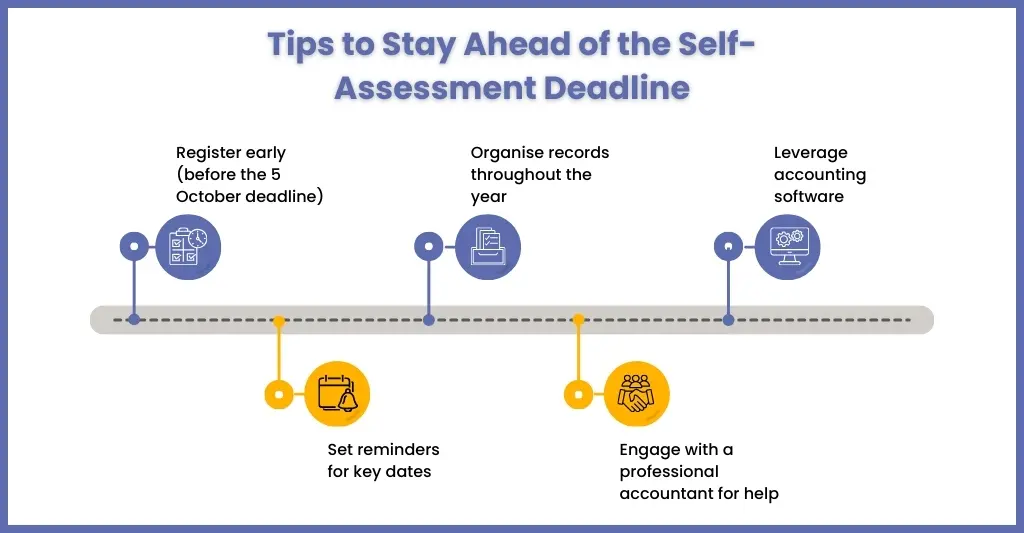
Register clients at onboarding, keep records current all year, and track every client’s dates in one shared calendar with a named owner.
It’s better to avoid the last-minute rush in registering your clients for self-assessment, as there is potential for costly mistakes. Therefore, it would be preferable to take proactive steps throughout the year to streamline the self-assessment process.
Here are some tips to stay ahead of the curve in self-assessment:
Register Early
Always encourage your clients to register for self-assessment or assist them in registration as soon as they start their business. With early registration, the HMRC will have all the details in advance, thus giving your clients the time to prepare for tax returns.
Why it matters: Early registration will save your clients from penalties even if they are not ready to submit their returns.
Organise Records Throughout the Year
Keeping financial records up to date throughout the year is one of the most effective ways to avoid last-minute stress when filing a self-assessment tax return. Encourage your clients to maintain accurate and organised records of all their profit and loss accounts, cash flow statements, receipts, and invoices.
Why it matters: A well-maintained record system ensures that clients don’t waste time hunting for documents at the last minute. It also reduces the likelihood of errors or missing deductions, which could increase their tax liability.
Leverage Technology
Select the best accounting software to track your clients’ incomes and expenses efficiently. Also, encourage your clients to use this software that integrates with their bank account, tracks business expenses, and calculates taxes automatically.
Why it matters: Utilising accounting software reduces human errors and simplifies the entire process. It will also ensure that the time and effort spent on filing is saved. Through accounting software, your clients will get access to accurate financial statements at any time, thus maintaining accountability. You can also utilise year-end accounts outsourcing services, which provide access to accounting software, thereby saving money on purchasing, installation, and training.
Set Reminders for Key Deadlines
There are multiple deadlines associated with self-assessments. The process begins with the registration deadline of 5 October, followed by filing the tax return by 31 January. Keeping track of these deadlines is essential; hence, keep a reminder system to ensure no deadlines are missed.
Why it matters: When reminders are sets for deadlines you will be in a position to alert your clients in advance about it thus saving them from HMRC penalties or other legal hassles.
Engage a Professional Accountant
The best way to handle the self-assessment process of your clients is to use the expertise of an accountant. A professional and experienced accountant is well aware of the UK tax laws, thus ensuring full compliance and minimising the risks of costly mistakes.
Why it matters: If in-house accounting expertise is unavailable, consider outsourcing to a provider with accountants who can assist and offer strategic advice. This way, you can reduce your clients’ liabilities and ensure everything is in order.
How can Corient help your practice meet the Self-Assessment deadline?
Corientbs has supported UK accounting practices since 2011 from our base in Coventry, pairing trained accountants with AI tools built for practice workflows. For large practices, that means extra capacity for Self-Assessment registrations and returns without hiring for a peak that lasts a few weeks.
We have seen situations where accounting practices get overwhelmed with multiple self-assessments. It is a situation that you would want to avoid after all, your clients are looking towards you for guidance. In such an overwhelming situation, you must partner with Corient, which is well-experienced in dealing with self-assessment deadlines.
Our services include:
- Proactive registration for new Self-Assessment clients.
- Timely submission of tax returns before HMRC deadlines.
- Accurate record-keeping and preparation of supporting documents.
- Strategic tax planning to minimise liabilities.
- Regular reminders and communication to ensure no deadlines are missed.
When your clients know that professional accountants of Corient are handling their assessments, then they will have the peace of mind that all the compliance related to self-assessment will be taken care of.
What other UK tax deadlines should accounting practices track?
Alongside Self-Assessment, practices should track PAYE, VAT, Corporation Tax and payments on account. The list below shows each one.
Well, we have covered everything related to self-assessment. Let’s take a look at other important UK tax deadlines. These deadlines are not related to self-assessment, but keeping an eye on them is essential to keep your clients compliant and avoid penalties or interest charges. Here’s a detailed look at some of the most important deadlines:
- PAYE submissions for employees: Submitted by employers monthly
- VAT returns: Quarterly for VAT-registered businesses
- Corporation Tax payments: 9 months after the end of the accounting period.
- Payment on account: Due on 31 January and 31 July each year.
Given the complexity associated with UK tax deadlines, accounting practices need to maintain a comprehensive tax calendar to track all their clients’ obligations efficiently.
Frequently Asked Questions about the Self-Assessment Registration Deadline
1. Can I register for Self-Assessment after the deadline?
Yes. HMRC accepts late registrations, and you should register as soon as you realise you need to. Registering late is not penalised in itself if you file by 31 January and pay what you owe on time. If tax is still unpaid after that date, HMRC can charge a failure-to-notify penalty, plus late payment charges and interest.
2. When do I pay tax after registering?
You pay by 11:59 pm on 31 January following the end of the tax year. For 2025/26 income, that is 31 January 2027. If you are self-employed, the same date usually includes your first payment on account for 2026/27. A second payment on account follows on 31 July 2027, so plan client cash flow early.
3. Can an accountant register me for Self-Assessment?
Yes. An accountant can register you with HMRC, receive your Unique Taxpayer Reference (UTR) and help set up your online account. The firm must then be authorised as your agent before it can file or speak to HMRC on your behalf. Large practices usually do this in bulk at onboarding, so every new client has a UTR well before October.
4. What happens if I don’t register for self-assessment by 5 October?
Registering late is not automatically fined. The failure-to-notify penalty applies when you still owe tax after the 31 January payment deadline, and it is based on the unpaid amount. Late filing and late payment penalties are separate, so file and pay by 31 January 2027 even if you registered late.
5. When should I register as self-employed in the UK?
Register by 5 October after the end of the tax year in which you started trading, provided your gross trading income went over the £1,000 trading allowance. Registering as soon as you start is better. HMRC then has your details early, and you get a full year to organise records before your first return is due.
6. Where can I find the official guidance for HMRC self-assessment registration?
GOV.UK hosts HMRC’s official guidance. Start with the “Register for Self Assessment” page and the Self Assessment deadlines page. Agents should also read the Making Tax Digital for Income Tax guidance, because clients above £50,000 qualifying income now follow different reporting rules from April 2026, and the registration process interacts with them.
Conclusion
The deadline to register for self-assessment is crucial for your UK-based business clients. By missing the deadline to register, you will be making them liable for penalties, interest, and other legal hassles. Therefore, it’s your responsibility to ensure that your clients are compliant with it. Ensure that the tips, like record-keeping, early registrations, and setting reminders, are followed to keep your clients compliant, so that they are focused on their business. With 5 October 2026 now passed, check that every new 2025/26 client has a UTR, and diarise 5 October 2027.
Agreed, that even with all the tips and awareness, handling multiple self-assessments single-handedly is not viable. You will need professional and experienced support, which can only come through by partnering with a well-renowned service provider like Corient. Since 2011, Corient has been providing valuable assistance to countless accounting practices in the UK in handling bulk self-assessments through year-end accounts outsourcing services with success.
If your clients need support with Self-Assessment, registration, or filing, our team is here to guide them every step of the way. For assistance, please use our contact form to get the help you deserve.
