
UK corporation tax rates for the financial year starting 1 April 2026 are 19% on profits up to £50,000, 25% on profits above £250,000, and an effective rate between 19% and 25% through marginal relief on profits in between. The £50,000 and £250,000 limits are shared between associated companies.
UK corporation tax rates no longer involve applying one percentage to a company’s profits. In 2026, UK businesses are facing a corporation tax system where different tax rates are applicable for different profit levels and eligibility for marginal relief. For your accounting practice, this means greater responsibility to ensure calculations are right and your clients pay the right amount of tax.
Corporation tax planning has moved from a compliance task to an advisory service. Your accountants are required to know about the latest rules that can help your clients save money, improve cash flow, and make better business decisions.
In this practical guide, we’ll break down the current corporation tax rates, explain how they work in practice, highlight common mistakes, and explore how accountants can turn tax complexity into an opportunity to deliver greater value.
Key Takeaways
- For the year starting 1 April 2026: 19% small profits rate up to £50,000, 25% main rate above £250,000, and marginal relief in between (effective rate 19% to 25%).
- The £50,000 and £250,000 limits are shared between associated companies, so two associated companies get £25,000 and £125,000 each.
- Marginal relief = 3/200 × (£250,000 − augmented profits) × taxable profits ÷ augmented profits.
- Most companies pay 9 months and 1 day after the period end. Profits above £1.5 million mean quarterly instalments, and above £20 million mean earlier ones.
- HMRC reports £100.4 billion of total corporate tax receipts in 2025 to 2026, up 4% on the year before.
- Corient has supported UK accountancy firms since 2011, including with corporation tax outsourcing.
What is the Corporation Tax Rate in the UK?
The UK corporation tax main rate is 25% for profits above £250,000 and the small profits rate is 19% for profits of £50,000 or less. Profits between £50,000 and £250,000 pay the 25% main rate reduced by marginal relief, giving an effective rate of 19% to 25%. These limits are shared between associated companies.
Corporation tax is a tax charged on the taxable profits of UK limited companies and other organisations such as clubs and societies.
The taxable profits for corporation tax that your clients make will include:
- Trading profits
- Investment income
- Chargeable gains from asset sales
The corporation tax rate depends on the company’s profit levels and whether it has associated companies.
The current corporation tax rates are:
- 19% Small Profits Rate
- 25% Main Rate
- A rate between 19% and 25% through Marginal Relief
How Do Corporation Tax Rates Work in Practice?
Corporation tax rates work in bands: a company’s profits decide whether it pays 19%, 25% or a marginal relief blend of the two. This structure has applied since 1 April 2023 and is unchanged for the year starting 1 April 2026, with the same £50,000 and £250,000 limits.
Here are the current and previous corporation tax rates:
| Rate | 2026 | 2025 | 2024 | 2023 | 2022 |
| Small profits rate (companies with profits under £50,000) | 19% | 19 % | 19% | 19% | — |
| Main rate (companies with profits over £250,000) | 25% | 25% | 25% | 25% | — |
| Main rate (all profits except ring fence profits) | — | — | — | — | 19% |
| Marginal Relief lower limit | £50,000 | £50,000 | £50,000 | £50,000 | — |
| Marginal Relief upper limit | £250,000 | £250,000 | £250,000 | £250,000 | — |
Source: GOV.UK, Rates and allowances: Corporation Tax (rates for years starting 1 April 2026 and 2025 are identical).
Now, how does it work? Let’s look at three businesses.
Company Taxable Profit Tax Position
| Company | Taxable Profit | Tax Position |
| Company A | £40,000 | Small Profits Rate (19%) |
| Company B | £120,000 | Marginal Relief Applies |
| Company C | £350,000 | Main Rate (25%) |
The marginal relief formula is Marginal Relief = F × (U − A) × N ÷ A
Where:
- U = Upper profit limit (£250,000)
- A = Augmented profits (taxable profits plus exempt distributions)
- N = Taxable total profits
- F = Marginal relief fraction (3/200)
Worked example for Company B (taxable and augmented profits both £120,000): 3/200 × (£250,000 − £120,000) × (£120,000 ÷ £120,000) = £1,950 marginal relief. Tax at 25% is £30,000, less £1,950, gives £28,050.
According to HMRC’s Corporation Tax Statistics 2026 (published 24 September 2026), total receipts from all corporate taxes were £100.4 billion in 2025 to 2026, up £3.5 billion (4%) on the previous year. Accurate compliance and planning, therefore, remain a major focus for both your clients and tax authorities.
How Do Associated Companies Affect Corporation Tax Rates?
Associated companies share the corporation tax profit limits. Two companies under common control get £25,000 and £125,000 each instead of £50,000 and £250,000, so each reaches marginal relief and the 25% main rate on lower profits. The limits are divided by the number of associated companies, counting the company itself.
What Are Associated Companies?
Companies are generally associated when one company controls another or when multiple companies are under common control.
Why Does This Matter?
Because the corporation tax thresholds are divided between associated companies. The £50,000 and £250,000 thresholds do not automatically apply to each company individually. The limits are also reduced proportionately for accounting periods shorter than 12 months.
Example
Suppose an individual owns:
- Company A
- Company B
The thresholds may be split between the two companies.
Instead of:
- £50,000 lower threshold
- £250,000 upper threshold
Each company may effectively receive:
- £25,000 lower threshold
- £125,000 upper threshold
As a result, businesses may enter marginal relief or main-rate taxation much sooner than expected.
| Companies in the associated group | Lower limit (19% rate) | Upper limit (25% rate) |
| 1 (standalone) | £50,000 | £250,000 |
| 2 | £25,000 | £125,000 |
| 3 | £16,667 | £83,333 |
| 4 | £12,500 | £62,500 |
This is an area where accountants frequently add significant value through planning and forecasting.
How Do You Pay Corporation Tax in the UK?
Companies pay corporation tax to HMRC by Faster Payments, CHAPS, Bacs, Direct Debit, or a debit or corporate credit card, quoting the 17-character payment reference. Most pay 9 months and 1 day after the accounting period ends. Large companies pay by quarterly instalments instead.
Online or Telephone Banking (Faster Payments, CHAPS, or Bacs)
This is the most commonly used payment method. Clients can make Corporation Tax payments directly from their bank account using:
- Faster Payments
- CHAPS
- Bacs
When making the payment, they must use their 17-character Corporation Tax payment reference number so HMRC can allocate the payment correctly.
Debit Card or Corporate Credit Card
They can pay Corporation Tax online through HMRC’s payment portal using:
- Debit cards
- Corporate credit cards
Personal credit cards are generally not accepted for Corporation Tax payments.
Direct Debit
Set up a Direct Debit through their HMRC online account. This option can be useful for clients that prefer automated payments and want to reduce the risk of missing deadlines.
Through a bank or Building Society
Some banks allow Corporation Tax payments to be made in person at a branch, although this option has become less common as HMRC encourages digital payments.
Through an Accountant or Agent
Your accountants can manage tax payments and reminders. While accountants cannot usually make payments directly from a client’s bank account, they can help ensure deadlines are met and payment references are used correctly.
Why Are Corporation Tax Rates More Complex for Accountants in 2026?
Corporation tax is more complex in 2026 because three rules overlap: multiple rate bands with marginal relief, profit limits shared between associated companies and HMRC’s continued focus on compliance. Each rule can change the rate a client actually pays, and clients now expect proactive tax planning rather than year-end returns alone.
Corporation tax looks simple, but it’s not due to several reasons. These reasons are:
Multiple Tax Bands
Since 2023, multiple tax rates have been introduced, which means calculations are no longer straightforward.
Associated Company Rules
There have been multiple instances where one company controls another one or multiple companies. In such a situation, ownership structures must be reviewed carefully.
Increased HMRC Scrutiny
HMRC’s Transformation Roadmap (21 July 2025) confirmed it does not intend to introduce Making Tax Digital for Corporation Tax, so companies still file an annual CT600. Scrutiny has not eased, though: accurate computations still matter. See our guide to MTD for corporation tax.
Greater Client Expectations
Clients are increasingly expecting practices to provide:
- Tax planning advice
- Cash flow forecasting
- Profit extraction strategies
- Business growth guidance
As a result, corporation tax has become both a compliance challenge and an advisory opportunity.
Profits are also moving. The ONS reports that the gross operating surplus of UK corporations (excluding the alignment adjustment) rose 2.1% in Q2 2026 to £169.7 billion, with private non-financial corporations up 3.0% (ONS, GDP quarterly national accounts, 30 September 2026). Rising profits can push clients out of the 19% band, so forecasts need refreshing.
What Are the Most Common Mistakes with Corporation Tax Rates?
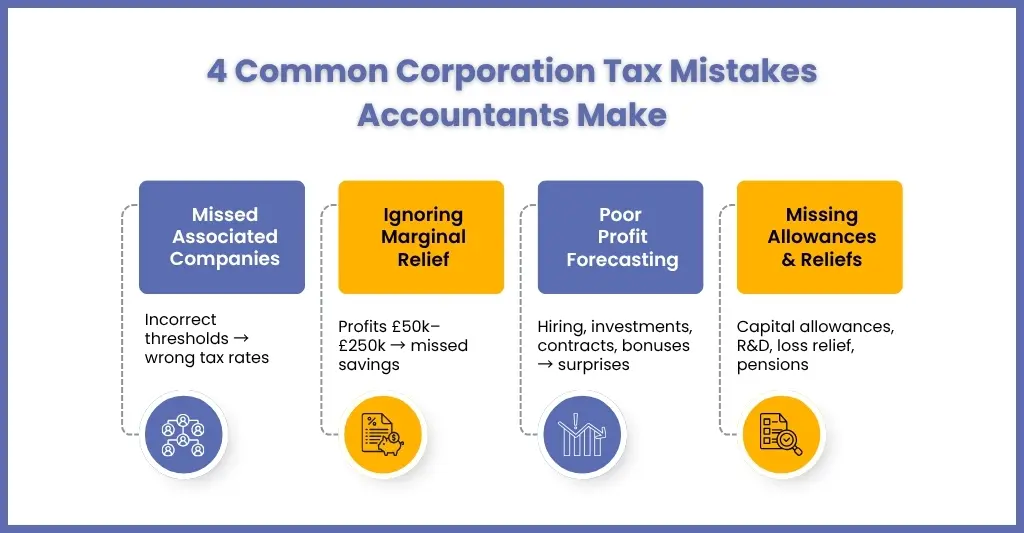
The most common corporation tax rate mistakes are missing associated companies, ignoring marginal relief, forecasting profits poorly and overlooking capital allowances, R&D relief, losses and pension planning. Each one can leave a client with a surprise bill, or an overstated one, so a short review checklist before every computation pays for itself.
Even with years of experience, experienced accounting practices commit some mistakes when it comes to corporation tax rates. Some of those common mistakes are:
Failing to Identify Associated Companies
It remains one of the most persistent errors committed by practices across the profession. Since the introduction of the current corporation tax regime, the profit thresholds for the Small Profits Rate and Main Rate are divided among associated companies. Missing out on associated company relations will lead to inaccuracies in tax calculations.
Ignoring Marginal Relief
There have been instances where practices solely focus on headline rates (25% and 19%) and ignore marginal relief opportunities. Many companies with profits between £50,000 and £250,000 generally fall into the marginal relief band, meaning their effective tax rate sits somewhere between the two. This will lead to inaccuracy in forecasts and missed tax planning opportunities.
Poor Profit Forecasting
The client depends on your forecasting so that decisions can be made that will affect their taxable profits.
Businesses constantly make decisions that affect taxable profits, including:
- Hiring new employees
- Purchasing equipment
- Investing in technology
- Taking on additional contracts
- Expanding into new markets
- Paying director bonuses
Without regular and accurate forecasting, tax surprises will become more common.
Missing Allowances and Reliefs
Many of your clients fail to maximise:
- Capital allowances
- Research and Development reliefs
- Loss relief opportunities
- Pension contribution planning
A proactive approach often produces better outcomes.
How Can Accountants Optimise Corporation Tax for Clients?
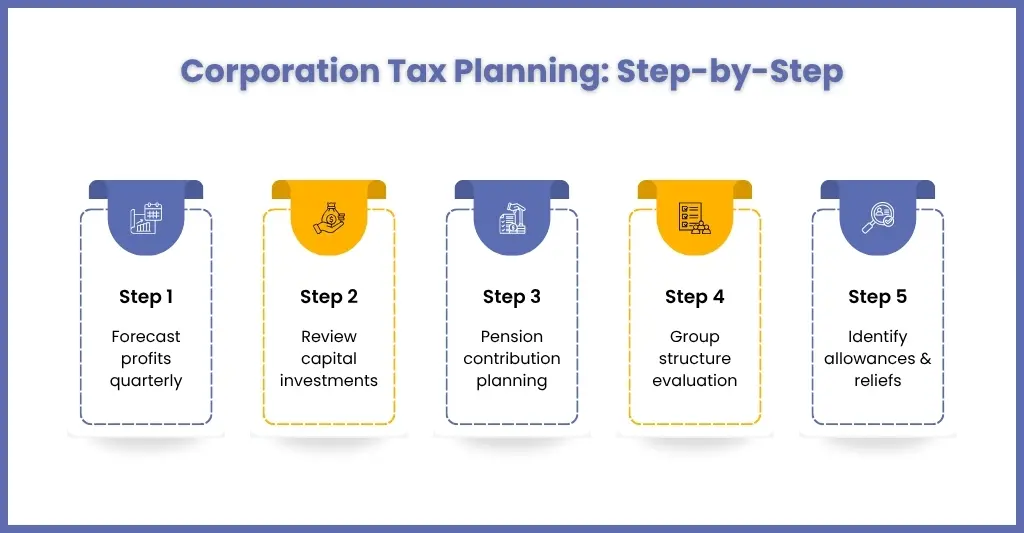
Accountants can legitimately reduce a client’s corporation tax by forecasting profits through the year, timing capital investment to claim allowances, planning employer pension contributions, reviewing group structures and claiming reliefs such as R&D. The aim is no surprises at year end and a lower effective rate.
Regular Profit Forecasting
One of the most powerful tax-planning tools available to accountants is regular profit forecasting. Many business owners only think about corporation tax when their year-end accounts are being prepared. By then, opportunities to reduce tax liabilities may already have been missed.
Through forecasting, you can identify the potential tax exposures well before year-end, which gives time for your clients to act upon. Corient’s management accounts outsourcing can supply the monthly numbers behind those forecasts.
Review Capital Investment Plans
Many companies purchase equipment, machinery, vehicles, software, and office technology throughout the year. However, without proper planning, clients may fail to maximise the tax relief available on these purchases.
Conduct frequent reviews of your client’s capital investment plans so that they time their asset purchases correctly. This way, they can maximise their allowances. The Annual Investment Allowance gives 100% relief on qualifying plant and machinery up to £1 million a year.
Consider Pension Contributions
Pension contributions still remain one of the most effective ways to reduce corporation tax liabilities. Employer contributions are generally treated as a deductible business expense, meaning they can reduce taxable profits while simultaneously helping directors and employees build retirement savings.
For clients, this can provide multiple advantages:
- Lower corporation tax liability
- Improved retirement planning
- Efficient profit extraction
- Potential National Insurance savings
Evaluate Group Structures
The corporation tax landscape became more complex with the introduction of the current tiered tax system. As a result, ownership structures now play a more important role in determining tax liabilities.
Associated companies can significantly affect corporation tax thresholds because the lower and upper profit limits are divided between qualifying companies.
Regular reviews can help:
- Identify potential tax risks
- Ensure compliance with associated company rules
- Support business restructuring decisions
- Improve future tax planning
Focus on Advisory Services
The role of accountants is changing. Historically, many firms generated the majority of their revenue through compliance services such as bookkeeping, payroll, VAT returns, and year-end accounts.
Today, clients increasingly expect strategic advice.
Many practices are therefore looking for ways to free up internal capacity, so their senior staff can focus on tax planning and client advisory work.
This is where corporation tax outsourcing services can play an important role.
By partnering with providers like Corient, accounting firms can delegate routine accounting, bookkeeping, payroll, and compliance tasks while retaining control of client relationships and high-value advisory services. Corient has supported UK accountancy firms since 2011, and our AI Crew tools, such as Sherlock for error detection and Corby for reconciliation, help keep the underlying accounts clean before the computation starts.
When Are the Key Corporation Tax Deadlines?
Most companies must pay corporation tax 9 months and 1 day after the accounting period ends and file the CT600 within 12 months. Companies with profits above £1.5 million pay in quarterly instalments instead, and those above £20 million pay earlier. The profit limits are divided by the number of associated companies.
Missing deadlines can result in penalties and unnecessary stress for clients.
| Company size | Profits (divided by associated companies + 1) | When corporation tax is due | CT600 return |
| Standard | £1.5 million or less | 9 months and 1 day after the accounting period ends (payment of corporation tax) | 12 months after period end (CT600 guide) |
| Large | Over £1.5 million, up to £20 million | Four quarterly instalments, in months 7, 10, 13 and 16 from the start of the period | 12 months after period end |
| Very large | Over £20 million | Four quarterly instalments, in months 3, 6, 9 and 12 from the start of the period | 12 months after period end |
Source: GOV.UK, Corporation Tax: payments for very large companies.
FAQs on Corporation Tax Rates for Accountants
What are the current corporation tax rates in the UK for 2026?
For the year starting 1 April 2026, the small profits rate is 19% on profits up to £50,000 and the main rate is 25% on profits above £250,000. Companies in between pay the main rate less marginal relief, so their effective rate lands somewhere from 19% to 25%. Remember that associated companies share those limits.
Do associated companies affect corporation tax rates?
Yes, and it catches people out. Companies under common control share the £50,000 and £250,000 limits, so two associated companies get £25,000 and £125,000 each. That can push a company into marginal relief or the 25% main rate on far lower profits than the client expects, which is why ownership reviews matter.
How can accountants reduce corporate tax liability for clients?
Reducing a corporation tax bill legitimately comes down to planning before the year ends, not after. Regular profit forecasts show where a client is heading, and that opens up options: timing equipment purchases to claim capital allowances, making employer pension contributions, claiming R&D relief and using losses. A tidy group structure helps too. Everything has to stay within HMRC rules.
What brings down Corporation Tax?
A company can legally lower its corporation tax bill by claiming expenses and allowances it’s entitled to: employer pension contributions, capital allowances on equipment, R&D relief and qualifying charitable donations. Using trading losses also helps. None of these remove the tax entirely, but together they can pull profits down into a lower band.
Who is exempt from Corporation Tax?
Charities are generally exempt on income and gains used for charitable purposes, but they still have to complete a corporation tax return if they have taxable income or gains that no relief covers. Companies pay corporation tax on profits; sole traders and partnerships don’t, because they pay income tax instead.
How Can Large Practices Turn Corporation Tax Complexity into Advice?
Large practices can turn corporation tax complexity into advisory work by mastering the bands, marginal relief and associated company rules, forecasting profits through the year and freeing senior staff from routine compliance. Outsourcing partners such as Corient add capacity so planning conversations happen before year-end.
Corporation tax rates have become much more complex for your clients to realise. Between multiple tax bands, marginal relief calculations, associated company rules, and increasing compliance expectations, there is plenty of room for confusion.
But this complexity creates an opportunity for you.
If you have a grip on the corporation tax rates and regulations, you will be in a position to provide valuable guidance, help your clients avoid making mistakes, and identify tax-saving opportunities. More importantly, you can position yourself as trusted advisors rather than compliance providers.
In case the advisory work grows more than your capacity, then partner with trusted outsourcing partners like Corient, which will free up time for higher-value corporation tax planning and strategic client support.
Contact us and deliver insight, build stronger relationships, and create long-term growth opportunities for your clients.