
Financial statements are the formal records of a company’s financial position and performance. UK businesses prepare four: the balance sheet, the profit and loss account, the cash flow statement, and the statement of changes in equity. They are prepared under FRS 102 and filed with Companies House and HMRC each year.
You must have noticed your clients being extra attentive regarding their financial statements, and rightly so. Financial statements are the backbone of every business’s financial health; without them, making informed decisions will be impossible. Even compliance and future business plans depend on an accurate financial statement. For this reason, accounting practices need to have a perfect knowledge of these important documents and their value-added qualities.
This guide covers what financial statements are, the four types you need to know, how to prepare them, the UK filing deadlines and penalties that apply, the FRS 102 and Companies House changes landing in 2026 and 2027, and the mistakes that cost practices money. Each section answers its own question, so you can jump straight to the part you need.
What is a Financial Statement?
A financial statement is a formal record that reports a business’s financial position, performance and cash movements over a defined period. Financial statements mirror the true state of your client’s business. In essence, businesses or accounting practices prepare these reports to detail a company’s financial activities and health. Government regulators and investors rely on these statements to assess tax obligations, make investment decisions, or approve financing, highlighting their critical importance.
Financial statements for businesses include a balance sheet, profit and loss statement, cash flow statement, and statement of changes in equity. Non-profit organisations also need to prepare these financial statements. In the UK, most companies prepare them under FRS 102, the financial reporting standard issued by the Financial Reporting Council. Micro-entities may instead apply FRS 105.
What are the different types of financial statements?

There are four types of financial statements: the balance sheet, the profit and loss account, the cash flow statement, and the statement of changes in equity. Each answers a different question about the business, and each is prepared from the same underlying ledger.
Financial statements are a collection of multiple documents that are different but still linked to each other. They are vital for maintaining efficiency and transparency in business.
| Statement | What it shows | Period covered | Key question it answers |
| Balance sheet | Assets, liabilities, equity | A single date | What does the business own and owe? |
| Profit and loss account | Revenue, expenses, profit | A period, usually 12 months | Did the business make money? |
| Cash flow statement | Cash in and cash out | A period, usually 12 months | Where did the cash actually go? |
| Statement of changes in equity | Movements in shareholders’ funds | A period, usually 12 months | How did ownership value change? |
Balance Sheet
A balance sheet is a familiar document that provides a summary of your client’s assets, liabilities, and shareholders’ equity at a specific time and date. Let’s understand what it includes.
1. Assets
- Cash and Cash Equivalents: These are liquid assets, such as certificates of deposits.
- Accounts Receivable: These are money owed by your client’s customers for the products and services sold to them.
- Inventory: These are goods that your client is holding and intends to sell during the course of business. Finished, half-finished, and raw materials can be classified as inventory.
- Prepaid Expenses: These are costs paid in advance before they are due and are considered an asset because the value has not been recognised.
- Property, Plant, and Equipment: Capital assets owned by your client’s business and offer long-term benefits. This includes heavy machinery or buildings used for manufacturing.
- Investments: While not used in any operations, investments are considered assets and are held for speculative future growth.
- Trademarks, Patents, Goodwill, and Other Intangible Assets: Such assets cannot be touched but have significant long-term economic benefits for your clients.
2. Liabilities
- Accounts Payable: These are the bills generated due to business operations. Under accounts payable come bills, rent invoices and raw materials.
- Wages: Wages apply to the staff who have worked.
- Notes Payable: These instruments record official debt agreements, including payment schedules and amounts.
- Dividends Payable: They are dividends that have already been acknowledged to be awarded to shareholders but have not yet been paid.
- Long-term Debt: It includes sinking bond funds, mortgages, and other loans that are due in their entirety in more than one year.
3. Shareholders’ Equity
- Shareholders’ Equity: It is your client’s total assets minus its total liabilities.
- Retained Earnings: It’s part of shareholders’ equity; this is the amount of net earnings that were not paid to shareholders as dividends.
Profit and Loss Account
Unlike the balance sheet, an income statement, also called profit and loss, covers a wide range of time, usually a year. It provides details of revenues, expenses, net income, and earnings per share during that year.
The primary purpose of the income statement is to convey details of profitability and the financial results of business activities; however, it can be very effective in showing whether sales or revenue is increasing when compared over multiple periods, which provides valuable information about the success of operations to executive and management.
The main objective of an income statement is to show the profits and other financial results due to your business activities. However, this statement can also show the growth of sales or revenues compared to previous periods, thus showcasing success. Profit and loss statements are used to attract new investors and maintain transparency with existing ones.
Cash Flow Statement
The cash flow statement showcases how cash is earned and spent, complementing the balance sheet and profit and loss statement. However, that does not mean it is less important.
Through cash flow statements, investors will understand the flow of cash, where it is coming from, and how it is being spent. Only cash flow statements can provide insight into whether your client is on solid financial footing.
Statement of changes in equity
A statement of changes in equity reconciles the opening and closing balances of shareholders’ funds, showing every movement in between. Those movements typically include profit or loss for the year, dividends paid, new shares issued, and prior period adjustments.
It is the shortest of the four statements and the one most often treated as an afterthought, but it is the only place where dividend policy, share issues and retained profit are shown together. For owner-managed businesses that mix salary and dividends, it is frequently the statement the client understands best once you walk them through it.
Why are financial statements important for your client’s business?
Financial statements matter because they are the only evidence base a business has for five separate decisions: what to do next, whether it is compliant, whether it can raise money, how it is performing against last year, and what the coming year is likely to look like.
Your clients are eager to get their hands on the financial statements you prepared, and rightly so. Through these financial statements, your clients get a clear picture of their financial health and identify areas where they are going wrong.
There are other reasons that make financial statements very important for your clients. They are as follows:
Promoting Informed Decision-Making
With financial statements in hand, your clients will understand which aspect of their business is giving them profits and areas that are causing losses. Even your accounting practice, armed with valuable information from the financial statements, can better advise your clients, which will help them make informed decisions.
Helping in Staying Compliant
As you stay updated with the latest accounting standards and regulations, you ensure compliance with all HMRC rules while preparing these statements. So, directly or indirectly, you are helping your clients stay compliant in the eyes of HMRC and Companies House.
Enabling Investments
Professionally prepared financial statements present accurate data in a clear and easy-to-understand format. Your clients can then use these statements to showcase their achievements to their stakeholders, thus creating transparency and confidence. They will also be used to attract and generate trust among new investors, thus helping them secure new investments for their business.
Measuring Performance
An accurately prepared financial statement will always accurately show your client’s financial performance. These statements can be compared with the previous ones and with established benchmarks, thus enabling your clients to establish where they are lacking and accordingly take corrective steps.
Material for Future Planning
Along with analysing past performance, financial statements also give your clients enough data to forecast the future. The data presented in the financial statements always points towards a trend, which can be identified through proper data analysis. You can highlight these trends to your clients, which will help them get better prepared.
How to Prepare a Financial Statement
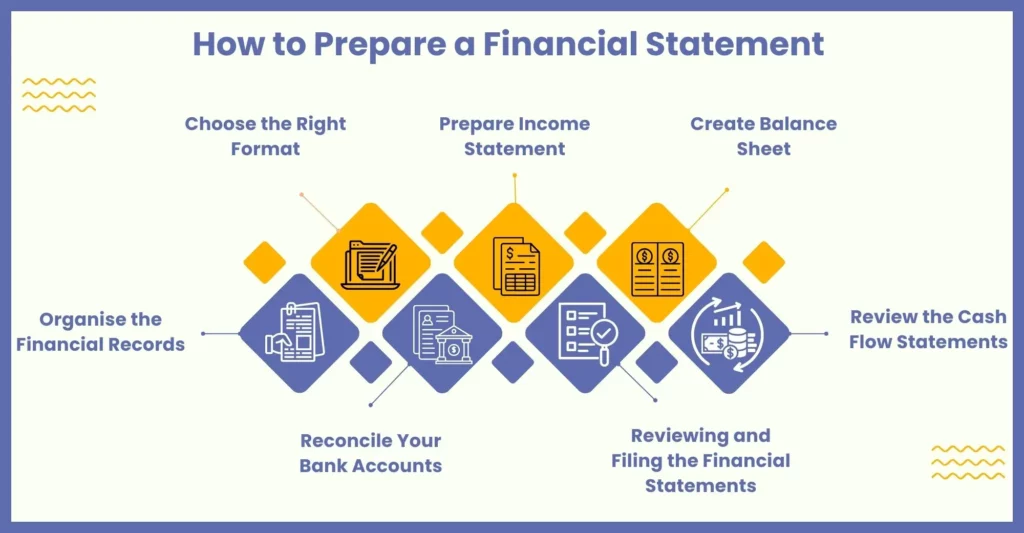
Preparing a financial statement takes seven steps: organise the records, choose a compliant format, prepare the profit and loss account, build the balance sheet, review the cash flow statement, reconcile the bank accounts, then review and file. Each step feeds the next, so skipping one creates work later.
Preparing financial statements is a crucial but complicated task that businesses are increasingly assigning to accounting practices for the sake of accuracy and compliance. The reason for preferring accounting practices to make financial statements is simple: expert accountants in practices will do accurate calculations and follow the latest accounting standards and HMRC regulations.
Step 1: Organise the Financial Records
First, you will have to gather all your client’s financial records in an orderly manner. Make your clients aware of keeping their records, such as receipts, invoices, bank statements, and so on, in an orderly manner. This will save time and quicken the entire process.
Step 2: Choose the Right Format
Select a format that is easy to understand and aligns with the latest UK accounting standards (FRS 102). In this, you can get help from the latest accounting software, which will offer templates. Granted, buying and operating accounting software such as QuickBooks and Xero require investments, training, and experience you may lack. In such situations, you can access these tools via year-end outsourcing services offered by accounting outsourcing service providers.
Step 3: Prepare Income Statement
Also known as a profit and loss statement, it provides a detailed description of your client’s revenues and expenditures for an accounting period. This document is important because it will determine the profitability of your client’s business. It will also help your clients understand their revenue generation and cost structures, which is valuable information for tax planning and improving your business strategy.
Step 4: Create Balance Sheet
A balance sheet will show you the position of your client’s business assets, liabilities, and equity at any time. By preparing a balance sheet, you can make your client aware of what it owns and owes, thus giving them a clear picture of their financial health. While preparing a balance sheet, consider all the assets, liabilities, and equity because any mistake or discrepancies will lead to issues down the line.
Step 5: Review the Cash Flow Statements
The cash flow statement shows the cash inflows and outflows of your client’s business, thus showing how well your client manages its cash. A robust cash flow is vital for meeting the requirements of a business in terms of investment and other obligations. Reviewing the cash flow statement, you can identify discrepancies beforehand and advise your client to make course corrections.
Step 6: Reconcile Your Bank Accounts
Bank reconciliation is important to ensure that the financial statements prepared align with your client’s bank accounts. Regularly reconciling your clients’ business accounts helps you quickly identify errors and fraud and take corrective steps to resolve them.
Step 7: Reviewing and Filing the Financial Statements
Once you have completed preparing the financial statement, just give it one last thorough review. This review ensures that the statements are prepared according to all the guidelines and accounting principles. Many accounting practices have incorporated this step in their process and have been able to identify errors that would have cost their clients dearly.
Once this step is completed, you can proceed to file the statements with HMRC if your clients have given you the authority to do so on their behalf. It’s important to file these statements before the deadline; otherwise, your client will face penalties and interest.
Now, we have noticed a situation where accounting practices are finding it difficult to handle the reviewing and filing process due to its time-consuming and complex nature and are outsourcing it. Therefore, don’t hesitate to avail yourself of year-end outsourcing services if preparing, reviewing, and filing statements have become burdensome.
What are the benefits of outsourcing financial statement preparation?
Outsourcing financial statement preparation gives a practice five things: technical accuracy against current standards, recovered partner time, additional advisory insight, better-supported client decisions, and audit-ready records. It works best where the constraint is capacity at peak season rather than the quality of the underlying client records.
Due to cost and time factors, businesses are finding it increasingly convenient to get their accounting work done through an accounting practice rather than doing it in-house. However, with so much responsibility, practices find it difficult to do justice to multiple aspects of accounting work, such as preparing financial statements.
Financial statement preparation requires expertise and time to tackle the increasingly complex calculations, accounting standards, and regulations, which are in short supply. For this reason, accounting practices are increasingly turning towards outside professional help from accounting outsourcing service providers, and it has worked wonders.
Here’s why professional help makes a difference:
Accuracy and Compliance
The accounting outsourcing service provider has a team of expert accountants who understand the latest accounting standards, software tools, and compliance requirements set by the HMRC. These experts will help ensure the statements meet the accounting standards and are HMRC compliant. At Corient, that team has been preparing UK statutory accounts since 2011 and has been working through FRS 102 Periodic Review transitions with client practices since the amendments took effect.
Time-Saving
Completing a financial statement requires considerable time and resources, and the complexity of the regulations has worsened matters. Therefore, practices have decided to outsource the work. By outsourcing financial statement work, you will be better positioned to focus on other important accounting tasks for your clients.
Strategic Insights
A professional outsourcing service provider always has a team of experts who possess a wealth of knowledge, which can provide your practice with the necessary insights to help you advise your clients in an informed way.
Better Decision-Making
A professional service provider provides accurate and fully compliant financial statements prepared by experienced accountants. Such well-prepared statements will help your clients better budget, plan, and forecast. Where clients need more than an annual view, management accounting outsourcing produces the monthly or quarterly numbers those decisions actually depend on.
Audit Readiness
HMRC audits of financial statements must be expected and can stress you out if you are not compliant with the standards and regulations. However, a professional service provider will prepare these statements keeping accounting standards and regulations in mind. The result will be clean and organised records, which will ease the entire audit process.
What are the most common mistakes to avoid in financial statements?
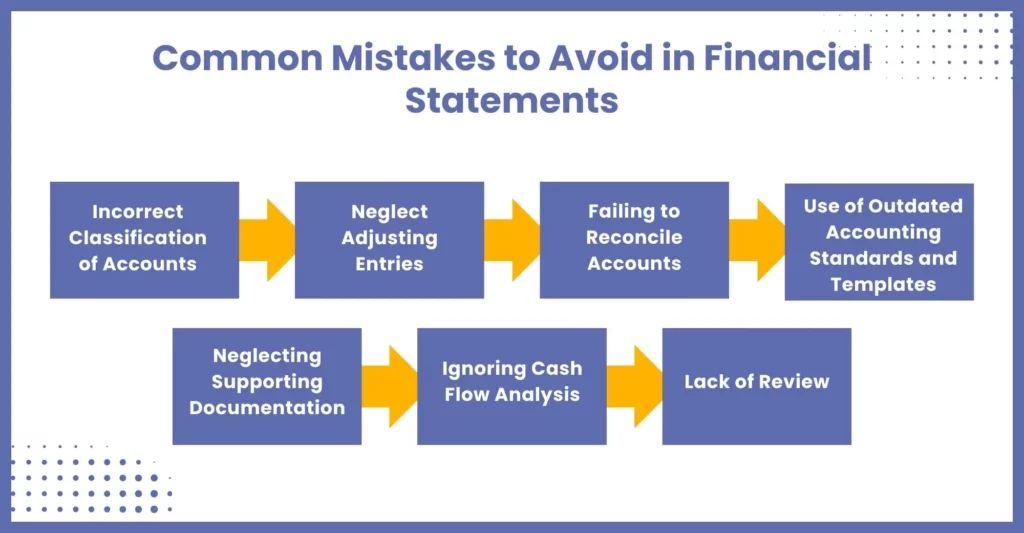
The seven most common errors are misclassifying accounts, skipping year-end adjusting entries, failing to reconcile, using outdated standards or templates, missing supporting documentation, ignoring cash flow analysis, and rushing the final review. Six of the seven are process failures rather than technical ones, which is why they recur.
To avoid such a situation, we have taken the liberty to prepare a list of common mistakes that will undoubtedly occur while making statements and must be avoided at all costs. Let’s get started:
Incorrect Classification of Accounts
It may look like a joke, but there have been instances where some accounting practices have misclassified income as capital or liabilities as expenses. Such misclassification will result in incorrect financial reports and decisions. Therefore, ensure consistency in the classification of assets, liabilities, income, and expenses.
Neglect Adjusting Entries
Errors in year-end adjustments like accruals, prepayments, and depreciation can lead to inaccurate profit numbers and tax liabilities. Hence, it is important to conduct a thorough review of the ledgers before finalisation.
Failing to Reconcile Accounts
Lack of daily reconciliation of bank statements will lead to discrepancies, which will affect the accuracy of bank statements. Such discrepancies will be hard to track, thus bringing disrepute to your practice. Hence, reconciliation must be conducted daily to identify and rectify errors.
Use of Outdated Accounting Standards and Templates
Ignoring the latest FRS 102 standard while preparing financial statements will only lead to compliance issues. Therefore, following the latest UK GAAP requirements and selecting accounting software that will offer you multiple template options to meet the newest accounting standards is essential.
Neglecting Supporting Documentation
Lack of documentation for journal entries will create problems during audits or HMRC reviews. Therefore, you must back every entry with documentation and actively coordinate with your clients.
Ignoring Cash Flow Analysis
Many practices today prioritize profit and loss statements and balance sheets but often overlook the cash flow statement. We want to remind you that the cash flow statement shows the cash inflows and outflows of your client’s business, thus showing how well your client is managing its cash. By reviewing the cash flow statement, you can identify discrepancies beforehand and advise your client to correct course.
Lack of Review
We understand your urge to complete the financial statements as soon as possible to meet the filing deadlines, but that does not mean you do not conduct reviews. Such quality checks are essential in identifying errors, thus saving you from reputational damages.
Now, we understand that preparing financial statements and conducting quality checks is time-consuming, which you want to avoid. In that case, you can avail of the year-end outsourcing services offered by service providers and get the financial statements and reviews done quickly, thus giving you quality and saving time.
People Also Ask
What are the four main financial statements?
The four main financial statements are the balance sheet, the profit and loss account, the cash flow statement, and the statement of changes in equity. The balance sheet shows position at a single date; the other three cover a period, usually twelve months. UK companies prepare all four under FRS 102, though small entities applying Section 1A may present less.
What is the difference between a balance sheet and a profit and loss account?
A balance sheet is a snapshot: it reports assets, liabilities and equity at one specific date, usually the year end. A profit and loss account covers a period, typically twelve months, and reports revenue, expenses and profit earned during it. The profit figure from the profit and loss account flows into retained earnings on the balance sheet.
What happens if financial statements are filed late?
Companies House issues an automatic penalty the day after the deadline: £150 for private companies up to one month late, rising to £1,500 for more than six months. Penalties double if accounts are late in two successive financial years. Public companies pay more, up to £7,500. Persistent failure can lead to prosecution, director disqualification or strike-off.
Should an accounting practice outsource financial statement preparation?
Outsourcing suits practices facing January and September capacity peaks, FRS 102 transition work, or partner time lost to routine preparation. A provider handles bookkeeping-to-accounts production while your team retains review, sign-off and client advice. It works less well where client records are chaotic, since the same clean-up burden simply moves rather than disappears.
Conclusion
Corient has prepared UK statutory accounts for accountancy practices since 2011, working from Coventry with teams trained on FRS 102, FRS 105 and the major UK accounts production platforms. Practices typically engage us for year-end capacity, ongoing bookkeeping, or management accounts.
Understanding financial statements is fundamental for any accounting practice aiming to support its clients’ growth and compliance. From guiding better decisions to ensuring accurate tax submissions, these statements clearly show a business’s financial journey. By getting professional help from an accounting outsourcing service provider, you simplify compliance and add real value to your client’s operations.
Speaking of professional help, you will find multiple service providers offering eye-grabbing packages to attract you, but none has created an impact like Corient. Since 2011, Corient, through its tech-savvy accounting service, has gained the trust of countless accounting firms. We’ve transformed how many of your competitors create financial statements—and we’re ready to do the same for you. Tell us what you need through the contact form and one of our team will come back to you.
Looking forward to a bright partnership!