

Payment on account is an advance payment towards a self-employed client’s next tax bill, triggered when their last Self Assessment bill exceeded £1,000 and less than 80% of their tax was collected through PAYE. HMRC splits it into two instalments, due 31 January and 31 July, each based on half of the prior year’s tax liability.
Your self-employed clients may find themselves surprised and interested when you introduce them to payment on account. If most of your clients are self-employed, they must make a payment on account—an advance payment toward their future tax bill. HMRC introduced this system specifically for newly self-employed individuals whose income isn’t yet taxed at source. Self-employed individuals and others with untaxed income make these advance tax payments based on the previous year’s tax bill. They pay in two instalments—on 31st January and 31st July. If your client’s last Self-Assessment bill exceeded £1,000 and they paid less than 80% of their tax through PAYE, they must make a payment on account.
To avoid your clients from getting surprised by a payment on account, you will need to explain to them what it means, who is liable to pay it, and how to prepare it. To help you guide your clients, we have prepared a guide on this advanced tax payment system, which will simplify your task.
Key Takeaways
- Payment on account applies to anyone whose last Self Assessment bill was over £1,000, with less than 80% of tax collected via PAYE.
- For the 2026/27 tax year, instalments are due 31 January 2027 and 31 July 2027 — each normally half the prior year’s tax bill.
- HMRC’s current late payment interest rate is 7.75% (base rate + 4%), effective from 9 January 2026.
- From 6 April 2026, Making Tax Digital for Income Tax became mandatory for sole traders and landlords earning above £50,000, adding quarterly reporting alongside payment on account.
- Practices can reduce admin load by outsourcing payment on account calculations, HMRC filing, and deadline tracking to a specialist partner.
What Is Payment on Account?
Payment on account is HMRC’s system for collecting Income Tax and Class 4 National Insurance in advance, based on a taxpayer’s previous year’s liability, paid in two equal instalments six months apart.
The payment on account system allows self-employed individuals to make advance payments toward their future tax bills. HMRC calculates the tax amount based on the previous year’s income tax and Class 4 National Insurance contributions. This system helps your self-employed clients—or anyone whose income isn’t taxed at source—spread their tax payments across the year by paying twice, six months apart.
“Did You Know?
GOV.UK, 3 February 2026
11.48 million people filed their Self Assessment tax return by the 31 January 2026 deadline for the 2024/25 tax year — but HMRC estimates around 1 million taxpayers missed it, many of whom will also owe a payment on account instalment.
How Does Payment on Account Work?
Payment on account works by HMRC estimating a client’s tax bill from the previous year, splitting it into two equal instalments due 31 January and 31 July, then reconciling the difference once the actual Self Assessment return is filed.
Many of your clients will have limited knowledge about payment on account and even less understanding of how it works. This system applies to those whose tax is not deducted at the source and spreads the cost. Let’s understand how this system operates:
Making an Estimate Based on the Previous Year
The HMRC will estimate your client’s tax liability by analysing the previous year’s tax bill.
Instalments
Once the amount is fixed, the instalments need to be equally divided.
- The first instalment is due by 31 January 2027 for the 2026/27 tax year (this payment date also covers the balancing payment for 2025/26)
- The second instalment is due by 31 July 2027
Calculations
HMRC calculates the payment on account based on the previous year’s tax bill. For example, if your 2025–26 tax bill is £4,000, you must pay £2,000 in advance for 2026–27, split into two instalments.
Making Adjustments
If the actual tax liability ends up being higher than estimated, your client will have to pay the balance by 31 January. If it’s lower, they may receive a refund or offset it against future liabilities.
Understandably, your clients will not have a deep understanding of payment on account, so they rely on accounting practices like yours. However, these days, to save time and resources, practices are opting for accounting outsourcing services offered by expert service providers to streamline their operations.
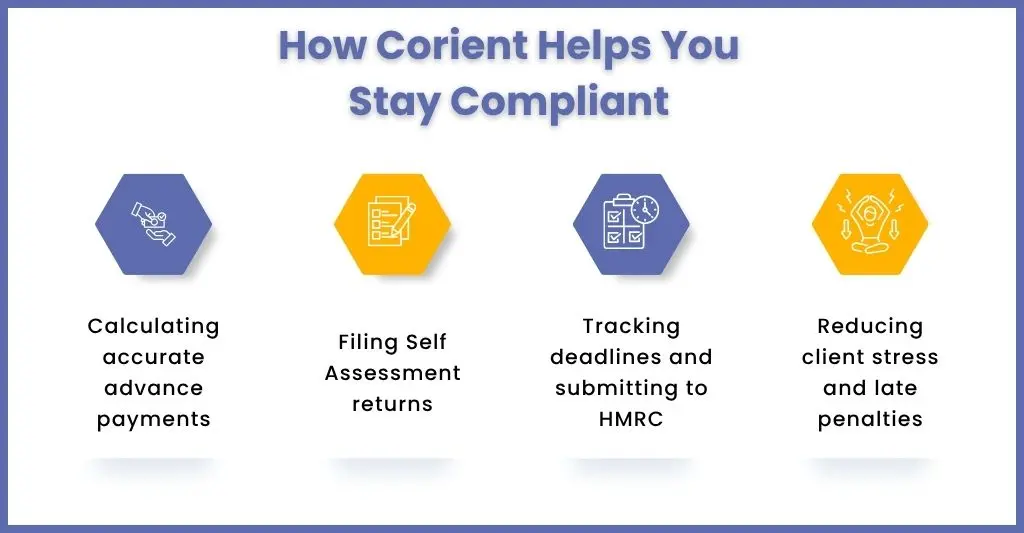
Corient’s tax team supports UK accounting practices with payment on account calculations, HMRC submissions and deadline tracking as part of a wider personal tax outsourcing service — freeing up in-house capacity during the January and July payment peaks.
When Are the Payment on Account Deadlines?
The two payment on account deadlines are 31 January and 31 July every year. For the 2026/27 tax year that means 31 January 2027 (also covering the 2025/26 balancing payment) and 31 July 2027.
Remember the deadlines related to payment on account. On or before these deadlines, your clients must make the payments to avoid any hassle. Here are the key deadlines to note:
- 31 January 2027: your practice must settle the balancing payment for the 2025/26 tax year, submit the client’s Self Assessment return, and make the first payment on account for 2026/27.
- 31 July 2027: the second payment on account instalment for the 2026/27 tax year falls due.
By explaining to your clients how payment on account works and its associated deadlines, you are helping them manage their finances effectively and avoid potential penalties. You must note that, like the payment of corporation tax deadline, HMRC charges interest on any outstanding amount if you miss the payment deadlines.
HMRC’s late payment interest rate is currently 7.75% a year (Bank of England base rate + 4%), effective from 9 January 2026 — down from 8% previously (GOV.UK, HMRC interest rates for late and early payments). This rate applies daily to any payment on account instalment paid after its due date.
Does Your Client Need to Make a Payment on Account?
A client needs to make a payment on account only if their last Self Assessment bill was over £1,000 and less than 80% of their tax was collected through PAYE.
While working on payment on account for practices, we have come across an interesting fact: a significant proportion of UK businesses may not fully understand the payment on account requirements. Among the multiple queries we receive is the eligibility for making a payment on account.
Hence, not all of your self-employed clients are liable for payment on account. They must make the payment only if:
- Their last Self-Assessment tax bill was over £1,000, and
- Less than 80% of their tax was collected via PAYE
This eligibility rule affects a large share of the market: ONS Labour Force Survey data tracks several million self-employed workers across the UK economy, the population most exposed to payment on account (ONS, UK self-employment jobs time series).
How Do You Pay Payment on Account to HMRC?
Clients can pay HMRC by bank transfer (Faster Payments, CHAPS or Bacs), debit or corporate credit card online, or Direct Debit.
Now that you’re aware of the internal workings of payment on account and who will be liable for it, let’s understand how your clients will make payments. Currently, there are many payment methods that the HMRC accepts; these are:
- Bank transfer (Faster Payments, CHAPS, or Bacs)
- Debit or corporate credit card (online)
- Direct Debit
It is essential to note that payment processing takes three working days if it is made through BACS, direct debit, or cheque. Hence, keep a watch on the deadline to ensure it does not fall on weekends or holidays. We recommend making payments well in advance of the deadline to avoid any hassle for your clients.
Can You Reduce Your Client’s Payment on Account?
Yes — a client’s payment on account can be reduced if they genuinely expect lower income this year than last, though under-estimating creates an interest liability on the shortfall.
HMRC determines the amount of payment on account based on last year’s tax bill. The regulatory agency will assume that your client will continue to earn at the same rate. Therefore, your client will also pay the same amount of tax in the following year.
The question that arises is how you will help your client reduce the payment on account. One way it can be reduced is when your clients’ income is taxed at the source, which will reduce the payment on account. However, caution must be exercised to ensure that if there is too much reduction in costs, HMRC will charge interest on the shortfall; therefore, it is essential to develop accurate estimates.
From 6 April 2026, Making Tax Digital for Income Tax became mandatory for sole traders and landlords with qualifying turnover above £50,000, requiring quarterly digital income and expense submissions alongside existing payment on account obligations (GOV.UK). For practices managing a large client base, this makes it more important than ever to track payment on account and MTD deadlines together — see our Making Tax Digital service page for how we support this.
Frequently Asked Questions (FAQ)
When is the payment on account deadline in 2026/27?
For the 2026/27 tax year, there are two payment on account deadlines. The first instalment — which also covers the 2025/26 balancing payment — is due by 31 January 2027. The second instalment is due by 31 July 2027. Practices should diarise both dates separately for each client, since HMRC applies interest and penalties independently to each missed instalment, and the January date carries the heavier admin load.
Is payment on account the same as a tax bill?
No. Payment on account is an advance towards a client’s next tax bill, not the final bill itself. HMRC estimates the amount using the previous year’s liability, and the actual figure is only confirmed once the Self Assessment return for that year is filed. Depending on how income changed, the client may owe a top-up balancing payment or be due a refund.
Why does HMRC want payment on account?
HMRC uses payment on account to collect Income Tax and Class 4 National Insurance closer to when income is actually earned, rather than as one large annual lump sum. It applies to anyone whose tax isn’t fully collected through PAYE, split into two equal instalments — each normally half of the previous year’s tax bill — due by midnight on 31 January and 31 July.
Does HMRC automatically refund overpaid payments on account?
Not automatically in most cases. A client is normally issued a P800 tax calculation showing any overpayment, which your practice should verify before a refund is claimed. Since 31 May 2024, HMRC stopped issuing all repayments automatically, so practices need to proactively check client accounts and submit refund requests once a P800 confirms an overpayment is genuinely due.
What is the current interest rate on late payment on account?
HMRC’s late payment interest rate is 7.75% a year, calculated as the Bank of England base rate plus 4%, and has applied since 9 January 2026 (GOV.UK). This is charged daily on any late payment on account instalment, on top of separate late payment penalties, so it’s worth flagging at-risk clients to well before each deadline.
Ready to Stay Ahead of Your Tax Payments?
Payment on account, if not taken seriously, can throw up some nasty surprises, which will cost your clients dearly and damage your practice reputation. Through this guide, we are making it easy for you to make your clients understand the importance of this tax payment system. In this guide, we have made an effort to simplify the internal workings of accounts on payment, payment methods, and deadlines.
Using this guide, you can help your clients avoid cash flow surprises and last-minute panic. To further enhance your services, you can utilise the assistance of a professional service provider, such as Corient. As an outsourced accounting partner to UK practices, Corient’s tax team handles payment on account calculations, HMRC filing, and deadline tracking as part of a wider tax outsourcing support offering — giving large practices back the capacity that January and July deadlines usually eat up.
We handle a range of accounting tasks, including payment on account calculations, HMRC filing, and deadline tracking, thereby reducing your workload and freeing up your resources. Use our contact form to share your requirements, and we will get in touch with you. Looking forward to seeing you soon.
