
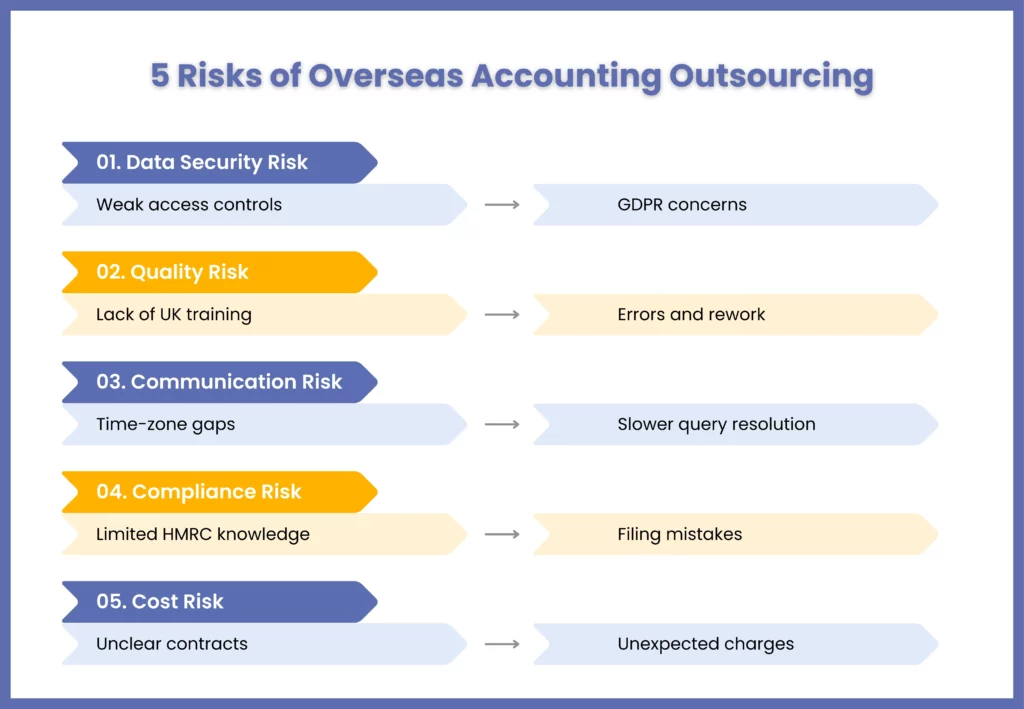
The biggest risks when outsourcing accounting work overseas are data security gaps, inconsistent quality, communication breakdowns, non-compliance with UK standards, and hidden costs buried in vague contracts. However, these risks do not mean giving up on outsourcing because they can be avoided by choosing the right provider carefully.
We have come across multiple accounting practices who have outsourced a batch of accounting work to a low-cost overseas provider, chasing a deadline. After some time, many complained that their reconciliations came back incomplete, client data had been shared over an unsecured email thread, and there was no resolution to their queries.
Unfortunately, this story isn’t unusual; it’s exactly why so many UK practices approach overseas outsourcing with caution, even while knowing the capacity benefits are real. This guide walks through the actual risks, backed by UK data, and how firms like Corientbs are built specifically to avoid them.
What Does Outsourcing Overseas Actually Mean for UK Practices?
Outsourcing overseas means handing over bookkeeping, payroll or other accounting work to a team based outside UK, most probable India, so that you can retain your in-house team for client relationship and monitoring work.
The work itself doesn’t change. What changes is where it’s physically processed, who’s doing it, and how tightly that process is managed. That last part is where most of the real risk sits.
Let’s understand the risks involved.
Risk 1: Data Security and Confidentiality
The biggest risk associated with outsourcing overseas is related to client data, and it’s the risk of it being handled without proper security controls, such as weak access permissions, unsecured file sharing, or unclear data storage policies.
This matters more than ever. The UK Government’s 2025/26 Cyber Security Breaches Survey found that over four in ten businesses (43%) and around three in ten charities (28%) reported having experienced any cyber security breach or attack in the last 12 months. Since you are responsible for your client’s sensitive data that includes financial and personal data, a single mishandled file can mean non-compliance with GDPR.
The fix isn’t avoiding outsourcing, but confirming how a provider stores, accesses, and protects data before you send a single file.
Risk 2: Inconsistent Quality and Accuracy
Inconsistent quality happens when your provider lacks UK-specific accounting training, proper review processes, or experience with UK’s best accounting software and standards.
We have come across some professional outsourcing providers that have ACCA- or CA-qualified and trained accountants specifically on UK compliance. Others are generalists working across multiple countries’ accounting rules, with UK nuances treated as an afterthought. The result is dip in quality.
Risk 3: Communication and Time-Zone Friction
The risk of gaps in communication, language issues, and unclear points of contact is quite persistent and slows down the resolution of urgent queries.
A four-and-a-half-hour time difference with India, for example, can mean a query sent at 4 pm UK time doesn’t get answered until the next UK morning. During a tight filing deadline, that delay is the difference between meeting a client’s expectations and explaining why you didn’t.
You will need to select a provider whose staff provide dedicated UK-hours support to largely eliminate this risk; hence, confirm directly with your provider whether they offer this.
Risk 4: Compliance with UK Standards and HMRC Rules
Compliance risks goes up when you provider is not updated with the latest UK- specific rules like RTI submissions, UK tax deadlines, or UK GAAP treatment.
This is a genuinely high-stakes risk. Non-compliance by a third-party provider still land on your shoulders, not the provider’s. Multiple surveys flagged compliance accuracy as one of the top concerns UK practices raise when evaluating any outsourced service, overseas or domestic. It’s a legitimate worry, not a fringe one.
Risk 5: Hidden Costs and Vague Contracts
Hidden cost risks come from providers that showcase a cheap price structure but expand the costs with extras like corrections, rush jobs, and additional communication when the billing starts.
A low headline rate can be misleading if the contract doesn’t clearly define what’s included. Many practices often discover the real cost only after committing, when errors need fixing, or urgent requests carry a premium they weren’t told about.
The safeguard here is simple: get pricing and scope confirmed in writing, with no vague “additional charges may apply” language buried in the small print.
| Risk | What Causes It | How to Reduce It |
| Data security | Weak access controls, unsecured file sharing | Confirm data storage and security standards upfront |
| Inconsistent quality | Generalist staff, limited UK-specific training | Request a trial job before committing |
| Communication delays | Large time-zone gaps, unclear contact points | Choose providers with UK-hours support |
| Compliance errors | Limited UK regulatory training | Verify RTI, HMRC, and UK GAAP experience directly |
| Hidden costs | Vague contracts, undefined scope | Get fixed, written pricing before starting |
How to Reduce These Risks When Outsourcing Overseas
These risks mentioned above may sound daunting, but through careful vetting of providers on security, UK compliance experience, and pricing transparency, you can considerably reduce the risks.
Ask direct questions to your providers: How is client data stored and protected? What UK-specific training does staff receive? What are guaranteed turnaround times during UK business hours? Is pricing fixed, or does it expand with “extras”?
Providers built specifically around UK practice needs tend to answer these questions clearly, because they’ve designed their entire service around solving exactly these concerns.
This is precisely the model Corientbs has followed since 2011, working as an extension of UK accounting teams, with UK statutory payroll processing, HMRC-aligned compliance, and data handling built around UK standards from the ground up, rather than adapted from a generic offshore template.
People Also Ask
What are the risks associated with outsourcing?
Outsourcing business tasks to third-party providers carries core risks like losing direct control over daily operations, facing hidden or unexpected financial costs, compromising data security and privacy, dealing with communication or cultural gaps, and suffering from inconsistent service quality.
Does outsourcing have to be in another country?
No, outsourcing does not have to be in another country. Outsourcing simply means hiring an outside company or person to do work that your own staff could do. That outside helper can be in the same city, the same state, or a different part of your home country.
What are the downsides of outsourcing?
Outsourcing can reduce costs and save time, but it also creates major risks like losing direct management control, communication and language hurdles, data security vulnerabilities, and unpredictable quality inconsistencies.
What is offshore outsourcing?
Offshore outsourcing is when a company hires an outside group in another country to do work. It mixes outsourcing (using an outside helper) with offshoring (going to another land). Firms use this plan to save money, find skilled workers, and run tasks around the clock.
Final Thoughts — Weighing the Risk Against the Reward
All the risk mentioned above associated with outsourcing overseas is real and can be avoided by choosing the right provider and asking the right questions first.
For UK accounting practices facing genuine capacity pressure, the reward, freed-up time, lower fixed costs, faster turnaround, is significant enough that dismissing outsourcing outright often means turning away growth for the wrong reason.
Corientbs has spent over a decade helping UK accounting practices access reliable payroll and accounting capacity, built specifically around UK statutory requirements, data security standards, and clear communication without the guesswork.
Contact us today for a no-obligation conversation about how we protect your clients’ data and your firm’s reputation.