
Choosing the right outsourcing partner means looking beyond price and checking a provider’s ability to deliver on quality, data security, knowledge of UK accounting standards, and the ability to work with your workflows. The ideal outsourcing partner will help you increase your capacity without additional in-house recruitment, allowing your accountants to improve client relationships while routine delivery is handled reliably.
To understand the importance of choosing the right outsourcing partner, we would like to put you in a scenario. Imagine your practice has just won 20 new clients, which is good news. The pipeline looks healthy, revenue is increasing, and the partners are pleased with the direction of the business.
Then reality catches up. You will need more accountants to handle bookkeeping, preparing VAT returns, reconciling accounts, chasing documents, and preparing year-end files. But recruitment takes time, qualified staff can be difficult to find, and the workload may not always justify another permanent employee.
This is one reason outsourcing has become a practical part of the modern accounting practice model. But outsourcing is not simply about finding someone to complete a task. The wrong provider can create more review work, communication problems and security concerns. The right one can feel like an extension of your existing team.
So, how do you tell the difference?
Why UK Accountancy Practices Outsource
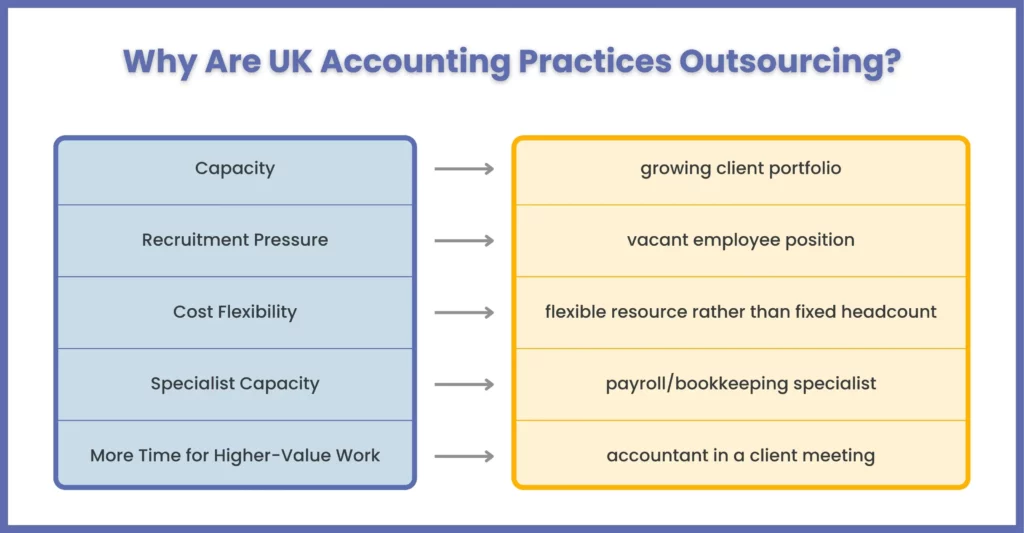
Outsourcing is preferred by UK accounting practices because of its ability to overcome several problems faced by them at once.
Here’s why it is being preferred.
Capacity
When you choose the right outsourcing partner, you will be in a position to take on more work without requiring you to permanently expand your in-house team.
Recruitment Pressure
AAT’s 2025 research filing the gap found that 34% of UK employers had struggled to recruit for finance and accounting positions in the previous year. It also found that skills shortages had reduced productivity for 42% of employers. For you, losing productive hours because experienced staff are stretched can have a direct impact on growth.
Cost Flexibility
Recruiting a permanent employee will lead to permanent costs. Outsourcing helps in avoiding that by providing access to capacity in the form of experienced accountants based on the volume and type of work.
Specialist Capacity
You may not need a full-time payroll specialist or bookkeeper. Through outsourcing, you can get access to specialists without building a team in-house.
More Time for Higher-Value Work
If routine bookkeeping and accounts preparation are handled efficiently, accountants can spend more time on client relationships, advisory work and business development.
Outsourcing is not about moving work elsewhere. It helps improve how the practice allocates its time.
Core Criteria for Choosing an Outsourcing Partner
Choosing the right outsourcing partner requires more than comparing hourly rates.
Start with these criteria.
UK Accounting Knowledge
Select a provider that understands the UK accounting environment in which you operate. That includes relevant UK accounting principles, HMRC processes, VAT, payroll requirements, Companies House and your preferred accounting software. Your provider should not struggle with basic UK accounting procedures every time a new member joins the delivery team.
Quality Control
Ask how work is checked before it reaches your practice.
- Is there a reviewer?
- Are checklists used?
- How are errors recorded?
- What happens when something is returned for correction?
A low-cost provider can lead to significant rework that can quickly become expensive.
Data Security
This should be a non-negotiable. You are handling sensitive financial and personal information of your clients, which you will need to share with your outsourcing partner. Your outsourcing partner must be able to comply with UK GDPR and follow appropriate technical and organisational measures.
Your due diligence should therefore cover:
- Access controls
- Encryption
- Staff confidentiality
- Security training
- Data storage
- Backup procedures
- Incident response
- Sub-processors
- Data deletion at the end of the contract
Do not simply ask, “Are you GDPR compliant?” Ask the provider to explain how.
Software Compatibility
Your outsourcing provider must be comfortable working with the software you use. That could include Xero, QuickBooks, Sage, FreeAgent, IRIS, TaxCalc, BrightPay or other platforms. Changing your entire technology stack just to accommodate your outsourcing provider will create a lot of hassle.
Communication
You need to know from your provider whom to contact when things go wrong
Ask:
- Will we have a dedicated contact?
- How quickly are queries answered?
- What happens with urgent work?
- How are issues escalated?
- Will the team attend regular review meetings?
Good communication prevents a lot of misunderstanding between the provider and you.
Scalability
Your requirements for today will not remain the same 6 months down the line. So, you need to clarify with your provider whether they can increase capacity if you win another 50 clients. Also ask what happens if your workload temporarily falls. Flexibility should work in both directions.
Does the Partner Work Under Your Brand?
This question troubles many accounting practices and providers have a solution in the form of a white-label model. It allows the outsourcing provider to operate behind the scenes while you maintain the client relationship.
That can mean your client continues to communicate with your practice while the outsourced team handles agreed bookkeeping, accounts preparation or other delivery work.
You will retain control over:
- Client communication
- Pricing
- Advice
- Final review
- Professional judgement
- The overall client relationship
Your external team focuses on agreed production work.
This model is popular among practices that want to increase capacity without making their operating model look significantly different to clients.
But before signing, ask:
- Who owns the client relationship?
- Who communicates with the client?
- Can work be completed under our brand?
- Who has final responsibility for review and sign-off?
The answers should be clear before work begins.
A Step-by-Step Evaluation Process
Choosing the right outsourcing partner will not take months, and when you follow a structured process, decision-making becomes much easier and faster.
Step 1: Define What You Want to Outsource
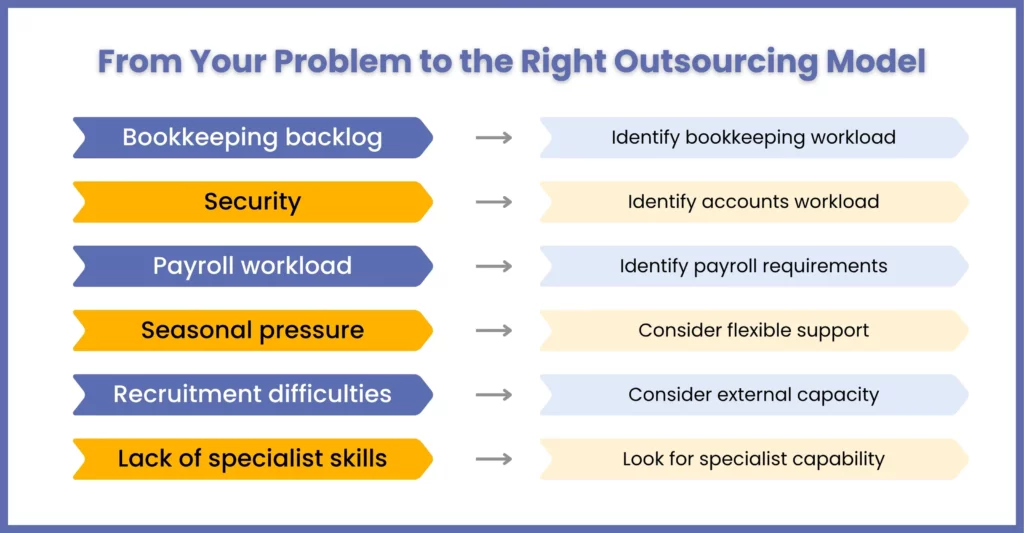
Start by identifying what problems you face.
For example:
- Bookkeeping backlog
- Accounts preparation capacity
- Payroll workload
- Seasonal pressure
- Recruitment difficulties
- Lack of specialist skills
Step 2: Calculate Your Current Workload
Work out how many hours are being spent on the activities you want to outsource. This gives you a realistic basis for comparing providers.
Step 3: Create Your Shortlist
Create a list of providers that are experienced in supporting UK accounting practices and accounting standards.
Step 4: Check Technical Capability
Verify your selected provider’s capability in working with your technology and software stack and understanding your workflow.
Step 5: Review Security
Ask your provider for details of access controls and other measures taken for data protection.
Step 6: Ask for a Clear Delivery Model
Get clarification from your provider as to who will perform the work, who reviews it, how queries are handled and what turnaround times you can expect.
Step 7: Test Before Scaling
Consider starting with a small group of clients or one service line. This gives both sides an opportunity to identify issues before the relationship becomes larger.
Step 8: Review the Results
With outsourcing, your responsibility is not over. You will need to keep track of:
- Accuracy
- Turnaround time
- Rework
- Communication
- Capacity created
- Cost
- Client impact
This will allow you to make further informed decisions.
Questions Every UK Accountant Should Ask Before Signing
A provider’s sales presentation will naturally focus on its strengths and gloss over its weaknesses. It’s your job to ask relevant questions to uncover how the relationship actually works.
These questions are:
| Area | Questions to Ask |
| Experience | How many UK accounting practices do you currently support? |
| People | Who will work on our accounts and who reviews their work? |
| Quality | What is your quality-control process? |
| Security | How is client data protected and who has access? |
| Software | Which accounting and practice-management platforms do you use? |
| Communication | Who is our main contact and how are issues escalated? |
| Capacity | Can the team scale when our workload increases? |
| Branding | Can you work under our brand? |
| Pricing | What exactly is included in the quoted fee? |
| Continuity | What happens if an assigned team member is unavailable? |
| Onboarding | How will client files and processes be transferred? |
| Exit | What happens to our data and work if the relationship ends? |
The ICO recommends proportionate due diligence when appointing processors, including checks around data security, system testing, audit requests and staff training. That means due diligence should happen before you sign, not after something goes wrong.
How Corientbs UK Fits Into the Selection Process
For accounting practices searching for an outsourcing partner, Corientbs is the right outsourcing partner because of its focused approach rather than treating accounting work as generic back-office processing.
Its outsourcing services are designed to give UK accounting practices access to additional capacity across areas such as bookkeeping, payroll, accounts preparation, management accounts and tax-related support.
Corientbs also positions its accounting outsourcing services around UK accounting practices, with teams familiar with UK accounting standards and HMRC requirements and the software commonly used by firms.
That matters because the best outsourcing relationship should feel like an extension of your practice, not another supplier you have to manage constantly. That’s important so that you can decide which work to retain internally and where additional capacity makes commercial sense.
For example, you may keep client meetings, advisory work and final review with your UK team while using additional external capacity for bookkeeping, accounts preparation or payroll processing.
This gives you more room to grow without making every increase in workload a recruitment exercise. And that is ultimately what choosing the right outsourcing partner should achieve.
More capacity, without more unnecessary complexity.
People Also Ask
What’s the difference between outsourcing and offshoring for an accounting practice?
Outsourcing means using an external organisation to perform work that could otherwise be handled internally. Offshoring means the work is performed outside the relevant home jurisdiction. A UK accounting practice can therefore outsource work to a UK provider without offshoring it, or outsource it to an overseas delivery team.
How do I know if my clients’ data is secure?
Start by verifying the security measures offered by the outsourcing provider during selection process such as Access controls, Encryption, Staff confidentiality, Security training, and Data storage, to name a few. These measures and constant monitoring will ensure your clients data is secure.
How long does choosing an outsourcing partner usually take?
There is no fixed timeline, it may take few days to few weeks. But it all depends on the requirements of your practice and clients, complexity of the work you are outsourcing, and price and service negotiations. Also, comparison of cost with rivals will take extra time.
How much does it cost to outsource an accountant?
The cost to outsource an accountant typically ranges between £150 and £900 per month. However, the exact price is highly dependent on your size, transaction volume, and the complexity of the services required. The cost may sound high but when compared with in-house handling you will find them highly reasonable.
What are the top 5 outsourcing destinations?
The top five global outsourcing destinations are the India, Philippines, Mexico, Vietnam, and Poland, chosen for their skilled workforces, cost savings, and reliable infrastructure.
Conclusion
Choosing the right outsourcing partner is not about finding the reasonable ones. It is about finding a team that can fit into your practice without creating another management headache.
The right partner should understand your clients.
Your software.
Your deadlines.
Your quality standards.
And the way you want your practice to operate.
Most importantly, outsourcing should give something back to your practice. Time. Capacity. Flexibility. So, if your practice is growing but your internal capacity is struggling to keep up, outsourcing could be worth exploring.
The key is to choose carefully.
Corientbs works across accounting practices of various sizes to provide flexible outsourced accounting capacity across bookkeeping, accounts preparation, payroll and other finance functions.
If you are considering outsourcing, start with the problem you want to solve, define the work clearly and then assess whether the partner can genuinely fit into your practice.
Ready to explore what the right outsourcing model could look like for your firm? Contact us to discuss your requirements and see how an extended delivery team could fit around your practice.