
An accounting practice requires outsourcing of repetitive and time-consuming tasks like bookkeeping, payroll, tax administration, IT support, cybersecurity, HR administration, and other back-office work. Since your accounting practice can be considered a business, you must start giving serious thought to outsourcing not to outsource everything, but to outsource some tasks- which gives you more time to focus on your customers, strategy, and growth.
Picture that you have landed multiple major clients. Revenue is going up, but every Friday is spent chasing invoices, checking payroll, updating spreadsheets, and sorting admin. The growth has created more work rather than more freedom.
This is where outsourcing can make a difference.
For accounting practices, this creates an opportunity too. By helping clients with reliable outsourced finance and accounting services, you can move beyond compliance and become more valuable strategic partners.
Why Should Accounting Practices Consider Outsourcing?
Outsourcing gives you access to specialist external support that can reduce administrative pressure and allow your internal teams to concentrate on higher-value work for your clients.
That’s why these days majority of UK accounting practices prefer to outsource partly or fully their accounting tasks.
So, which tasks should you consider moving outside your internal teams?
15 Tasks Every Accounting Practices Should Outsource
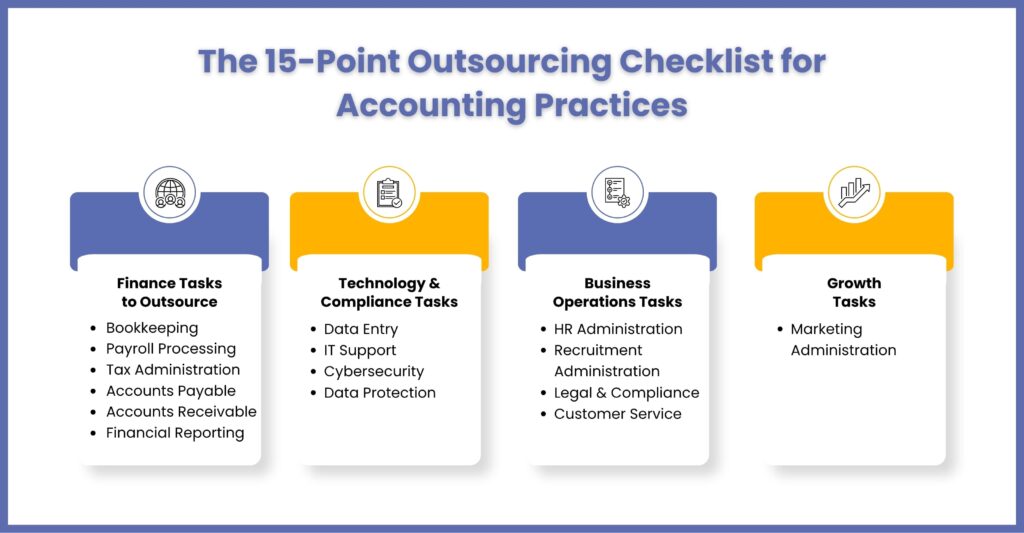
1. Bookkeeping
Bookkeeping is one of the first things you should outsource. It contains multiple tasks such as transaction recording, reconciliations of bank accounts, ledger maintenance, and maintaining financial records. These tasks consume a lot of time and do not generate any direct revenue.
Bookkeeping outsourcing gives you access to professionals who will keep the records updated. It offers a scalable way of supporting your clients without the need for internal hiring.
2. Payroll Processing
Payroll processing is getting more complicated with every passing day. The joining and leaving of employees, pension contributions, statutory payments, deductions, and changing rules are adding to the pressure.
Multiple studies have pointed out that payroll outsourcing reduces internal workload and gives access to payroll and tax expertise, thus enhancing efficiency and greater consistency.
For accounting practices, payroll outsourcing can therefore provide both efficiency and greater consistency.
3. Tax Administration
VAT returns, PAYE administration, corporation tax, and other tax-related work of clients are becoming difficult to handle in-house for a practice. Many times, we have observed multiple practices relying on outside help for managing complicated tax obligations. Outsourcing tax administration can help you stay organised with a qualified professional handling the compliance work.
Through VAT and other tax outsourcing, you can add significant value through a managed, advisory-led service.
4. Accounts Payable
Accounts payable involves several repetitive tasks such as processing supplier invoices, matching purchase orders, checking approvals, and scheduling payments, which are time-consuming for your internal teams.
Outsourcing accounts payable can create a more structured process, reduce manual data entry and help your clients maintain better visibility over outstanding liabilities. By outsourcing accounts payable, you can reduce manual data entry.
5. Accounts Receivable And Credit Control
Dealing with unpaid invoices is necessary, but it eats up a considerable amount of your time. Your outsourcing partner can manage your clients’ invoice follow-ups, debtor reports, payment reminders, and reconciliations. Accounts receivable outsourcing will help your clients improve their cash flow visibility.
6. Financial Reporting
Your clients are demanding timely and frequent information about revenue, costs, margins, and cash flow to make informed decisions; this makes financial reporting important.
Management reporting services from outsourcing providers can help you get access to financial expertise without adding to your costs. The management reports generated will help you strengthen your services by using the reports to provide insights and recommendations to your clients.
7. Data Entry And Routine Finance Administration
Manual data entry must be carefully considered for outsourcing, especially when it’s repetitive, like invoice processing, expense recording, or spreadsheet updates.
The UK Business Data Survey 2026 found that 86% of UK businesses handled digitised data in 2025–26, demonstrating just how deeply data processes are embedded in everyday business operations.
Through outsourcing, you can free up your accountants to focus on deep analysis and financial planning work.
8. IT Support
Your growing practice might not need a full-fledged in-house IT department, but you will still need routine IT support like software administration, troubleshooting, user support, system maintenance and access management. This can be handled by an outsourcing provider offering IT solutions.
9. Cybersecurity
Cybersecurity cannot be taken for granted, especially when you are increasingly handling sensitive financial details of your clients in high volumes.
The UK government’s Cyber Security Breaches Survey 2025/26, over four in ten businesses (43%) and around three in ten charities (28%) reported having experienced any kind of cyber security breach or attack in the last 12 months.
Outsourcing cybersecurity can provide access to specialist monitoring, security assessments, incident response and compliance expertise without requiring a large internal security team.
10. Data Protection Support
Being compliant with GDPR and wider data protection responsibilities can divert considerable resources away from everyday operations. By outsourcing specialist data protection work, you help establish appropriate processes, documentation, training and governance.
11. HR Administration
When your practices expand, so will your employee count and, with that, your HR administration. It is necessary to maintain a high volume of employee records, documentation work, managing leave records, and onboarding, which consume time. Unless you have decided to outsource the work, it helps you to focus on people and performance while specialist providers handle routine processes.
12. Recruitment Administration
Recruitment involves more than interviewing candidates. Job advertising, CV screening, interview scheduling, candidate communication and onboarding administration can become a substantial workload.
Outsourcing some or all of this administration can help you maintain a professional recruitment process without requiring a large internal HR team.
13. Legal and Compliance Administration
You will frequently come across multiple contracts, employee documentation, regulatory requirements, and compliance paperwork. You can internally hire a professional to handle specialist legal work. But for routine compliance work, you can choose to outsource, thus reducing workload and keeping track of it for decision-making.
14. Customer Service And Back-Office Support
Customer enquiries, appointment scheduling, and routine support requests can become overwhelming during periods of rapid growth. An outsourced support team can provide additional capacity while allowing internal employees to concentrate on complex client issues and revenue-generating activities.
15. Marketing Administration
Marketing strategy may need to remain close to the practice, but many executional tasks can be outsourced. These can include content production, email campaigns, social media scheduling, website updates, research and reporting.
This gives you access to specialist skills without committing immediately to a large permanent marketing team.
How Should an Accounting Practice Decide What to Outsource?
The best approach is to start with tasks that are high-volume, repetitive, specialist, or difficult to scale internally.
A useful assessment is to ask:
- Does this task consume significant employee time?
- Does it require specialist knowledge?
- Is the workload increasing faster than headcount?
- Would mistakes create financial or compliance risks?
- Can an external provider perform it more efficiently?
- Does keeping it in-house genuinely create strategic value?
What Does Outsourcing Mean For Accounting Practices?
For accounting practices, outsourcing is increasingly becoming part of the practice-growth strategy itself.
Practices that are already using outsourcing and offshoring have seen substantial increases in the number of chargeable hours covered by outsourced work. It can also help practices increase capacity, manage seasonal workloads and create room for advisory services.
A trusted partner such as Corientbs can support accounting practices with outsourced finance and accounting capabilities, helping firms extend their service capacity while keeping their focus on client relationships and higher-value advice.
People Also Ask
What is outsourcing of accounting?
Outsourcing of accounting is the business practice of hiring an external firm or professional service provider to handle some or all of a company’s financial and bookkeeping tasks instead of employing a full-time, in-house staff. It spans routine daily entries up to high-level financial strategy.
What are basic accounting tasks?
Basic accounting tasks involve recording, organising, and reporting a daily financial activities. These core duties ensure financial accuracy, track cash flow, and maintain compliance with tax laws using tools like general ledgers or platforms.
Every accounting practice is expected to perform these basic accounting tasks, but due to multiple factors like complex regulations and a high volume of work, these tasks are increasingly being outsourced.
What are daily accounting tasks?
Day-to-day accounting activities involve recording financial transactions, managing cash flow, tracking daily sales and expenses, and reconciling bank accounts to keep a business running smoothly and maintain accurate financial records.
Most of these day-to-day tasks are highly time-consuming and have the potential to divert resources away from high-value accounting and advisory work. That’s why many practices are resorting to outsourcing to save time and resources.
What is the main task of financial accounting?
The basic function of financial accounting is to systematically record, classify, and summarize business transactions, and to report financial information through statements like the balance sheet and income statement so that stakeholders can make informed economic decisions.
Conclusion
By outsourcing the right tasks, you will not only save valuable time but also provide ample time for your accounting team to focus on high-value work that brings greater returns. Bookkeeping, payroll, tax administration, accounts payable, credit control, reporting, IT, cybersecurity, HR and other back-office functions can all be strong candidates.
These days, clients increasingly need help building efficient, scalable operations, not simply completing compliance requirements. By combining trusted advice with dependable outsourced delivery, practices can become a more integral part of their clients’ growth journeys.
Want to expand your firm’s capacity without expanding your internal workload at the same pace? Explore how Corientbs’s outsourced accounting and finance solutions can help your practice deliver more, scale efficiently and spend more time on the advisory relationships that drive growth.