
The outsourcing accounting services cost for accounting practices based in the UK can range from approximately £8 to £50 per hour or £150 to £1,000+ per month, depending on the engagement model.
But the real cost is not the price of outsourcing accounting services; it’s about profitability, scalability, efficiency, and whether your practice can grow without overloading your accounting team.
Right now, accounting practices are facing increasing client demands, more compliance requirements, and staff shortages. Hiring out additional accountants is not an option because it is increasingly expensive and difficult.
According to the Deloitte Global Outsourcing Survey 2024, 80% of executives are planning to maintain or increase investment in third-party outsourcing. That’s why outsourcing is being preferred by many accounting practices as a strategic growth model in 2026.
But outsourcing is not a one-size-fits-all solution. To get a deeper understanding, we have prepared this guide. Here you will come to know about the outsourcing accounting services cost, including pricing models, hidden costs, ROI, and how firms like Corient help practices scale efficiently without overwhelming internal teams.
Cost of Outsourcing Accounting Services for UK Accounting Practices
The cost of outsourcing accounting services depends on the type of work being outsourced. Some want to outsource only certain transactional tasks like bookkeeping or payroll, while others want to outsource the entire function.
Here are approximate outsourcing accounting services cost in the UK market:
| Service Category | Typical Price Range (UK) | Details |
| Basic bookkeeping | £100 – £800 per month | Covers day to day bookkeeping, bank reconciliation, posting invoices, and basic monthly reports. Ideal for sole traders and small limited companies. |
| Monthly accounts and VAT returns | 150 – £600 per month | Includes VAT preparation, Making Tax Digital compliance, and quarterly submissions. |
| Payroll processing | £4 – £8 per payslip or £40 – £120 per month | Depends on employee numbers, payroll frequency and pension duties. |
| Tax preparation and filing | £150 – £1,200+ per year | Varies based on business size, structure and filing complexity |
| Accounts payable and receivable support | £200 – £2,000+ per month | Cost depends on transaction volume, invoicing, payment processing and credit control. |
| Management accounts | £250 – £1,500+ per month | Regular financial reports, budgeting and cash flow support for growing businesses. |
| Year end accounts and compliance | £600 – £3,000+ per year | Covers statutory accounts, Corporation Tax returns and Companies House filing. |
| Fractional or part time CFO or FD | £1,000 – £5,000+ per month | High level financial strategy, forecasting, planning and board reporting. |
| Full service outsourced finance function | £800 – £6,000+ per month | Complete finance department support, including bookkeeping, payroll, VAT, reporting and advice. |
It’s important to note that the price of outsourcing is much more flexible than hiring in-house employees.
What Factors Affect the Cost of Outsourcing Accounting Services?
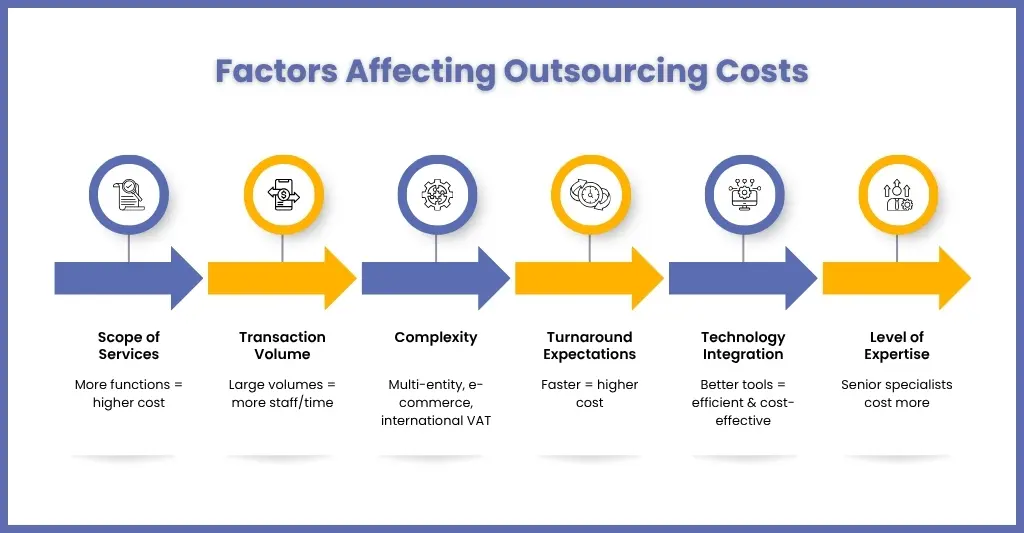
The outsourcing accounting services cost is influenced by multiple factors, and we have listed some of the important ones that need your attention.
Scope of Services
The more accounting functions you want to outsource, the higher the outsourcing accounting services cost.
For example:
- Bookkeeping only → lower cost
- Bookkeeping + payroll + VAT + reporting → higher cost
Many practices prefer to outsource only repetitive tasks because they are time-consuming and resource-intensive, while some prefer to outsource complex accounting tasks because of the risk of errors involved.
Transaction Volume
If your practice processes 200 invoices per month, it will certainly cost you less than one that processes 5,000 invoices per month. Large transaction volumes mean more staff, automation and review processes to be dedicated by your outsourcing partner.
Complexity of Client Work
Handling simple bookkeeping tasks is easier than handling:
- Multi-entity accounting
- Ecommerce reconciliation
- International VAT
- Construction industry schemes
- Recruitment payroll
Complex workflows require experienced professionals and additional quality checks.
Turnaround Expectations
Quick turnarounds mean dedication of more capacity, which will lead to an increase in outsourcing accounting services cost.
For example:
- Same-day bookkeeping updates
- Rapid month-end closing
- High-frequency reporting
Technology Integration
Prefer to choose an outsourcing partner that offers its accounting outsourcing services using the best accounting software and other tools, such as:
- Xero
- QuickBooks
- Sage
- Dext
- Hubdoc
Firms with disconnected systems or manual processes usually experience higher operational costs.
Level of Expertise Required
For doing bookkeeping support, you will need less experienced outsourcing services, which will cost you less. On the other hand, specialised advisory services or those of a senior accountant will cost you more.
Services involving:
- Management reporting
- Forecasting
- Compliance reviews
- Audit preparation
typically require more experienced professionals.
Outsourcing vs In-House Accounting: Cost Comparison for Practices
Many accounting practices make the mistake of comparing outsourcing accounting services cost only with their employee salaries. Instead, you will have to widen your comparison.
In-House Hiring Costs
Hiring internally includes expenses such as:
- Salaries
- Employer NIC contributions
- Pension costs
- Recruitment fees
- Software licenses
- Office equipment
- Training costs
- Sick leave and holidays
Outsourcing Costs
With outsourcing, you will typically pay only for:
- Work completed
- Required capacity
- Agreed service scope
Cost Comparison Table: In-House vs Outsourced Accounting Support
| Cost Area | In-House Accounting Team | Outsourced Accounting Support |
| Salary Costs | Fixed annual salaries | Flexible monthly/service-based fees |
| Employer NIC & Pension | Additional employer expense | Usually included in outsourcing fee |
| Recruitment Costs | High recruitment and onboarding costs | No recruitment expense |
| Training & Development | Ongoing investment required | Managed by outsourcing provider |
| Office Space & Equipment | Additional desks, systems, hardware | No additional office overhead |
| Software Licenses | Separate user licenses required | Often included/shared through provider |
| Staff Absences | Productivity affected by holidays or sick leave | Backup resources typically available |
| Scalability | Hiring needed for growth | Easily scale support up or down |
| Seasonal Workloads | Overtime or temporary staff needed | Flexible support during busy periods |
| Turnaround Time | Depends on internal capacity | Dedicated teams improve efficiency |
| Operational Risk | Staff turnover impacts workflow | Reduced dependency on single employees |
| Typical Annual Cost | £50,000–£70,000+ per employee | Often significantly lower depending on scope |
Common Pricing Models in Accounting Outsourcing
The UK accounting market is filled with multiple outsourcing providers that use different pricing models to handle different service types and workflow complexities.
Fixed Monthly Pricing
A predictable monthly fee based on the agreed service scope.
This pricing model follows a predictable monthly fee structure based on an agreement between the service provider and the accounting practice.
The model is ideal for:
- Stable workloads
- Recurring bookkeeping
- Long-term support arrangements
Pay-As-You-Go Pricing
Under this Pay-As-You-Go model, the charges will be based on the actual work done or hours spent on the work.
Ideal for:
- Expanding practices
- Seasonal workloads
- Firms needing flexibility
This model is highly popular among practices because it avoids paying for services they don’t want.
Per-Transaction Pricing
Charges will be based on:
- Number of invoices
- Payroll runs
- Reconciliations
- Client accounts managed
This model is ideal for:
- High-volume transactional work
Dedicated Resource Model
There are service providers that dedicate an entire team to work exclusively for a practice.
Such a model serves better for:
- Practices with large, ongoing workloads or outsource entire accounting tasks
- Practices needing consistent operational support
Hidden Costs Accounting Practices Should Be Aware Of
It is accurate that outsourcing reduces a considerable amount of operational costs, but there are potholes in the form of hidden expenses that can ruin your experience if not taken into account.
Poor Transition Planning
When the transition of accounting tasks from your accounting team to your outsourcing partner is badly managed, then it creates issues like:
- Duplicate work
- Operational delays
- Inconsistent reporting
- Client disruption
This is why structured onboarding is critical.
Inconsistent Communication
Some unprofessional service providers will lack proper communication mechanisms, leading to:
- Missed deadlines
- Unclear reporting
- Quality concerns
The lowest bidder provider is not always the most cost-effective long-term option.
Lack of Standardised Workflows
Without proper procedures in place, you will find yourself spending additional time just reviewing the outsourced work internally. This defeats the entire purpose of outsourcing, time saving and reduction of workload.
Technology Gaps
Some providers might still use outdated systems, which will create integration challenges with your latest accounting systems. Therefore, place emphasis on technology integration while choosing your outsourcing partner.
Is Outsourcing Accounting Services Worth the Cost for UK Practices?
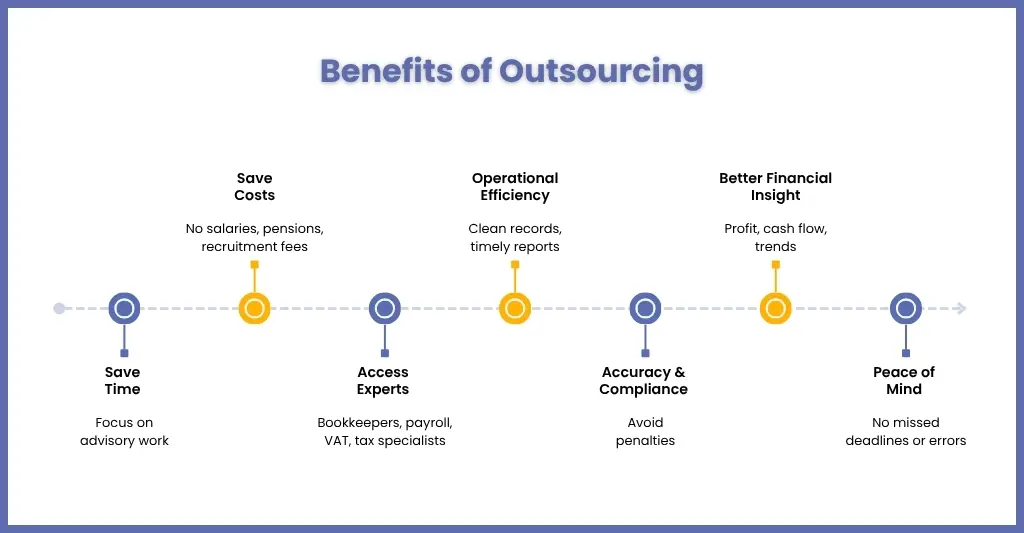
Outsourcing is worth a shot because of the wide-ranging benefits it puts on the table. It has enabled multiple practices to reduce their workload and provide insights to make better decisions.
Saving Time
Managing accounting tasks take time and outsourcing saves that time by taking over the task. This enables you to focus on other important aspects like advisory services or strategic planning.
Saving Costs
Outsourcing prevents you from spending on:
- Salaries
- Employer NI
- Pension contributions
- Training costs
- Software fees
- Recruitment
For many accounting practices, outsourcing costs less than hiring even one junior bookkeeper.
Access to Experts
Through a professional outsourcing provider, you will get access to experts, such as:
- Bookkeepers
- Payroll specialists
- Tax experts
- VAT advisers
- Finance managers
Instead of recruiting multiple staff, you will have access to trained professionals without incurring hiring costs.
Improving Operational Efficiency
Your outsourcing partner will keep your clients’ books in order and in compliance.
Based on that, you will receive:
- Clean records
- Clear reports
- Better cash flow tracking
- Accurate invoices and payments
These clean records and reports can provide insights to your clients during their decision-making process.
Accuracy and Compliance
Professional accountants of service will ensure that:
- VAT is filed correctly
- Payroll follows HMRC rules
- Deadlines are met
- Year-end accounts are accurate
- Tax savings are not missed
This reduces errors and helps avoid penalties.
Tax Efficiency and Savings
Good outsourcing providers will try to save taxes for your clients through tax efficiency by:
- Claiming all allowable expenses for your clients
- Using the correct VAT scheme
- Improving cash flow
- Planning taxes in advance
- Reducing your overall tax liability legally
These savings often cover the cost of outsourcing.
Better Financial Insight
Outsourcing provides access to monthly or weekly reports that help you understand:
- Profit
- Cash flow
- Costs
- Sales trends
- Budget performance
This gives you insights into your client’s performance and allows you to guide them towards clearer decision-making.
Peace of Mind
Knowing that trained professionals are handling your clients’ accounts reduces stress.
You do not have to worry about:
- Missed deadlines
- Incorrect VAT
- Late payroll
- Tax errors
- Missing receipts
When Should Accounting Practices Consider Outsourcing?
Many practices wait until the end when it comes to outsourcing, but this must be prevented at all costs. Therefore, look at the common signs which will indicate to you that it’s time to outsource. These signs are.
- Staff burnout
- Missed deadlines
- Rising client complaints
- Recruitment struggles
- Month-end backlogs
- Inconsistent quality
- Inability to scale profitably
If your team is spending more time on error corrections and managing operational pressure due to expansion, then it’s time to outsource
How Corient Helps Accounting Practices Reduce Outsourcing Costs
One of the major reasons why outsourcing has failed for some practices is a lack of focus on operational efficiency during the selection process.
Corient is known for its professionalism, expertise and its structured approach by combining:
- Accounting expertise
- Cloud technology integration
- Workflow standardisation
- Scalable support models
- Compliance-focused processes
This helps you in reducing your operational inefficiencies while improving turnaround consistency.
Corient has helped practices with services such as:
- Bookkeeping outsourcing
- VAT support
- Payroll outsourcing
- Accounts payable and receivable management
- Management reporting
Our goal is not simply to reduce your costs but to put your practice on the path of sustainable growth without overwhelming your internal teams.
Frequently Asked Questions (FAQ)
What is the average cost of outsourcing accounting services in the UK?
The cost of outsourcing will depend on the services and their complexities. The basic bookkeeping will cost you less, but full-service outsourced accounting will cost you several thousand pounds per month.
Is outsourcing accounting cheaper than hiring in-house staff?
In-house accounting costs you in recruitment, pensions, benefits, training, and office infrastructure, and outsourcing removes those costs and provides you with scalable and expert support.
How much can accounting firms save by outsourcing?
Savings vary by practice size and operational structure, but many firms reduce finance operational costs by 30–50% through outsourcing and workflow automation.
How much does outsourced payroll cost UK?
Outsourced payroll in the UK typically costs between £4 and £15 per employee, per month (PEPM), or about £5 to £10 per payslip. For micro-businesses, many providers charge a fixed monthly base fee ranging from £25 to £60.
Conclusion: Making the Right Cost Decision for Your Accounting Practice
The true outsourcing accounting services cost is not limited to the monthly or yearly package you pay for, but how much inefficiency, burnout, recruitment pressure, and lost growth you will avoid by outsourcing.
In 2026, UK accounting firms face increasing compliance demands, rising staffing challenges, and growing client expectations. Outsourcing has become less about cutting costs and more about building scalable, resilient operations.
When implemented strategically, outsourcing helps practices:
- Improve efficiency
- Reduce operational pressure
- Increase capacity
- Maintain compliance
- Scale without high fixed costs
Most importantly, it allows accountants to focus on higher-value advisory work instead of being buried in repetitive operational tasks.
Firms like Corient help UK accounting practices create this balance by combining experienced finance support, structured workflows, and cloud-based operational systems designed for long-term growth.
Are you ready to go to the next level with accounting outsourcing? Contact us and experience the future of accounting.