
Yes, it’s worth exploring outsourcing for UK accounting practices because it helps reduce operational costs, enhances capacity, and allows in-house teams to focus on high-value work. The real benefit is not cost savings but the easy access to skilled labour without incurring long-term costs of recruitment, training, and additional overheads.
You will feel the need for outsourcing when you expand your client base. More clients mean more revenue, but they also bring more deadlines, more compliance work, and more pressure on existing teams. You would not like your accounting teams spending most of their evenings completing bookkeeping tasks, preparing accounts, and managing administrative work instead of advising clients and growing the business.
This is where the question “Is outsourcing worth it?” becomes important.
For many UK accounting practices, outsourcing has moved from being a cost-cutting strategy to a growth strategy. It will give you easy access to experienced professionals who will help you manage workload fluctuations and create additional capacity without immediately increasing fixed costs.
Outsourcing accounting providers like Corientbs supports accounting practices by providing outsourced accounting solutions that help firms handle routine workloads efficiently while allowing internal teams to focus on client relationships and advisory services.
What Does Outsourcing Mean for UK Accounting Practices?
Outsourcing accounting work means working or partnering with an external service provider to complete certain accounting tasks instead of handling them internally.
For accounting practices, outsourcing commonly includes:
- Bookkeeping
- Accounts preparation
- Payroll processing
- VAT return preparation
- Bank reconciliations
- Management accounts
- Tax support
- Administrative tasks
A professional outsourcing team will work like an extension of your practice. They follow agreed processes, use approved accounting systems, and support internal teams with additional capacity.
Modern outsourcing is no longer simply about sending work away. It is about creating a flexible operating model. A practice can increase support during busy periods and reduce it when workloads become lighter.
Why Are UK Accounting Practices Considering Outsourcing?
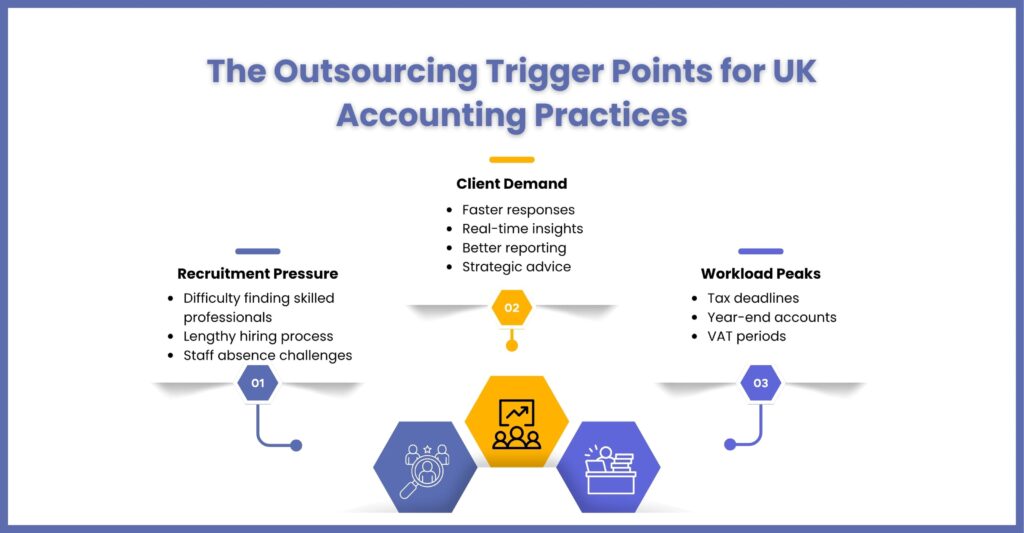
These days, you will find many accounting practices open to outsourcing to overcome several challenges that have made life difficult for them.
Rising Recruitment Pressure
Finding experienced accounting professionals in the UK is a difficult task. According to Filing the Gap research from the Association of Accounting Technicians (AAT) 2025, 34% of employers struggled to fill positions for financial and accounting roles last year.
Recruitment creates additional challenges:
- Advertising roles
- Interviewing candidates
- Training employees
- Managing probation periods
- Covering staff absences
Outsourcing provides an attractive alternative way to access skilled resources without waiting months for recruitment.
Increasing Client Expectations
Your clients expect more from you than just simple accounting work.
They want:
- Faster responses to queries
- Real-time financial insights
- Better reporting
- Strategic advice
However, most of your accounting professionals often spend large amounts of time completing repetitive tasks. Outsourcing can relieve some of these operational pressures, allowing you to dedicate more time to advisory services.
Seasonal Workload Peaks
Tax deadlines, year-end accounts, and VAT periods create significant workload increases. Many practices hire temporary staff to manage busy periods. However, this can create unnecessary costs during lean periods. Outsourcing allows you to scale support based on actual demand.
Is Outsourcing More Cost-Effective Than Hiring In-House Staff?
Yes, outsourcing accounting work is a cost-effective option compared to hiring additional employees, keeping the fixed employment costs under control.
The cost of hiring someone is not limited to salary; you must also consider:
- Employer National Insurance contributions
- Pension contributions
- Recruitment fees
- Training costs
- Software licences
- Office equipment
- Holiday pay
- Sick leave
A £35,000 annual salary can cost significantly more once these additional employment expenses are included.
Cost Comparison: Hiring vs Outsourcing
| Cost Factor | Hiring In-House Employee | Outsourced Accounting Support |
| Salary commitment | Fixed annual cost | Flexible based on workload |
| Recruitment fees | Required | Not required |
| Training investment | Required | Provider-managed |
| Software and equipment | Additional cost | Usually included |
| Holiday and sick cover | Business responsibility | Managed by provider |
| Scaling capacity | Slow | Faster and flexible |
Side-stepping these unnecessary fixed costs can improve cash flow and profitability.
What Are the Main Benefits of Outsourcing for Accounting Practices?
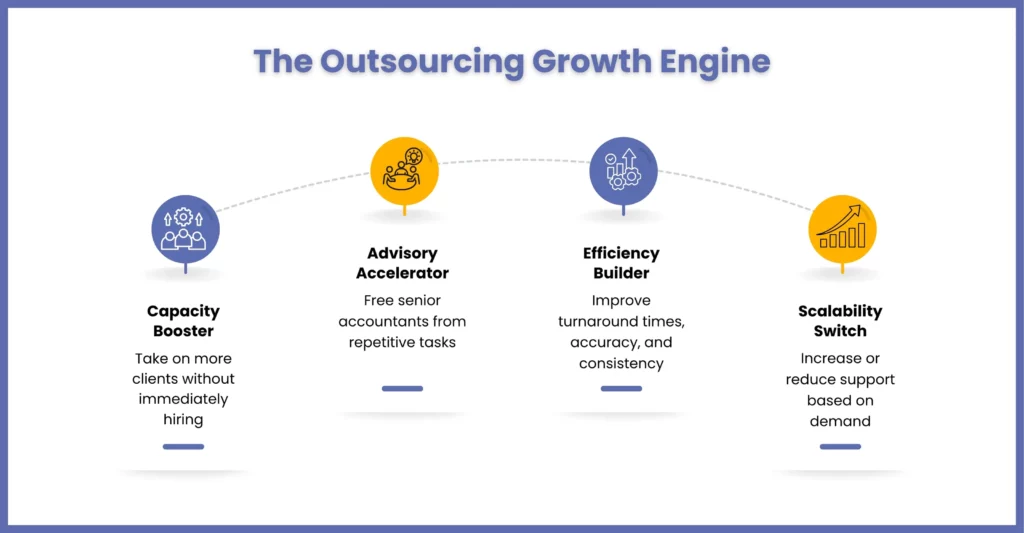
Outsourcing is popular among accounting practices because of the benefits it puts on the table.
Increased Capacity Without Hiring
One of the greatest benefits of outsourcing is its ability to deliver on increased capacity. This enables you to take on more clients without immediately expanding your internal team.
This is particularly valuable during:
- Self-assessment season
- Year-end deadlines
- VAT periods
- Client onboarding periods
More Time for Advisory Services
Routine accounting work is important, but it is also repetitive and consumes a lot of time, thus preventing your accountants from focusing on high-value work.
Outsourcing allows your senior accountants to spend more time on:
- Business advice
- Client meetings
- Tax planning
- Growth strategies
This can improve both client satisfaction and revenue opportunities.
Improved Operational Efficiency
Experienced outsourcing providers usually have established workflows and quality control processes.
This can help you improve:
- Turnaround times
- Accuracy
- Process consistency
Better Scalability
Growth does not always happen predictably. You might gain five new clients one month and experience slower growth the next. Outsourcing provides flexibility because support levels can change as business needs change.
How Much Can Accounting Practices Save Through Outsourcing?
The exact savings from outsourcing will depend on the type and volume of work outsourced. However, many practices have a reduction in cost by avoiding:
- Additional salaries
- Recruitment expenses
- Office costs
- Training investments
The bigger financial benefit often comes from increased capacity.
For example:
Your accountants are spending 20 hours per month completing bookkeeping tasks and could now use that time for:
- Meeting clients
- Selling additional services
- Improving retention
The opportunity cost of keeping everything internal can often be higher than the outsourcing cost itself.
How Does Corientbs Help UK Accounting Practices?
When it comes to choosing an outsourcing provider, Corientbs is second to none. It has made a name for itself by helping practices build flexible capacity through outsourced accounting support.
Instead of getting stuck in an expensive recruitment cycle, Corientbs will give you access to experienced professionals who can do the job for you.
The accounting outsourcing services it offers include:
- Bookkeeping support
- Accounts preparation
- VAT support
- Payroll assistance
- Finance operations
The aim is not to replace your internal teams but to strengthen them.
By handling routine accounting workloads, Corientbs helps you focus on delivering better client experiences and expanding advisory services.
When Is Outsourcing Worth It for Your Accounting Practice?
Outsourcing is worth considering when:
- Your team regularly works overtime
- Deadlines create stress
- You are turning away new clients due to capacity
- Recruitment feels expensive or difficult
- Senior accountants spend too much time on routine work
It may not be the right solution if:
- Processes are unclear
- There is no internal workflow structure
- The firm is unwilling to invest time in communication
Successful outsourcing starts with clear processes and the right outsourcing partner.
People Also Ask
What are some benefits and drawbacks of outsourcing?
Outsourcing saves money and time by letting a company hire outside workers for specific tasks. It cuts labour costs and gives access to global experts, but it can also cause communication gaps and a loss of direct control over daily work.
What are the advantages of outsourcing?
Outsourcing lets companies hire outside groups to do specific jobs. The main benefits are lower costs, access to global experts, more time to focus on main goals, and the flexibility to grow or shrink work size quickly.
What is the purpose of outsourcing?
The main purpose of outsourcing is to let practices hire outside workers or third-party groups to do specific jobs. This helps save money, gives access to global experts, and lets internal teams focus on main business goals.
What are the risks of outsourcing?
The primary risks of outsourcing include losing direct operational control, exposing sensitive data and intellectual property, facing hidden or unexpected financial costs, and dealing with communication gaps caused by cultural or language differences and time zones.
Conclusion: Is Outsourcing Worth It?
For many UK accounting practices, outsourcing is no longer just a way to reduce costs. It’s a route to create capacity, improve efficiency, and support sustainable growth. Smart practices benefit the most by using outsourcing strategically.
They do not outsource everything. They outsource the right tasks to free their teams for higher-value work.
As competition increases and client expectations continue to rise, flexible support can become a major advantage.
That’s where Corientbs comes in. Corientbs will help you overcome capacity challenges by providing reliable outsourced accounting support designed around your needs. If your practice is spending too much time processing work and not enough time growing, outsourcing could be the next step forward.
Contact us today to discover how outsourced accounting can help.