
A client onboarding checklist for accounting firms is a documented sequence of steps — client acceptance, AML and identity checks, the engagement letter, data and software access, and workflow setup — completed before any chargeable work begins. Most UK practices work through eight stages and should finish onboarding within 30 days.
There is no better way to expand your accounting firm than getting new clients. It also sends a message that your services and expertise are in demand, giving you a chance to build long-term relationships. However, getting a client onboard is not as simple as it seems; it can get complicated if not handled properly. The process of onboarding involves collecting documents, setting expectations, ensuring compliance, and streamlining processes, which means there is a lot to manage.
To manage the client onboarding process a system must be designed for smooth client onboarding, this system will set the foundation for smooth collaboration, compliance, and client satisfaction. It doesn’t matter who your client is; by having a client onboarding checklist, you will ensure that nothing is taken for granted. Below you’ll find the full eight-stage checklist, the AML and Companies House checks that now apply, realistic timings, and the software UK practices actually use.
Let’s understand client onboarding in detail so you and your clients can enjoy a seamless experience.
What is Client Onboarding for Accounting Firms?
Client onboarding is the structured process of moving a prospect from signed proposal to fully set-up client — covering identity and AML checks, engagement terms, document collection, software and bank access, and workflow setup. For a UK firm it is both a relationship exercise and a legal requirement under the Money Laundering, Terrorist Financing and Transfer of Funds (Information on the Payer) Regulations 2017.
The process starts with a meeting with your new client, where you will identify their needs. It is also an opportunity to fine-tune your client’s expectations, understand your client’s preferred communication style, and familiarise your firm’s operations.
The primary objective of client onboarding is to put your new clients at ease and give them a positive experience. It should make them realise they have made a good decision by selecting your accounting firm. When your clients send you an enquiry, you must set your client onboarding process into motion. With the best onboarding process, you can give your clients peace of mind and trust, which will help in building a strong and long-lasting relationship.
Why is client onboarding important for accounting firms?
Good onboarding does three things: it gets you paid sooner, it protects you from regulatory penalties, and it sets the expectations that decide whether the client stays. A slow or informal onboarding process delays the first invoice, leaves gaps in your customer due diligence file, and starts the relationship on the back foot.
The compliance risk is measurable. HMRC’s published enforcement data shows that between April and September 2025 it issued 369 penalties totalling £1,881,237 across its supervised sectors — of which 134 penalties worth £513,930 went to accountancy service providers. Around 90% related to trading without registration rather than sophisticated failures. The full list is published at GOV.UK: businesses not complying with money laundering regulations.
Cost has moved too. HMRC’s AML supervision premises fee rose from £300 to £400 on 1 December 2025 — the first increase since May 2019. Onboarding badly is now more expensive than it was.
When you have a good onboarding process, it creates a solid foundation based on which trust is built on both sides. Through this process, you get a clear picture of your client’s expectations, giving you an idea of how much resources will be needed and at what cost. It also helps your accounting firm understand the client’s business goals and motivation.
Onboarding is also a process where your team gets the opportunity to get acquainted with your client and vice versa. It is also an occasion to explain your accounting processes to your clients and ensure that they align with their accounting requirements.
Accounting Client Onboarding: Steps to Follow
It’s important to get accounting client onboarding right from the first time to create a good impression on your clients, and the best way to do that is by having an effective client onboarding checklist.
The main function of the checklist is to gather all the relevant information from your clients, such as contact information, biographical background, business details, risk assessments, and reporting requirements. When these information sources are available, the onboarding process becomes smooth.
Here’s what you must implement to standardised your accounting client onboarding:
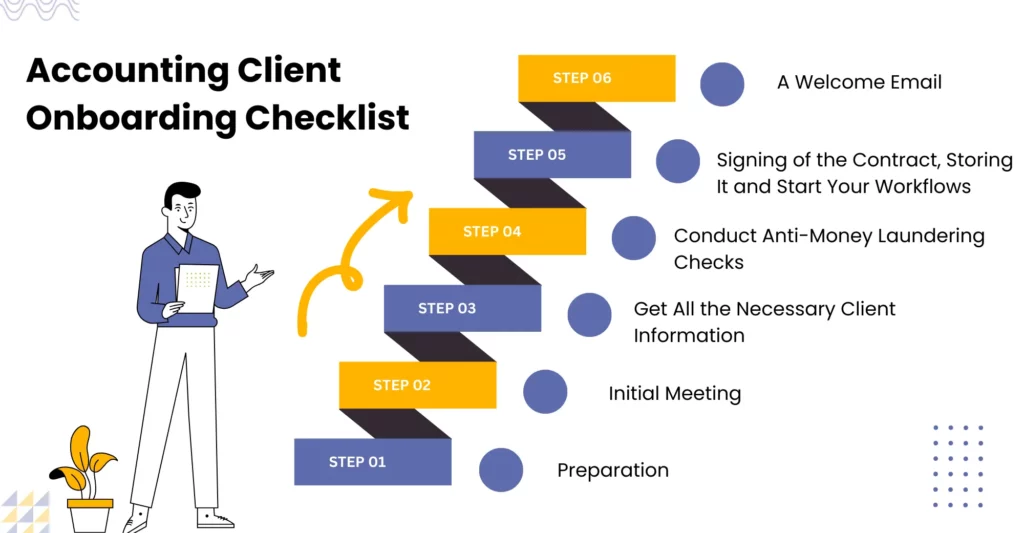
1. Preparation
Being proactive will be the key to your success, especially when multiple competitors are vying for new clients. Hence, it is important for you to grab the opportunities at once when a potential client contact you. Usually, a client will enquire about your services, and you will have to gather all the relevant information about them and their accounting requirements.
2. Initial Meeting
This step gives you a chance to introduce your accounting team to the potential client and showcase your service offerings and expertise. Depending on the potential client’s location and availability, the meeting could be face-to-face or online.
This initial meeting is to discuss your role and set expectations. Both will also decide on the preferred mode of communication for future work and the scope of accounting services you will provide. Ample time must be given for this initial meeting so that everything is covered and the client has enough time to ask questions and clarify their doubts.
3. Get All the Necessary Client Information
If things are moving forward, ask the potential client to send a list of important information for handling their accounts. These details are:
- Personal information, including the client’s name, business name and full contact details
- Access to their accounting software
- Access to online banking, loan accounts, credit cards
- Copies of prior tax returns
- Access to inventory records
4. Conduct Anti-Money Laundering Checks
All accounting firms in the UK must undertake Anti-Money Laundering (AML) checks on new clients before acting for them. This will usually come before a letter of engagement.
5. Signing of the Contract, Storing It and Start Your Workflows
With all the modalities between you and your client sorted, it is time to sign the contract; this contract must be stored on your client management software for future reference.
Once the contract signing is done, focus on the workflows to map job deadlines and assign task priorities. Doing this manually will be difficult, so seek the help of accounting practice management software. With this tool, you can automate tasks, especially recurring ones, and gain maximum visibility of all the job activity in your accounting practice.
6. A Welcome Email
A personal touch will go a long way in building a long-term relationship with your client. For instance, your practice’s branded email welcoming them will do the trick. Your welcome email must be in easy-to-understand language so that your client can understand the following steps, expectations, and the timeline of the project.
7. Additional Financial Information
Even after the onboarding your new client you may require access to your client’s financial information such as:
- Financial statements (specifically, income statements, cash flow statements, and balance sheets)
- Recent account reconciliations
- Prior tax returns
- Invoices
- Payroll information
Following these steps is essential, but we also understand that it can become burdensome to implement it fully. Hence, to reduce your accounting team’s work stress and enhance your client onboarding you must try accounting outsourcing services offered by professional accounting outsourcing service providers.
What AML and identity checks are required before onboarding a UK client?
Before you act for a new client, you must complete customer due diligence under the Money Laundering Regulations 2017, check the client against Companies House records, and — since 18 November 2025 — confirm that directors and PSCs have completed Companies House identity verification. Evidence must be documented and retained, not just performed.
Customer due diligence (CDD) is the process of identifying the client, verifying that identity from an independent source, identifying beneficial owners, and understanding the purpose and intended nature of the business relationship. A PSC — person with significant control — is broadly anyone holding more than 25% of a company’s shares or voting rights, or otherwise exercising significant influence.
The governing guidance is the CCAB’s Anti-Money Laundering Guidance for the Accountancy Sector (AMLGAS), prepared jointly by ICAEW, ACCA, ICAS, Chartered Accountants Ireland and CIPFA and approved by HM Treasury. The current version is based on the law as at 1 July 2026, replacing the June 2023 edition — worth re-reading if your firm’s procedures haven’t been updated since. See ACCA’s anti-money laundering resources.
How can technology speed up client onboarding?
Technology removes the three slowest parts of onboarding: chasing documents, verifying identity, and manually re-keying data into your ledger. Automated collection, digital identity verification, workflow automation and direct software integration together take a typical onboarding from six weeks to under three.
Client onboarding is not just a function for getting new clients. It is also an opportunity to develop long-term relations between your accounting practice and potential clients. However, leveraging automation, AI, and cloud-based solutions can further enhance client onboarding, reducing manual work and improving accuracy and efficiency.
Benefits of Technology in Client Onboarding
Automated Data Collection and Verification
Using AI-driven document verification, you can eliminate extensive paperwork and manual data entry by automating the data collection and verification process. This will reduce errors, speed up onboarding, and ensure full compliance with Anti-Money Laundering (AML) and Know-Your-Customer (KYC) regulations.
Digital Identity Verification
Biometric authentication and e-signatures will streamline the entire onboarding process while maintaining security. Through digital identity verification, you can quickly identify the clients and reduce unnecessary paperwork and in-person meetings.
Automated Workflow and Task Management
You can use workflow automation tools to assign tasks, send automated follow-ups, and track progress. This ensures that no step in the onboarding process is missed and helps improve overall efficiency.
Integration with Accounting Software
Seamless integration with the best accounting software, such as Xero, QuickBooks, or Sage, allows for direct data migration and synchronisation. This reduces duplicate data entry and ensures client financial information is readily available for reporting and analysis.
Which software is best for client onboarding in a UK accounting practice?
There is no single best tool — it depends on whether your bottleneck is proposals, AML, or document chasing. GoProposal and IRIS Elements lead on proposals and engagement letters; FibreCRM and Nomi lead on AML and KYC; TaxDome and Karbon lead on end-to-end practice management; Xero HQ and Hubdoc handle document collection.
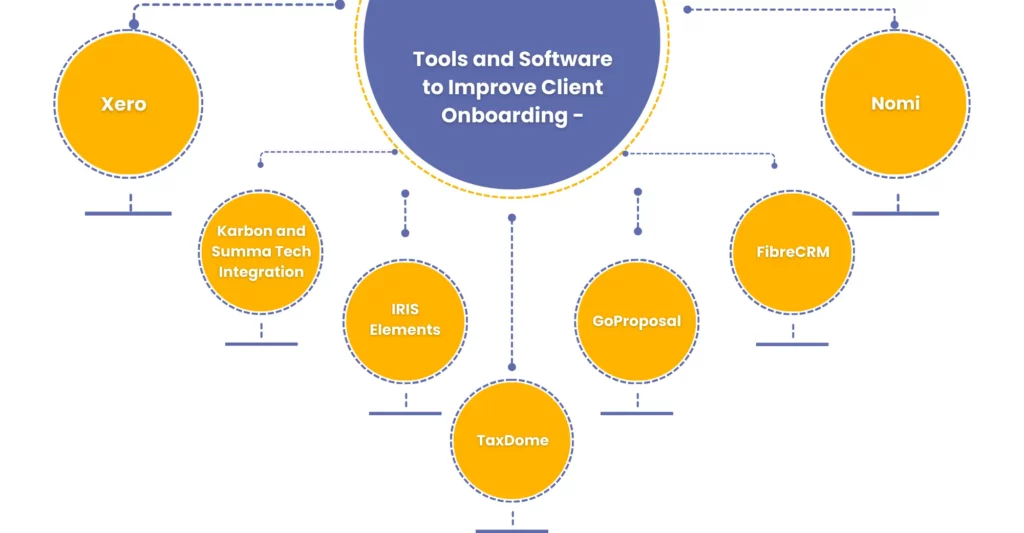
| Tool | Strongest for | Built-in AML/KYC | Best fit |
| TaxDome | End-to-end practice management, client portal | Via integration | Firms wanting one system for everything |
| Karbon (+ Summa Tech) | Workflow and team collaboration | Via integration | Multi-office or larger teams |
| IRIS Elements | Proposals, AML, practice management | Yes | UK firms already in the IRIS ecosystem |
| GoProposal | Pricing, proposals, engagement letters | Yes | Firms whose bottleneck is quoting and scoping |
| FibreCRM | KYC, risk due diligence, professional clearance | Yes — SmartSearch, CreditSafe, ID3 | Compliance-heavy practices |
| Nomi | CRM, automatic KYC, reminders | Yes | Smaller practices and bookkeepers |
| Xero HQ + Hubdoc | Requesting and collecting client documents | No | Firms already standardised on Xero |
When used, specialised tools will enhance the client onboarding process for UK accounting practices. We are mentioning some of them that will streamline various aspects of client onboarding:
Xero
Xero HQ Ask: An ideal platform for requesting and securely getting client information and documents, ensuring efficient communication and data collection.
- Hubdoc: A tool to save time that goes into your clients’ document collection.
- Xero Practice Manager: Ensure secure storage and management of client information, thus ensuring a seamless onboarding experience.
Karbon and Summa Tech Integration
Integrating Karbon and Summa Tech will enhance your onboarding process by combining practice management capabilities with efficient client data collection and verification tools.
IRIS Elements
IRIS Elements offers a comprehensive client onboarding solution tailored for accountants:
- Proposal Manager: Create and deliver bespoke proposals that clients can accept with a single click.
- AML Compliance: Run essential Anti-Money Laundering checks and maintain critical compliance.
- Practice Management: Organise your practice, automate administrative tasks, and seamlessly integrate clients into your workflow.
TaxDome
TaxDome is an all-in-one practice management software that aids in client onboarding through:
- Secure document management
- Custom-built forms and surveys
- Client portal with secure messaging
- Unlimited e-signatures
- Synced email to keep communications in one place
GoProposal
GoProposal assists accounting firms in improving client onboarding by:
- Creating professional proposals and managing engagements
- Establishing transparent, consistent pricing
- Delivering compliance-driven engagement letters
- Offering AML features for speedy identity verification and performing KYC checks
FibreCRM
Developed specifically for accountants, FibreCRM’s onboarding solution covers key steps in onboarding a new customer and managing risk, including:
- Companies House integration
- Client data capture
- KYC & risk due diligence
- AML checks via SmartSearch, CreditSafe, or ID3 Global
- Professional clearance
- Engagement letters with e-signing
- Integration with practice management systems
Nomi
Nomi provides CRM software tailored for accountants and bookkeepers, featuring:
- Robust task management
- Automatic KYC checks
- Digital onboarding processes
- Client communication management
- Automated reminders
By using these tools in your onboarding operations, you can enhance the efficiency of your practices, ensure compliance, and provide a seamless onboarding experience for new clients.
How does Corient handle client onboarding for UK accounting firms?
Corient has supported UK accountancy practices since 2011 from its base at The Techno Centre, Puma Way, Coventry CV1 2TT. We run the same eight-stage checklist described above on behalf of practices — handling information gathering, document chasing, software setup and workflow configuration so the partner only handles the client relationship.
In practice, that means our team takes the administrative load: collecting identity documents, requesting software and bank access, setting up the client record in your practice management system, and configuring recurring deadlines. Your firm keeps the AML sign-off and the client conversation, which is where it should sit.
Practices typically start with one function and expand. The common entry points are bookkeeping outsourcing and payroll outsourcing, then year-end accounts, corporation tax and audit support. Our AI Crew tools — Billy for invoice processing, Corby X for reconciliation, Luca for year-end and Sherlock for error detection — sit alongside the team rather than replacing it.
People Also Ask
1. What onboarding process does Corient use for new accountancy firms?
Corient Business Solutions has an established onboarding checklist for new accountancy firms. The checklist is as follows:
a. Initial Meeting – Where you introduce your accounting team to the potential client and showcase your service offerings and expertise.
b. Get All the Necessary Client Information
c. Conduct Anti-Money Laundering Checks
d. A Welcome Email
e. Signing of the Contract, Storing It and Starting Your Workflows
What is a client onboarding checklist for accounting firms?
A client onboarding checklist for accounting firms is a documented, repeatable list of steps completed before work begins. It typically covers client acceptance, anti-money laundering and identity checks, the engagement letter, document and software access, banking permissions, workflow setup and a welcome communication. The checklist exists so nothing is missed and every client receives the same standard of service.
How long does client onboarding take for an accounting practice?
Most well-organised UK practices complete onboarding in 15 to 30 working days. The two stages that cannot be rushed are professional clearance from the outgoing accountant, which commonly takes 5 to 15 days, and HMRC agent authorisation. Firms working without a written checklist frequently take 45 to 60 days because these steps are started sequentially rather than in parallel.
What documents should an accounting firm request from a new client?
Request photo ID and proof of address for each director and PSC, the company registration number and registered office, adviser-level access to Xero, QuickBooks or Sage, bank feed or read-only banking access, prior year tax returns and computations, recent reconciliations, open invoices, payroll data and inventory records. Send the full list at once rather than in stages.
Conclusion
By following the above-mentioned client onboarding checklist, you will be in a position to smoothen the onboarding experience of your new clients without compromising on compliance and laying a foundation for a long-lasting relationship.
It is also important to mention that the checklist can be reviewed and refined according to the evolving requirements of your clients and the accounting industry. With Companies House identity verification bedding in through 2026 and Making Tax Digital thresholds falling each April, a checklist reviewed annually is no longer sufficient — review it whenever a compliance deadline moves. However, it is understood that implementing the checklist and periodic review is a time-consuming process. To ease this pressure, we suggest you explore the option of outsourcing to a service provider.
While the UK is home to several reputed accounting outsourcing providers, Corient has been a rising star, especially among accounting practices. Since 2011, we have been helping practices streamline their accounting functions in every possible way. Along with client onboarding services, we also offer services ranging from bookkeeping, payroll, year end, corporation tax, and audit services. Please write down your requirements or doubts on our website contact form, and our executives will contact you as soon as possible.
Looking forward to a fruitful partnership.