
Outsourced accountants of reputed outsourcing providers are well-trained in Xero, QuickBooks, and Sage. Many outsourced accounting teams train their accountants across multiple platforms and can manage bookkeeping, reconciliations, reporting, payroll support, and compliance tasks within the software your practice already uses. This allows you to scale services without changing systems or increasing internal workload.
When you have the opportunity to expand or get in new clients, you will happily accept it. More clients mean more revenue, stronger relationships, and opportunities to expand services. But behind every new client comes a practical challenge: managing their financial data efficiently.
We are sure you might have faced a situation where different clients prefer different accounting software. As your client base expands, such demand will become difficult to manage in-house, and you will have to look for additional support.
Modern outsourced accountants regularly work across leading accounting platforms, including Xero, QuickBooks, and Sage. For UK accounting practices, this means they can access additional expertise while keeping the systems their clients already trust.
As UK accounting compliance requirements increase and your clients will expect faster financial insights, in such situations, having access to outsourced accountants who will work like an extended team and understand these platforms is an important advantage.
For practices looking to grow without constantly increasing internal headcount, outsourced accounting support from providers like Corient can help create additional capacity while maintaining quality and control.
Can Outsourced Accountants Work in Xero, QuickBooks and Sage?
Yes, they are trained to do that and these platforms are designed for cloud-based collaboration and controlled access.
Professional outsourced accounting teams commonly assist practices on:
- Bank reconciliations
- Transaction categorisation
- Accounts payable and receivable
- VAT preparation
- Management reporting
- Month-end close support
- Bookkeeping reviews
- Financial data clean-up
Most modern accounting software platforms allow firms to provide external accountants with secure user access rather than sharing passwords or transferring files manually.
This makes collaboration easier while maintaining data security. This is particularly useful when your clients often use different platforms depending on their business size, industry, and existing processes.
How Do Outsourced Accountants Work with Xero?
Xero is trusted by outsourcing providers for its ability to manage multiple accounting tasks such as bookkeeping, reconciliations, reporting, and financial reviews.
The software supports:
- Bank feeds
- Automated invoice processing
- VAT reporting
- Payroll integrations
- Financial reporting
- Third-party business applications
Your outsourcing partner can help maintain accurate Xero files by:
- Reviewing bank transactions
- Matching payments and receipts
- Reconciling accounts
- Correcting coding errors
- Preparing reports for review
Xero also helps in collaboration through user permissions, allowing practices to control what external team members can access. That’s why outsourcing providers prefer it because it allows practices to maintain oversight while professionals from providers will handle day-to-day accounting tasks.
Corient supports accounting practices by working alongside existing workflows and helping firms manage increasing workloads without forcing clients to move away from platforms they already use.
How Do Outsourced Accountants Work with QuickBooks Online?
QuickBooks Online is widely regarded for its simple interface and integration options, which is why it’s preferred by outsourcing providers.
Common outsourced accounting activities in QuickBooks include:
- Recording income and expenses
- Bank reconciliation
- Invoice management
- Supplier payments
- Financial reporting
- Month-end preparation
For firms managing multiple clients, having accountants experienced in QuickBooks reduces the time needed for training and review.
How Do Outsourced Accountants Work with Sage?
Sage remains highly popular among accounting practices and businesses, particularly those requiring more traditional accounting workflows.
Using Sage, outsourced accountants can assist with:
- Ledger maintenance
- Bank reconciliation
- VAT preparation
- Supplier and customer accounts
- Reporting
- Data reviews
An outsourced accounting partner that understands Sage can support these clients without requiring unnecessary software changes.
What Accounting Software Can Outsourced Accountants Support?
Most experienced outsourced accounting teams support multiple platforms.
The table below shows how common platforms compare:
| Software | Common UK Users | Typical Outsourced Support Tasks |
| Xero | SMEs, startups, professional services firms | Bookkeeping, VAT, reconciliation, reporting |
| QuickBooks Online | Small businesses and growing companies | Transaction processing, invoicing, reporting |
| Sage Accounting | SMEs and established businesses | Bookkeeping, reporting, compliance support |
| Sage 50 | Established businesses with desktop workflows | Accounts maintenance, reconciliations |
| FreeAgent | Contractors and smaller businesses | Bookkeeping and tax preparation support |
Choosing an outsourcing partner with multi-platform expertise gives accounting practices greater flexibility when accepting new clients.
Why Are UK Accounting Practices Outsourcing Accounting Software Expertise?
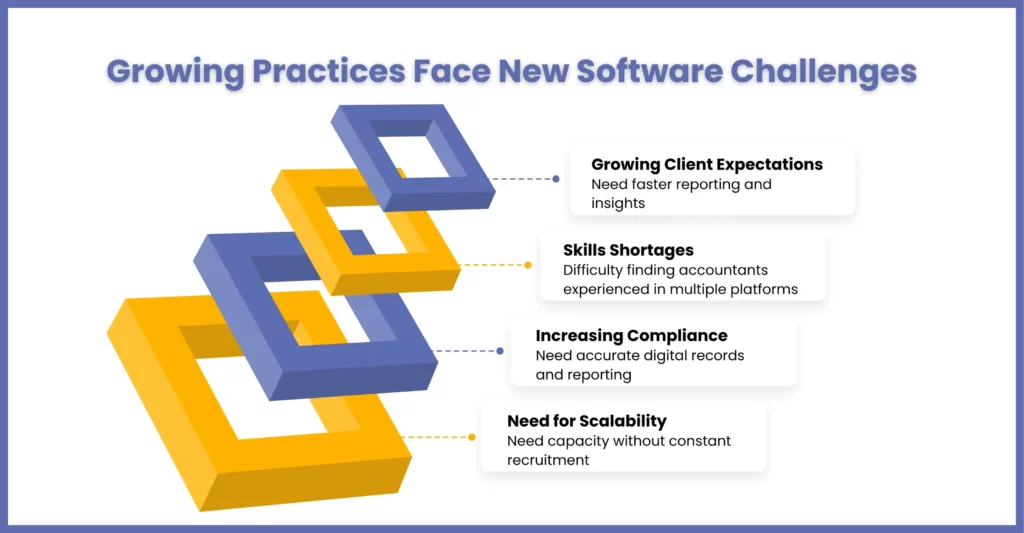
Operating the latest version of accounting software like Xero, Sage, or QuickBooks requires expertise, which many practices lack or are in the process of developing. That’s why many are partnering with an outsourcing provider.
There are several factors that are driving this trend:
Growing Client Expectations
UK business environment is becoming increasingly competitive; to stay relevant, your clients are demanding quick financial insights, advice, and reporting, apart from the usual accounting work. It helps them make better and more informed decisions.
Skills Shortages
UK accounting sector is facing critical shortages in accounting skills. According to AAT’s Filling the Gap report, four in five of all employer’s report skill shortages, which are leading to a drop in productivity and quality. Finding experienced professionals who possess the knowledge of multiple accounting platforms is not so easy.
Increasing Compliance Requirements
Compliance in the UK accounting market is increasingly becoming complex. HMRC’s Making Tax Digital initiative will progressively expand in every accounting aspect, making digital reporting and digital record-keeping compulsory. This has created additional demand for outsourced accountants who have the understanding and experience of handling such compliance.
Need for Scalability
Outsourcing allows practices to increase capacity during busy periods without committing immediately to permanent recruitment.
What Are the Benefits of Using Outsourced Accountants Across Different Platforms?
Those outsourcing providers that have considerable experience in operating Xero, QuickBooks, and Sage will provide considerable benefits. These benefits are:
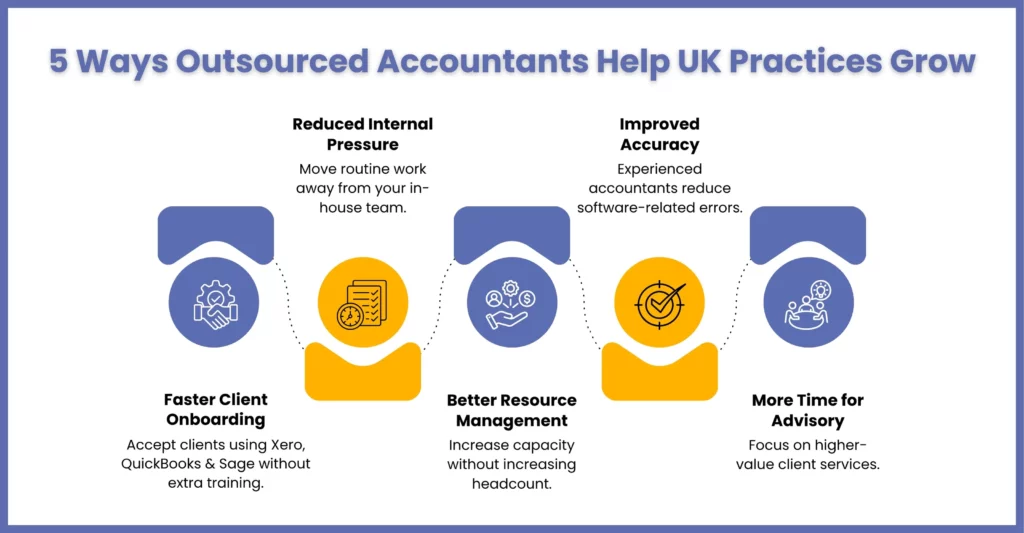
Faster Client Onboarding
When your outsourcing partner’s accountants are trained and experienced in different software platforms, then you will be in a better position to accept clients without worrying about training them.
Reduced Internal Pressure
You can shift all routine accounting work to your outsourcing partner, allowing your in-house team to focus on high-value advisory services for your clients.
Better Resource Management
With the outsourcing partner by your side, you have the option of scaling up your services to take on additional load rather than needing to hire additional employees, thus saving your time, efforts, and resources.
Improved Accuracy
Well-known outsourcing providers employ experienced accountants who are trained in operating accounting software platforms, which means they are aware of how it works, how it processes, and can identify common errors easily.
More Time for Advisory Services
When bookkeeping and reconciliation workloads are managed effectively, your in-house accountants have more time to provide strategic value.
How Should Accounting Practices Choose an Outsourced Accounting Partner?
Choosing the right outsourced accounting partner requires looking beyond software knowledge.
While choosing an outsourcing partner, you should evaluate:
| Area to Check | Why It Matters |
| Software experience | Ensures they can work with existing client systems |
| Security standards | Protects sensitive financial information |
| Accounting qualifications | Ensures quality and accuracy |
| Communication process | Maintains smooth collaboration |
| Quality controls | Reduces errors and improves reliability |
| Scalability | Supports future practice growth |
A strong outsourcing partner should work as an extension of your practice rather than simply completing tasks.
How Does Corient Support Accounting Practices Using Xero, QuickBooks and Sage?
Corient is well-renowned for helping accounting practices increase their capacity by providing experienced accounting support who use a wide range of accounting platforms. Rather than asking practices to change their systems, Corient works with existing processes and software environments.
Support can include:
- Bookkeeping assistance
- Account preparation support
- Reconciliations
- Management accounts
- VAT support
- Finance operations assistance
This allows you to manage more clients while maintaining service quality.
For your accounting firms, outsourcing can provide access to experienced accounting professionals without the challenges of recruiting, training, and retaining additional internal staff.
Frequently Asked Questions About Outsourced Accountants and Accounting Software
What is outsourcing in accounting?
Outsourcing in accounting means hiring an external firm or professional to manage a company’s financial tasks, such as bookkeeping, payroll, and tax preparation. Instead of building a full in-house finance team, businesses use third-party experts to handle routine records and reporting.
Outsourcing has evolved further than a cost cutting measures and has become into a method through which practices are able to offload routine accounting work so that they can focus on high-value advisory work and client communication, thus increasing their service value.
What are types of accounting software?
Accounting software is split into several main types based on function and deployment, including commercial/small-business systems, cloud-based platforms, and enterprise resource planning (ERP) suites. Each of these types have their importance but when it comes to accounting practices they would prefer cloud-based platforms in order to maintain transparency and communication with their clients and outsourcing provider.
What accounting functions can be outsourced?
Outsourced accounting occurs when a business hires an external, third-party company to handle its finance and accounting functions. These functions can include managing payroll, accounts payable, accounts receivable, monthly bank reconciliations, tax prep support, legal compliance and financial reporting, among others.
Is AI replacing bookkeepers?
No, AI is not replacing bookkeepers, but it is replacing repetitive tasks like data entry, basic transaction coding, and bank feed matching. Rather than eliminating the entire profession, artificial intelligence is shifting the role from manual data processing toward higher-value advisory and quality control work. This has helped practices in saving the costs on recruitments, training, and associated infrastructure.
What accounting software does HMRC recommend?
HMRC does not recommend any specific brand, product, or software provider. Instead, they maintain an official list of recognised and compatible software that works with Making Tax Digital (MTD). You can search and filter approved options using the official GOV.UK software finder tool. Some of the popular software’s you can explore are Xero, QuickBooks, and Sage.
Conclusion
Accounting software platforms have completely changed the way UK practices conduct their business, but managing multiple platforms and meeting client demands singlehandedly in-house is not possible.
Fortunately, this problem can be resolved by partnering with a reputed provider who experience working with multiple accounting platforms like Xero, QuickBooks, and Sage. This allows you to increase your capacity without much internal changes in your system on which your client relies.
Outsourcing is no longer a method to reduce your workload or save costs. It is more about creating the flexibility to deliver better service and supporting more of your clients, so that you can focus on higher-value advisory work.
Corient helps UK accounting practices strengthen their operations with experienced outsourced accounting professionals who understand modern accounting platforms and workflows.
If your practice is spending too much time managing processes instead of growing relationships, it may be time to explore a smarter approach.
Contact us today to discover how outsourced accounting support can help your practice scale efficiently while maintaining accuracy, quality, and client satisfaction.