
Emma runs an accounting practice in Birmingham. She faced a situation where her client suddenly informed her that its payroll submission had been rejected. The reason was an RTI error; her junior accountant missed a lever update, and Full Payment Submission (FPS) had already been done. The client was in panic, and Emma was exhausted.
Sounds familiar!
According to HMRC, multiple Real Time Information (RTI) submissions become late or delayed, triggering automatic penalties each year, starting from £100 per month. Meanwhile, the Chartered Institute of Payroll Professionals (CIPP) consistently reports rising payroll complexity due to legislative changes, pension auto-enrolment requirements, and student loan updates.
In such situations, your accounting practice can no longer treat payroll as routine work. It had become a time-consuming and complex function. Yes, many of your counterparts have found that payroll outsourcing is a way to deal with these challenges, but the real question that you will have to face is:
- What to consider when outsourcing payroll?
- Is it the right move for your firm in 2026?
Let’s break payroll outsourcing down properly to understand the risks and benefits better.
What to Consider When Outsourcing Payroll
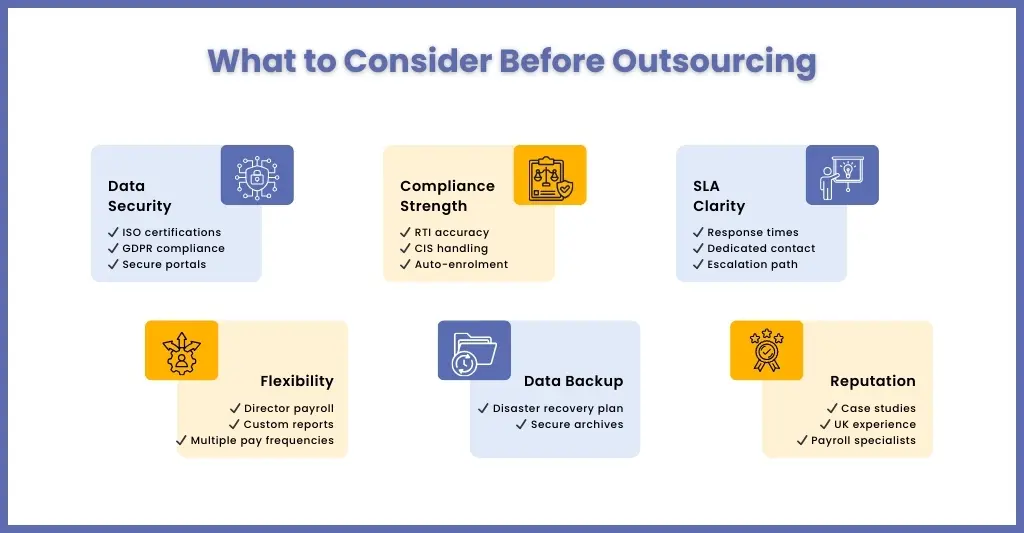
Under payroll outsourcing, the third-party payroll outsourcing provider selected by you will handle all aspects of your client’s payroll on your behalf, which includes employee salaries, taxes, and benefits.
To enjoy the full benefits of outsourcing payroll, you will need to find the right payroll outsourcing provider that meets your requirements. For that, you need to consider certain things while searching for an outsourcing partner.
Here’s what to consider when outsourcing payroll in 2026.
Ensuring They Offer Complete Data Security
Your client’s payroll data is ultra-sensitive, and before even sharing it with an outsourcing provider, you need to know their data security measures. It is ideal to choose a service provider with a reputation for data security.
Such providers have invested considerably in ISO certifications, secure portals, GDPR-compliant processes, and access controls and audit logs to offer robust security measures against data breaches and cyber theft.
Keeping Your Payroll Compliant
Maintaining payroll compliance has become a complicated affair; therefore, it’s important to choose a provider that is up to date with UK-relevant laws and regulations. This includes UK tax laws, national minimum wage and national living wage rates, and other legal requirements. Failure to comply with these laws will lead to costly fines and legal consequences.
Take an Interest in Reviewing the Customer Service and Service Level Agreements
A service level agreement (SLA) shows the terms of the services provided by a service provider, including the level of service, response times, and guarantees. Therefore, it is important to review the SLA to ensure it meets your expectations and requirements. Be sure about the appointment of a dedicated accountant who will answer your queries during the onboarding process.
Reputation
When you are looking for a payroll outsourcing partner, give preference to a reputable provider with a verifiable record of success. Check for their customer reviews and case studies for detailed analysis.
Ability to Be Flexible
You will have certain unique payroll accounting requirements, and it’s important to choose a payroll outsourcing provider that meets these requirements. These special requirements include the ability to customise payroll reports, payment schedules, and other aspects of the payroll process.
Having Data Backup
Payroll data loss can happen anytime, especially during a fire accident or natural disaster, which will hamper the smooth functioning of your practice. To pre-empt this, you need to choose a payroll provider that will offer a robust data backup and recovery plan, which will keep your data safe and accessible.
Risks to Watch Out for When Outsourcing Payroll (and How to Mitigate Them)
Outsourcing payroll has multiple benefits, big and small, but it also has its share of risks. These risks will harm you if adequate attention is not paid to remedy them. These risks are as follows:
Privacy and Data Security
When you are partnering with your payroll partner, you will need to share your client employee’s sensitive information, which includes their social security number, bank details, and personal data. Such sharing increases the chances of data breaches, theft, loss, or unauthorised access.
Solution:
The only way to overcome is by selecting a provider that offers robust data security measures and compliance with UK GDPR and ISO certifications.
Compliance Issues
Maintaining adherence with your payroll requirements is essential because it involves compliance with UK payroll regulations, tax laws, and employment regulations. If your payroll outsourcing partner is not up-to-date with the latest legal updates, then it leads to non-compliance, penalties, and legal hassles for your clients.
Solution:
Select an outsourcing provider that will keep itself updated with the latest developments in the UK payroll world.
Dependence On The Provider
Outsourcing payroll work can make your practice completely dependent on your payroll partner. Such dependency can expose your practice to operational risks such as payroll errors and delays, which can impact your payroll operations.
Solution:
Outsource recurring and time-consuming payroll tasks and keep a close watch on them. Avoid outsourcing complex payroll tasks that require human judgment.
Loss of Control
Handing over payroll responsibility to a third-party payroll provider can result in loss of control over critical payroll functions. Such a loss makes monitoring payroll work and your partner’s performance difficult. Even making alterations in payroll processes becomes slow and difficult.
Solution:
Structured workflows and regular performance reporting will address the risk of a lack of control.
Hidden Costs
Yes, outsourcing payroll is known for its cost-saving potential, but it also leads to unexpected expenses. These expenses include setup fees, charges for additional reports or rush services, and expenses related to correcting payroll errors.
Solution:
Demand transparency with regard to price during the onboarding process. Make it clear that any hidden costs would not be tolerated.
Benefits of Outsourcing Payroll for Accounting Firms
Payroll outsourcing is popular among accounting practices due to its benefits. These benefits are:
Getting Access to Payroll Experts
Through a reputed payroll outsourcing service offered by a provider, you will get access to dedicated payroll specialists who are well-aware of UK accounting standards and intricacies. As a result, you will have a few payroll errors in:
- Pay and deductions
- Payroll tax filings
- Benefits
- Paid time off and any additional benefits
Cuts Down Cost and Time Spent
Outsourcing payroll completely has enabled multiple practices to enjoy a considerable reduction in costs, both in terms of time-saving and overhead. By outsourcing tedious payroll responsibilities, your accountants can also dedicate more time to strategic objectives, such as customer care and advisory services.
Data Security
All reputable payroll outsourcing service providers offer their payroll outsourcing services with advanced systems and encryption software to secure sensitive payroll data. These data contain sensitive information related to your clients’ employees, such as employee id, name, salary details, and so on, and encryption keeps them safe from cyber theft and breaches. Outsourcing also mitigates the risk of internal data theft.
Scalability During Peak Periods
Your payroll outsourcing partner has the capacity to handle additional year-end, CIS surge, or new client batch without adding any pressure on your payroll team.
Who Should Outsource Payroll?
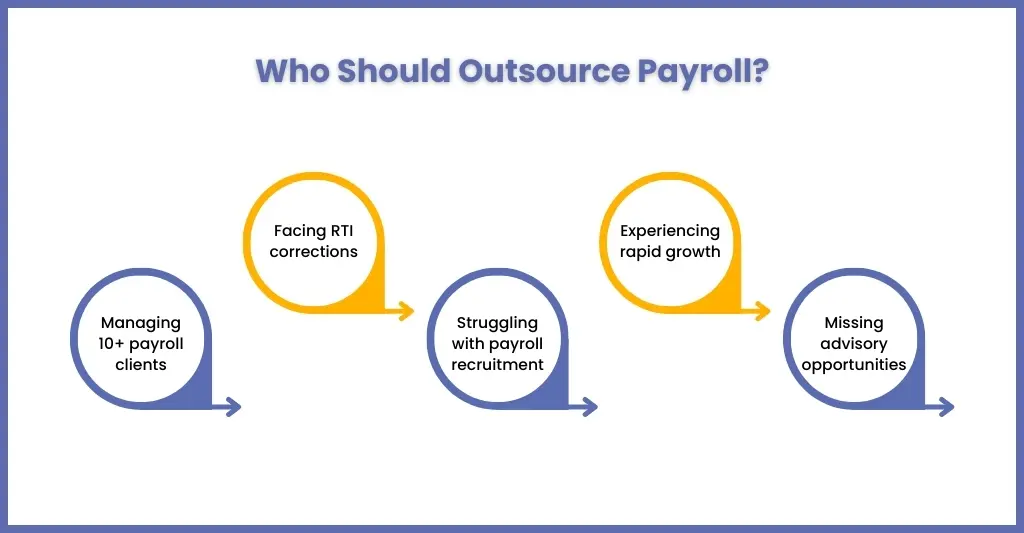
Not all accounting practices will find outsourcing payroll beneficial. Therefore, only those practices must look at outsourcing their payroll if:
- They are managing 10+ payroll clients
- Struggling with payroll recruitment
- Wanting to focus and expand on advisory work
- Experiencing rapid client growth for your payroll services
- Facing repeated RTI corrections
Consider outsourcing payroll if it’s becoming too time-consuming.
How to Choose the Right Payroll Outsourcing Partner
It’s important to note that not all payroll outsourcing service providers offer the best and most appropriate services. Therefore, it is important to select the right one that meets your requirements and satisfies your clients.
Ask the following questions:
- Do you specialise in UK payroll compliance?
- How do you handle HMRC queries?
- What’s your error correction policy?
- Does your payroll software include advanced security features?
- Can you scale with my practice?
- Do you offer support during implementation?
- Is your selected payroll software cloud-based?
When you select the right partner, it will work like an extended team. At Corient, we operate structured payroll workflows aligned with HMRC and The Pension Regulator (TPR) standards, ensuring compliance without overwhelming your internal team.
Cost of Outsourcing Payroll in the UK
The cost of outsourcing payroll depends on multiple factors. Some of the major ones are:
- Number of employees
- Payroll complexity, especially in CIS, director payroll, and pensions
- Frequency of payroll runs
- Additional reporting needs
While most payroll outsourcing providers charge based on per payslip, per employer or monthly retainer models, fixing on how much it will cost is difficult. The cost of outsourcing varies from provider to provider, but it will surely be less than in-house payroll (approximately 20 to 40 %). Why? Because of the following factors:
- Salary
- Employer NIC
- Pension contributions
- Training
- Sick leave coverage
- Recruitment fees
Common Mistakes Practices Make When Outsourcing Payroll
Compared to in-house payroll, payroll outsourcing reduces a considerable burden on your payroll team. However, that does not mean that your responsibility toward payroll is over. Payroll outsourcing works best as a collaborative effort with the outsourcing partner, and not doing it will lead to mistakes. Here are some common ones that must be avoided.
Lack of Alignment of Expectations from the Start
The non-alignment of expectations between the practice and the payroll provider is one of the common mistakes made when outsourcing payroll.
Before even outsourcing the responsibility of payroll, get answers to these questions:
- What is included in the agreement?
- Who does what?
- When are the deadlines?
- What advice is part of the collaboration?
Without clear expectations, frustration quickly builds – even if payroll is technically being run correctly.
Unclear Responsibilities
Many practices still assume that outsourcing payroll means handing over the responsibility of payroll. But that’s not the case.
- Practice still has overall responsibility towards payroll
- Only the provider will have operational responsibility under the agreement
Such neglect towards responsibilities will lead to gaps.
Poor or Incomplete Data Handover
Expect payroll to be accurate only when accurate data is provided. It is one of the common mistakes made during the handover.
Some common mistakes made during the handover to a provider are:
- Incomplete employee information
- Errors in holidays taken
The fewer the problems during operation, the more accurate it is.
Lack of Dialogue Between Practice and Provider
Some practices think of payroll outsourcing as a tool to completely take on their responsibility and forget about it, which should be avoided.
As a practice owner, you know that salaries keep changing along with:
- Salary adjustment
- Changes in working hours
- Hiring new employees
Without dialogue, your outsourcing partner will never know about these changes, which increases the risk of errors and misunderstandings.
Only Focus on Price
Price is one criterion, but not the only one, to select your payroll outsourcing partner. Low price also means an outsourcing provider offering lower quality payroll outsourcing services. Using such services will lower the value of your payroll services.
Lack of SLA and Follow-Up
A service level agreement (SLA) will set the terms between you and your payroll outsourcing partner. It contains response time, quality needed, escalation procedures, and follow-up measures. Without it, it would be difficult to know whether the collaboration is working well.
Less Internal Involvement
Even after outsourcing, your input and monitoring are required to review the payroll work done, identifying delays and errors, and making sure issues of your client’s employees are resolved quickly.
People Also Ask
What are the risks of outsourcing payroll?
Outsourcing payroll has its share of risks like data security, compliance issues, over dependency on the provider, loss of control and hidden costs. However, these can be mitigated with clear SLAs, secure systems, and UK-trained specialists.
How long does it take to transition to outsourced payroll?
That’s depends on the volume of payroll work that you transfer to your outsourcing partner and its complexities.
Can outsourced payroll handle HMRC compliance?
It can handle HMRC compliance on your behalf provided the provider is experienced in RTI submissions, CIS, statutory payments, and pension regulations under HMRC and The Pensions Regulator.
Is it cheaper to outsource payroll?
Compared to in-house payroll, yes it is cheaper because you do not need to recruit and pay payroll experts and get access to payroll software without even buying it.
Conclusion – Making the Right Decision When Outsourcing Payroll
Wondering what Emma decided to do, she did not abandon offering payroll services; she only stopped processing it in-house. She partnered with a payroll outsourcing team, which reduced her stress, protected compliance, and freed up time for advisory work, where real growth happens.
2026 is the year when payroll will become even more complex; hence, the real question you must ask yourself is: Will your practice be able to carry the weight alone, or build smarter capacity?
That’s where Corient comes in; we support UK accounting practices with reliable payroll processing, strong compliance controls, and scalable systems designed specifically for firms like yours.
Worried about getting left behind in payroll? Contact us via our website, and we will ensure that you’re never outdated.