
Payroll automation means using software to handle payroll tasks — calculations, tax deductions, RTI submissions and payslips — without manual input. UK accounting practices can roll it out without disrupting their team by starting gradually: automating one process or client group first, training staff early, and monitoring results before scaling further.
Managing payroll is not a piece of cake, even for the most experienced accounting practice. But there is good news: payroll automation is here to save the day by reducing your time consumption, error reduction, and compliance improvement, without stressing your in-house payroll team.
Frankly, payroll automation is well-known among practices, but they fail in their implementation. For successful implementation, you will have to adopt a gradual approach.
One accounting practice was spending countless hours chasing timesheets, adding employee data, verifying pension contributions, and correcting payroll mistakes. To avoid this, she chose payroll automation but was worried that its implementation would disrupt its services.
To overcome this fear, a gradual implementation was done and, in a few months, all repetitive tasks were automated, and payroll accuracy improved. The practice had more time to focus on client relationships and advisory work.
Are you facing the same dilemma? Then it’s time to choose payroll automation and automate the creation and distribution of payslips, P45S, P60S, P11Ds, and rewards statements. Let’s see what it involves and its key benefits.
Key Takeaways
- Payroll automation reduces manual data entry, cuts errors, and frees staff time for advisory work.
- 9 in 10 UK payroll teams experienced errors in the past year, and 48% of those errors stem from manual processing (Finity UK Payroll Efficiency Report, 2026).
- 30.3 million people were on UK payrolls as of February 2026, according to ONS/HMRC PAYE Real Time Information data — a reminder of the scale payroll errors can affect.
- Cloud-based payroll software remains the most-used option, chosen by 41% of respondents in Moorepay’s Annual Payroll Survey Report 2025–26.
- A phased six-step rollout — audit, involve the team, clean data, choose software, start small, monitor — avoids disrupting live payroll.
- Corient supports UK accounting practices with hands-on payroll automation implementation and ongoing managed payroll services.
What is Payroll Automation?
Payroll automation is the use of software to carry out payroll tasks — such as calculations, tax deductions and payslip generation — automatically, without manual input at each step.
Payroll automation is the use of software tools to automate payroll processes which otherwise require manual intervention. Automated payroll systems can simplify various tasks, including payroll reporting, tax calculations, and salary payments.
Payroll automation can help with:
- Employee data management
- Payroll calculations
- Tax deductions
- Pension contributions
- Payslip generation
- HMRC reporting
- Payroll approvals
- Compliance monitoring
The importance of payroll automation can be gauged by a 2024 Employment Hero study, which found that 31% of payroll providers are automating 31-60% of their payroll services, and this figure has definitely increased.
Payroll automation is not here to put your accountants out of a job, but to help them become more efficient.
Why Payroll Automation Is Essential for Modern Businesses
Payroll automation is essential because UK payroll has grown too complex for manual processing to keep pace — RTI submissions, auto-enrolment pensions, National Minimum Wage checks and frequent legislative updates all carry error risk when handled by hand.
UK payroll is becoming more complex with every passing year but that does not give you relief in managing:
- Real-Time Information (RTI) submissions
- Auto-enrolment pensions
- National Minimum Wage compliance
- Statutory payments
- Frequent legislative updates
Real Time Information (RTI) is HMRC’s system requiring employers to report PAYE details — pay, tax and deductions — every time they pay employees, rather than once a year. You can see HMRC’s own guidance on reporting payroll information in real time for the current rules.
On the other hand, your clients are depending on your services for greater accuracy. The challenge is that many payroll teams still rely heavily on manual processes.
According to the UK Payroll Efficiency Report 2026 by Finity, 9 in 10 payroll teams experienced payroll errors in the past year, while 77% of payroll professionals lose up to 11 hours every week due to inefficient systems and processes. The report also found that 48% of payroll errors are caused by manual processing. That’s a lot of time and money being lost.
Through payroll automation, you can reduce duplication, minimise errors, improve payroll compliance, and save time so that your payroll team can focus on advisory work. When you are handling multiple clients, automation becomes more valuable.
If building this in-house isn’t the right fit for your practice, Corient’s payroll outsourcing service can run automated payroll on your behalf, under your own brand.
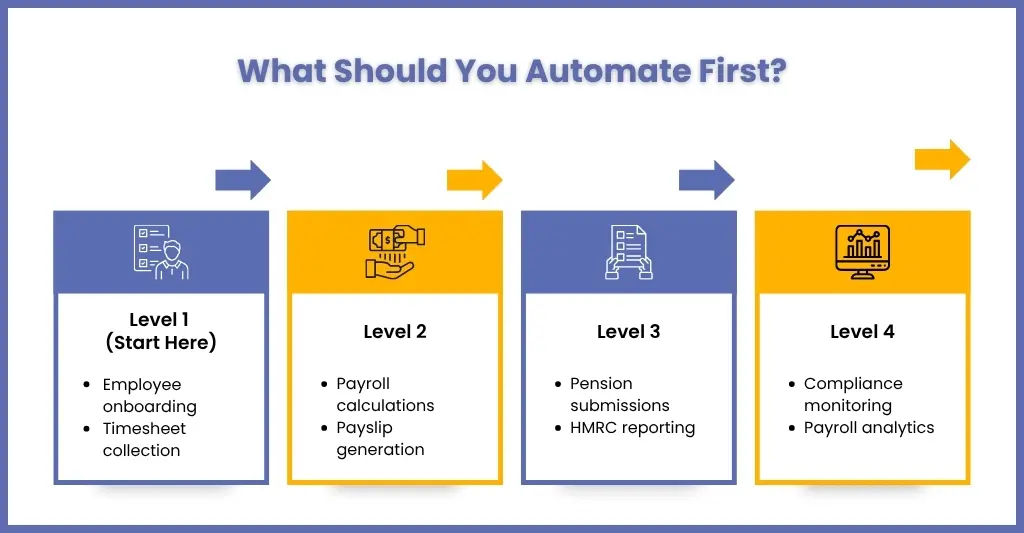
Steps to Implement Payroll Automation Without Disrupting Your Team
You can implement payroll automation without disrupting your team by rolling it out in six phased steps: auditing current processes, involving staff early, preparing clean data, selecting suitable software, starting with a small pilot, then monitoring and optimising.
By now, you must be eager to automate your entire payroll process, but we would advise a gradual implementation to avoid disruptions. So, how do I go about it? We have prepared some steps for the smooth implementation without disrupting payroll.
Step 1: Take a Look at Your Current Payroll Processes
Before automating your payroll process, analyse your current one to understand its strength and weaknesses.
Ask questions such as:
- Which payroll tasks consume the most time?
- Where do most errors occur?
- Which activities are repetitive?
- Which tasks require manual data entry?
Identifying bottlenecks helps determine where automation will deliver the greatest impact.
Step 2: Involve Your Team Early
It might surprise you but the biggest resistance to payroll automation will come from your team due to fear of job cuts. In reality, payroll automation is specially designed to take over repetitive payroll tasks, not replace payroll professionals.
Explain to your team that automation will:
- Reduce manual work
- Minimise errors
- Improve efficiency
- Allow them to focus on higher-value activities
When your employees understand the benefits, adoption becomes much easier.
Step 3: Prepare the Payroll Data
To maximise the benefits of payroll automation, make sure you keep the payroll data of your clients in proper order. Once the data is clean, it will be transferred to the automation tool or payroll software. Poor data quality will lead to incorrect results, like pay inaccuracies or compliance issues.
Step 4: Find the Payroll Software That Works for You
There are multiple payroll software’s available in the UK market that offers to automate payroll, so of them the best payroll software and some are ones that can fulfil your needs. Always select software that meets your priorities.
Step 5: Start it Small
Instead of automating the entire payroll process, begin automating areas that require automation the most.
Examples include:
- Employee onboarding
- Digital timesheet collection
- Payslip generation
- Pension submissions
Or select a bunch of clients for automation.
Never implement payroll automation across all clients immediately.
When they get automated flawlessly, it gives confidence that you are on the right track and it minimises disruption.
Step 6: Monitor and Optimise
Payroll automation is a continuous project and needs continuous human monitoring.
Always keep reviewing:
- Payroll processing times
- Error rates
- Compliance performance
- Team feedback
Continuous improvement ensures maximum return on investment.
Manual Payroll vs Automated Payroll at a Glance
| Payroll Task | Manual Approach | Automated Approach |
| Timesheet collection | Paper or spreadsheet chasing, manual entry | Digital capture feeds directly into payroll software |
| Tax & NI calculations | Calculated by hand or in spreadsheets, updated manually each tax year | Calculated automatically and updated when HMRC rates change |
| RTI submission to HMRC | Prepared and filed separately each pay run | Submitted automatically with each processed pay run |
| Payslip generation | Created and distributed individually | Generated and issued in bulk, often via self-service |
| Error rate | Higher — 48% of payroll errors are linked to manual processing (Finity, 2026) | Lower — reduces duplication and repetitive-entry mistakes |
Benefits of Payroll Automation
The main benefits of payroll automation are fewer manual errors, faster processing, accurate and on-time employee payments, easier HMRC compliance, and more staff time for advisory work instead of routine data entry.
Payroll automation has gained prominence among accounting practices because it speeds up the process, reduces manual tasks, and saves time, but let’s take a more detailed look at all the benefits:
Improved Efficiency
Running UK payroll has become a time and resource consuming process that could have been invested on improving and expanding your high-revenue generating advisory and tax planning services. Payroll automation helps you in achieving that by automating repetitive process and keeping things working in the background.
Less Risk of Error
Payroll automation achieved through payroll software will reduce the risk of human errors that are associated with manual data entry. The latest versions of payroll software’s feature advance features to calculate figures like deductions and overtime pay with highest accuracy. These software’s will also keep tab on the changes in tax for each financial year and automatically update it.
Accurate Payment to Employees
You will always like to ensure that payment to your client’s employees is done correctly and on time. Automated payroll solutions will ensure that you meet payment deadlines.
Regulation Compliance
UK tax system is complicated but payroll automation can smoothen the entire process. Automated payroll will help with things like deducting national insurance and pensions from employees’ wages, so you don’t have to figure it out on your own.
This will make your life easier knowing that your clients are compliant with HMRC regulations and tax laws.
Transparency Among Employees
Many payroll solutions have features that give employees the freedom to get access to their paycheques, deductions, and see and edit their personal information, thus reducing your burden.
Increased Data Security
Right payroll software will always feature data encryption features to protect sensitive payroll data of your clients. Previously, such data used to be kept in printed spreadsheets or payslips. Payroll software automates and digitises these data, allowing you to store and protect it effectively.
Corient’s payroll operations team works to UK GDPR-aligned data handling standards when managing client payroll data on a practice’s behalf.
Common Challenges and How to Overcome Them
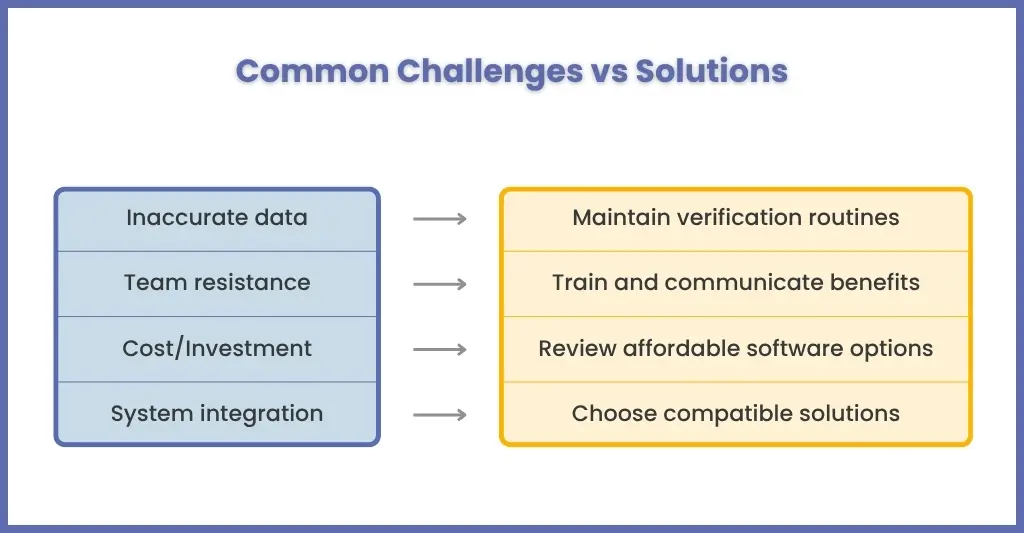
The most common payroll automation challenges are poor-quality source data, staff resistance, upfront cost, integration issues with legacy systems, and a lack of in-house expertise — each has a specific, manageable fix.
Payroll automation has made its name by easing the workload on countless accounting practices, but it has its share of challenges. The list of challenges is small, but it is worth taking a glance at how to overcome them.
Inaccurate Data
While payroll automation can help with consistency, if you’re feeding it poor-quality data, then the output could cause problems. Payroll automation will work well only when it’s fed with accurate and good-quality data. Poor data quality will lead to wrong outputs, damaging your reputation among clients.
Solution: Maintain data accuracy throughout by ensuring frequent data verification.
Team Resistance
When you employees are untrained on payroll software, they are bound to make mistakes and resist the changes. Plus, lack of familiarisation will generate misconceptions about automation that it will replace them in the future.
Solution: Train them on the payroll software and ensure they know that it is for making them efficient, not to replace them.
Cost/Investment
Not all payroll systems are the best and cost of purchasing and installation will differ from each other.
Solution: Take you time to review the best option that fits into your budget.
System Integration Problems
Sometimes your legacy systems will find trouble in getting integrated with the new payroll software, creating plenty of pitfalls.
Solutions: Choose solutions that integrate well with your existing technology stack.
Lack of Internal Expertise
We have come across many accounting practices that have simply backed out of payroll automation due to a lack of expertise in operating payroll automation tools.
Solution: Partner with experienced payroll professionals, like Corient, who can support implementation and ongoing payroll operations.
People Also Ask
Can payroll run be automated to save time and reduce errors?
Yes. Payroll software can automate the full payroll run — calculating gross-to-net pay, applying tax and National Insurance deductions, tracking pension contributions, and submitting Real Time Information (RTI) to HMRC automatically. This removes most manual data entry, which the Finity UK Payroll Efficiency Report 2026 links to nearly half of all payroll errors, freeing payroll teams to focus on reviewing exceptions rather than processing every line by hand.
How can I ensure payroll automation complies with UK laws?
Choose payroll software built for UK compliance — supporting HMRC RTI submissions, auto-enrolment pension duties, and National Minimum Wage checks as standard. Review legislative updates each tax year, since rates, thresholds and reporting rules change annually. Working with payroll professionals who monitor HMRC guidance, such as Corient’s payroll team, adds a second layer of assurance that automated outputs stay accurate as rules shift.
Will payroll automation disrupt my team?
Not if it’s phased in correctly. Practices that introduce automation gradually — piloting one process or client group first, training staff properly, and explaining that automation removes repetitive tasks rather than jobs — typically see smoother adoption. Most accounting practices report that automation reduces workload within a few months rather than creating lasting disruption, provided the rollout isn’t rushed across all clients at once.
Can AI automate payroll?
Yes. AI-driven tools are increasingly used to flag anomalies, predict payroll discrepancies, and reduce manual review time within payroll processing. McKinsey research has linked AI-driven payroll software to around a 20% improvement in payroll accuracy. AI typically works alongside rule-based automation rather than replacing it — handling calculations and RTI submissions, while AI flags exceptions for human review.
How can payroll be automated?
Payroll is automated by using dedicated software to handle tasks that would otherwise need manual input — timesheet collection, tax and National Insurance calculations, pension contributions, payslip generation and HMRC RTI submissions. Practices typically start by auditing current processes, cleaning employee data, selecting software that fits their existing tech stack, and automating one task or client group before expanding automation further.
Conclusion
Payroll automation cannot be considered an exception; it has become a necessity for practices to improve their efficiency, reduce errors, and scale their payroll services. But getting the payroll software will not translate into success in payroll automation; you need to implement it successfully.
By introducing automation gradually, involving your team, testing thoroughly, and partnering with experienced payroll specialists, you can modernise payroll operations without disrupting day-to-day activities.
For accounting practices looking to stay competitive, improve client service, and increase profitability, payroll automation offers a clear path forward. And when combined with expert support from Corient, it becomes even easier to achieve a payroll process that is accurate, compliant, scalable, and future-ready.
Corient’s payroll team — led by specialists with over a decade of hands-on payroll and finance experience — supports UK accounting practices through every stage of automation, from the initial process audit to ongoing managed payroll.
Are you ready to transform your payroll through automation? Contact us to see the difference.