
Payroll errors are mistakes in how employees are paid, taxed, or reported to HMRC, such as wrong tax codes, bad employee data, late Full Payment Submissions, and misclassified workers. Large practices prevent them with repeatable controls: validate data before each run, reconcile every client’s submission, audit monthly, and automate or outsource where volumes strain the team.
Since we are aware of the realities of the accounting world in the UK, we know how difficult managing payroll is. MHR’s research found that 88% of UK businesses had payroll errors in 2022 that left staff paid incorrectly or late (Accountancy Today, 24 February 2023). For this reason, they have placed their trust in professional accounting practices like yours for reducing errors, but that’s not enough.
Payroll regulations in the UK have progressively become tougher and tightly enforced by HMRC. For 2026/27, employer National Insurance is 15% above a £5,000 secondary threshold, and the National Living Wage for workers aged 21 and over is £12.71 an hour from 1 April 2026 (HMRC rates and thresholds). We are aware of the reality that a sizable number of accounting practices are increasingly finding it difficult to handle the payroll responsibilities for their clients. Payroll errors occurring again are the last thing your clients would expect from you, which would lead to significant pay delays for your client’s employees.
Lack of pay or delays in salary payments will certainly demoralise their employees, which will further lead to multiple compounded issues. In Remote’s State of Global Payroll survey, 47% of UK employees had experienced a payroll error in the past year, and 42% said it harmed their relationship with their employer (HR Review). Such mistakes will also damage your reputation in the accounting world and also attract legal cases. Therefore, it is important to preempt such mistakes by identifying them and avoiding them. If some mistake does happen, then resolving it without much damage to the practice’s reputation and financial damage should be the first priority.
Key Takeaways
- 88% of UK businesses had payroll errors in 2022 (MHR), and 80% spent 12+ hours a month fixing them.
- The most common errors: wrong calculations, bad employee data, late payments, wrong tax codes, and misclassification.
- 2026/27: employer NI is 15% above £5,000, and the National Living Wage is £12.71 (age 21+) from 1 April 2026.
- HMRC late-filing penalties run £100–£400 a month per PAYE scheme.
- Fix errors fast: correct, tell the employee, report on the next FPS, keep a log.
What Are the Most Common Payroll Errors Accounting Practices Should Avoid?
The most common payroll errors are wrong pay calculations, incorrect employee data, late payments, poor records, wrong tax codes, inaccurate time records, outdated software, missing payslips and misclassified workers. A payroll error is any mistake in calculating, paying, deducting or reporting employee pay.
It is important to note that the payroll field is full of payroll error minefields, and to avoid them it’s important to first identify them and then avoid them. However, there are so many payroll errors occurring that focusing becomes difficult; hence, we have narrowed it down to some common payroll errors your clients make while doing payroll.
| Error | What it looks like | Check before the run |
| Miscalculated pay | Over/underpayment, wrong deductions | Compare against last month’s variances |
| Wrong employee data | Mistyped NI number, old address | Validate against source documents |
| Late payments | Pay or HMRC submission late | Diarise client cut-off dates |
| Incorrect tax codes | Wrong code on a starter | Match to P45 or HMRC notice |
| Misclassification | Employee treated as contractor | Review status, including IR35 |
Miscalculations in Payments

It will be disheartening for your client’s employees to receive an incorrect paycheck. Not only will it demoralise them, affecting their payroll operation, but also damage your client’s reputation. Equally frustrating will be for you to investigate and rectify the human error, which will consume a considerable amount of time and resources. Hence, it will be important for you to avoid any mistakes.
Some of the common miscalculations are overpaying or underpaying employees, missing out on paychecks for new employees, wrong deductions for benefits, and incorrect payments for those employees who are on leave.
Wrong Employee Information
There is always a possibility that your clients may make an error in their employee information. Therefore, it is your responsibility to verify the vital information provided by your clients before using it. Incorrect information such as address or National Insurance Number will lead to wrong calculations and delays in payroll disbursement.
Delays in Payments
Delays in payments can happen due to multiple reasons, from lack of information to lack of records. If there are any documents or information required from the clients for payment purposes, then it must be communicated quickly. Any payment delay will lead to legal issues and trust breakdown between you and the client and lower the morale of the employees.
Inaccuracy in Records
Inaccurate records are a recurring problem which can be controlled by verifying the employee records received from your clients. These records are essential for compliance, and any failure will lead to penalties from the HMRC.
Incorrect Tax Codes
Any inaccuracy in tax codes can cause you to over- or underpay taxes, and it is important to make sure that accurate tax codes are added.
Not Tracking Working Hours and Free Time
Inaccurately recorded working time will lead to payment errors and will require corrections that will span multiple tax years. Rectifying this human error will consume multiple hours, which will be stressful for you. Hence, it is important to make sure that accurate overtime and breaks are recorded for accurate payments.
Not Upgrading Payroll Systems
Failing to update payroll systems with new technologies and regulations leads to non-compliance and errors.
Failure to Provide Payslips
You are required to give payslips to your client’s employees to maintain transparency. Any neglect to provide this crucial document will lead to trust breakdown and confusion among your client’s employees. The non-provision of payslips will also escalate into a legal issue.
Employee Misclassification
It is a common payroll mistake made where individual workers are not categorised correctly under the law. Under the off-payroll working rules (IR35), medium and large private-sector clients must decide a contractor’s status. Any misclassification will lead to wrong calculations, benefits, and taxes.
How Do You Fix a Payroll Mistake Effectively?
To fix a payroll mistake, identify the error from the payslip and payroll records, correct it straight away, give the employee a revised payslip, and log what happened. Report the correction to HMRC on your next Full Payment Submission.
Panicking when you find out a payroll mistake will only worsen the situation, and the only way to salvage it is by rectifying and making sure that the affected employee will get its fair amount.
- You will not be able to rectify the common payroll mistake without identifying it. Hence, it is important for you to check the payslips and payroll records of the affected employee and detect the error. The error could be anything from an incorrect tax code, wrong employee information, incorrect working hours, or deductions.
- If the mistake has been detected, then it must be rectified without any delays. For example, if an incorrect tax code has been identified, then it must be taken up with the HMRC and incorrect salary details must be rectified in the next pay cycle.
- Once the error is rectified, you will have to inform the employee about it. You must provide the employee with the updated payslip so that you can explain the changes and the employee can review it to their satisfaction.
- Keep a record of the mistakes committed and note down the actions taken to rectify them. These records will allow you to prevent similar mistakes in the future.
It is understandable that rectifying these mistakes or keeping an eye on them is a resource-intensive and complicated process. Hence, if you are unable to resolve it, then you must seek help from a professional service provider offering payroll outsourcing services. Through payroll outsourcing, you can streamline your payroll process and select from the best payroll service providers; you can compare their case studies and note down their achievements.
How Can Accounting Practices Avoid Payroll Errors?
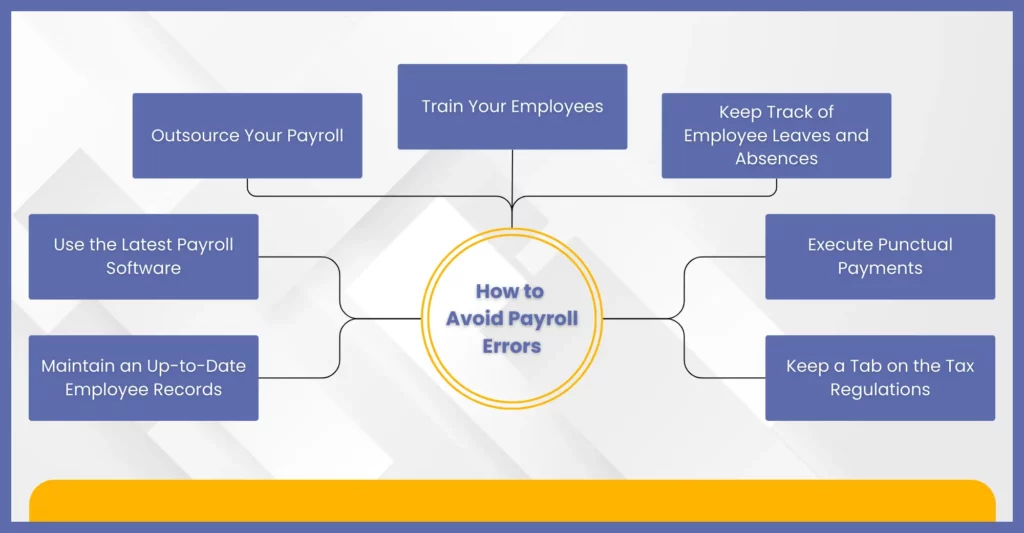
Practices avoid payroll errors by validating data before each run, using HMRC-recognised payroll software, reconciling every submission, auditing monthly and training staff on each year’s rule changes. At scale, many large practices add outsourced capacity so peak months don’t depend on a stretched team.
Rather than committing and then rectifying the error, which will consume a vast amount of time and resources it is better to prevent it. By taking such preventive measures, you will be in a position to offer error-free payroll services to your clients, thus gaining and maintaining their trust.
Here are some ways you can avoid payroll errors:
Use the Latest Payroll Software
We would recommend that you identify the best and most advanced payroll software and use it for your payroll process. Choose HMRC-recognised software with Real Time Information (RTI) support; common UK options include Sage Payroll, IRIS, BrightPay and Xero Payroll. Payroll software will help you streamline the process, promote automation, and reduce manual errors. With the help of payroll software, you will be in a position to calculate huge volumes of salaries, benefits, taxes, overtime, and other deductions accurately.
Maintain Up-to-Date Employee Records
It is an important responsibility to check that your client’s employee records are up-to-date and reviewed at regular intervals. If any employee’s salary, benefits, address, or any other information changes, then that change must be reflected in your payroll system. These records are required to be up-to-date for payroll reporting purposes, which will ensure further accuracy and compliance.
Keep a Tab on the Tax Regulations
Tax legislation in the UK keeps changing every April. Hence, it is important to keep a tab on the latest rules and payroll regulations. For 2026/27, check employer NI (15% above £5,000), the National Living Wage (£12.71 from 1 April 2026), and the Statutory Sick Pay changes from 6 April 2026 on HMRC’s rates and thresholds page. For further assistance, you can take the help of a tax consultant, or you can use the latest payroll software, which will help you stay compliant.
Execute Punctual Payments
Late Full Payment Submissions can trigger monthly penalties of £100 to £400 per PAYE scheme, plus 5% of the tax and National Insurance due if more than three months late (GOV.UK).
| Employees in the PAYE scheme | Monthly late filing penalty |
| 1 to 9 | £100 |
| 10 to 49 | £200 |
| 50 to 249 | £300 |
| 250 or more | £400 |
Avoid penalties by making the salary payments on time, which was time-consuming if done manually. However, these days you have payroll software to do the heavy lifting. You just have to fix the payment dates, and payments will be executed automatically.
Keep Track of Employee Leaves and Absences
To maintain accuracy in payroll calculations, you will have to keep track of your client employees’ leaves and absences. To do that, you can use an automated system where employees can apply for leaves. Also, conduct regular audits of time-off requests and attendance records to identify discrepancies.
Train Your Employees
Provide regular training to your payroll staff, especially on new updates in payroll regulations and on how to use the latest payroll software. Such training will benefit both your payroll team and your client’s employees in smoothing the process of managing leaves and payslips.
Outsource Your Payroll
UK-based accounting practices like yours are these days facing a lot of difficulties in single-handedly managing payroll for their clients. There are many reasons for this situation, and the result of this is a lot of time and payroll staff required for managing payroll. Also, you will require more expertise to handle complex payroll regulations. Fulfilling such requirements will put your budget over the edge; therefore, payroll outsourcing services are the only viable option.
Through payroll outsourcing services, you will be able to proactively avoid all payroll errors beforehand, thus ensuring your client’s employees are paid accurately and on time. Corientbs has run payroll for UK accounting practices since 2011, and our AI Crew includes Sherlock, built for error detection. You can estimate costs on our payroll pricing page.
Frequently Asked Questions (FAQ)
Who regulates payroll in the UK?
HMRC sets and enforces UK payroll rules, including PAYE, National Insurance and Real Time Information reporting. It also enforces the National Minimum Wage, while The Pensions Regulator oversees workplace pension duties. There is no separate licence for payroll bureaux, so legal responsibility stays with the employer, even when an accounting practice or outsourcing partner runs the payroll.
How much time does a company have to rectify payroll mistakes in the UK?
There is no fixed grace period, so correct errors as soon as you find them. Pay any underpayment as soon as possible and report the correction to HMRC on your next Full Payment Submission. Recover overpayments only by agreement with the employee, and keep a written record of every step you take.
How can I prevent payroll errors?
Validate employee data before every run, use HMRC-recognised payroll software, reconcile each Full Payment Submission against the payroll report, and audit a sample of payslips every month. Train your team on each April’s rate changes. If volumes outgrow your team, outsource peak workloads to a specialist so checks never get skipped.
Is it worth outsourcing payroll to avoid mistakes?
For many practices, yes. Remote’s State of Global Payroll survey found 67% of businesses that outsource payroll reported better accuracy. Outsourcing also adds capacity for tax calculations, National Insurance, pensions and HMRC filings, which frees partners for advisory work. Check the provider’s controls, software and UK payroll experience first.
What are the penalties for late payroll submissions to HMRC?
HMRC charges late filing penalties per PAYE scheme each month: £100 for one to nine employees, £200 for 10 to 49, £300 for 50 to 249 and £400 for 250 or more. A further 5% of the tax and National Insurance due applies if a submission is more than three months late.
Conclusion: What Should Large Practices Do About Payroll Errors Next?
Payroll errors are the biggest headache for any accounting practice, and they will not disappear magically without doing something. Only by acknowledging and proactively countering these errors can you offer error-free and value-added payroll services to your clients.
Agreed that some of these measures are too much to do singlehandedly, hence we would suggest that you explore the option of payroll outsourcing services, which are in abundance in the UK. Corientbs can be the ideal payroll outsourcing service provider for you due to its experience in handling complicated payroll tasks for accounting practices since 2011. Its tech-savvy payroll services have brought in quality transformation for multiple practices, and that’s the reason why it is very much trusted by them. You can write your doubts and questions related to services on our website contact form, and our executive will get in touch with you.