
To answer the question, how much does it cost to outsource payroll in the UK? Payroll outsourcing in the UK costs between £3 and £25 per employee per month. The exact cost depends on the number of employees, payroll frequency, complexity of pay arrangements, level of compliance support required, and the type of provider — ranging from software-only platforms to fully managed white-label outsourcing partners.
An expanding accounting practice with a steadily increasing client base was finding it difficult to manage payroll for its clients. Initially, recruitments were made to handle the workload. However, after calculating salary costs, pension contributions, recruitment fees, software subscriptions, training expenses, and office overheads, they realised the true cost of expanding their internal payroll team was far higher than expected.
Instead, they explore payroll outsourcing services.
Within months, they experienced an increase in their payroll capacity, a reduction in payroll compliance risks, quick turnarounds, and access to payroll expertise, without any new hiring.
This experience is becoming increasingly common across the UK accounting sector.
According to new research commissioned by Zellis and conducted by an independent research firm, one in five Brits (21%) has changed jobs after being paid late or inaccurately by their employer.
This means that payroll outsourcing is no longer simply about reducing costs; it is about creating scalability, reliability, and protecting profitability.
Key Takeaways
- Payroll outsourcing in the UK costs between £3 and £25 per employee per month — depending on service complexity, payroll frequency, and provider type
- The highest hidden cost is keeping payroll in-house: a qualified payroll professional costs £45,000+ per year, including salary, NI, pension, and training
- There are four pricing models: per employee, fixed monthly fee, tiered pricing, and custom enterprise, each suited to different practice sizes
- Auto-enrolment, pension administration, and HMRC compliance support are typically charged as additional fees — always check what is included
- Corient, ISO 27001 certified with 600+ UK-qualified professionals, offers fully managed white-label payroll outsourcing
Payroll Outsourcing Cost at a Glance — UK 2026 Pricing Table
Payroll outsourcing costs in the UK typically range from £3 per employee per month for basic processing to £25+ per employee per month for fully managed, compliance-included services. The table below provides a 2026 benchmark across the most common service types.
| Service Type | Typical UK Pricing (2026) | Best For |
| Basic Payroll Processing | £3–£6 per employee/month | Small payrolls |
| Managed Payroll Service | £5–£10 per employee/month | Growing SMEs |
| Full-Service Payroll Outsourcing | £7–£15+ per employee/month | Accounting practices |
| Director-Only Payroll | £10–£30 per month | Small limited companies |
| Auto-Enrolment Support | Often additional £10–£50 monthly | Pension compliance |
| Year-End Processing | Additional fees may apply | Annual reporting |
| Bespoke Outsourced Payroll Solutions | Custom pricing | Multi-client accounting firms |
These figures provide a general benchmark. Actual pricing varies depending on the provider and the complexity of services required.
What Factors Influence the Overall Cost of Payroll Services?
Six factors most significantly influence the overall cost of payroll outsourcing in the UK: the number of employees, payroll frequency, complexity of pay arrangements, auto-enrolment pension obligations, HMRC compliance support requirements, and the degree of software integration needed.
Number of Employees
One of the most cost factors is the employee count. Most providers will charge as:
- Per employee
- Per payroll run
- Per client account
The larger the payroll, the higher the cost, but many providers will offer discounts on higher volumes.
Payroll Frequency
How often payroll is processed also affects pricing.
For example:
- Monthly payroll
- Weekly payroll
- Fortnightly payroll
- Four-weekly payroll
Weekly payroll needs more processing, which means more resources and time, resulting in higher fees.
Complexity of Payroll
You will come across many simple and not-so-simple payroll tasks when you run your practices.
The not-so-simple ones involve:
- Multiple pay rates
- Overtime calculations
- Bonuses
- Commission structures
- Salary sacrifice arrangements
- Statutory payments
The more complexity in the payroll, the more time and expertise required.
Auto-Enrolment Pension Management
Workplace pension compliance remains a key responsibility for UK employers.
Providers often charge additional fees for:
- Pension submissions
- Employee enrolment
- Re-enrolment processes
- Pension compliance reporting
HMRC Compliance Support
Payroll providers offering compliance support often charge more than those doing payroll calculations and deductions. However, such support can help you in avoiding costly errors and penalties.
Software Integration Requirements
Many firms use platforms such as:
- Xero
- QuickBooks
- Sage
- BrightPay
Providers that offer seamless integration often deliver greater efficiency but may charge premium rates.
How Do Payroll Outsourcing Fees Vary Between Providers?
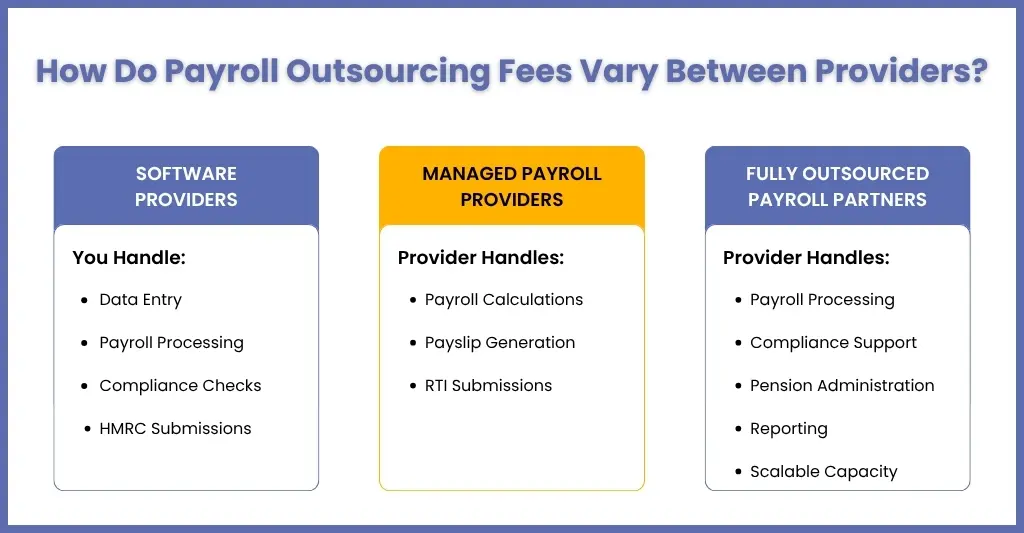
Payroll outsourcing fees vary primarily based on the service model: software-only providers charge the least but require your team to handle processing; managed providers handle payroll on your behalf for mid-range fees; fully outsourced partners like Corient act as an extension of your team and command higher fees that typically deliver the strongest overall return.
Software Providers
Such payroll providers only provide payroll software. Your team will remain responsible for:
- Data entry
- Payroll processing
- Compliance checks
- HMRC submissions
Less internal involvement in payroll work makes their pricing low.
Managed Payroll Providers
Managed providers process payroll on your behalf.
They typically handle:
- Payroll calculations
- Payslip generation
- RTI submissions
This model offers greater support and usually commands higher fees.
Fully Outsourced Payroll Partners
Providers like Corient act as an extended team of your accounting practice.
Services often include:
- Payroll processing
- Compliance support
- Pension administration
- Reporting
- Scalable capacity
You might find the price on the higher side, but the value it provides exceeds the cost, considering the recruitment and operational expenses.
Corient, which holds ISO 27001 and Cyber Essentials certification and employs 600+ UK-qualified payroll and accounting professionals, operates as a fully managed white-label partner — meaning your clients see your brand, while Corient handles all payroll processing, RTI submissions, pension administration, and compliance in the background.
How Much Does It Cost to Outsource Payroll
There are four main payroll outsourcing pricing models used by UK providers: per employee per month (the most common), fixed monthly fee (suited to smaller stable payrolls), tiered pricing (benefiting growing practices), and custom enterprise pricing (for multi-client accounting firms). Understanding which model applies to your situation is essential for accurate cost comparison.
Per Employee Pricing
It is one of the most common models.
Example:
- £5 per employee per month
- A client with 50 employees would cost approximately £250 monthly.
Fixed Monthly Fee
Some providers charge a flat fee regardless of employee numbers. This works well for smaller payrolls with predictable requirements.
Tiered Pricing
Beneficially for practices that have clients whose employee numbers are increasing.
For example:
- First 50 employees: £6 each
- Next 100 employees: £4 each
This model benefits larger payrolls.
Custom Enterprise Pricing
When you are managing multiple payroll clients, you might receive bespoke pricing arrangements based on volume and service requirements.
The Hidden Costs of Keeping Payroll In-House
Many practices make the mistake of comparing in-house payroll with payroll outsourcing based on costs, but this can be misleading. The true comparison should include all internal costs.
These hidden costs of in-house payroll are:
Recruitment Costs
Hiring experienced payroll professionals involves:
- Recruitment fees
- Advertising
- Interview time
- Onboarding costs
Recruitment and training can cost thousands of pounds before the employee even starts.
Staff Salaries
According to multiple reports, experienced payroll professionals are demanding higher salaries, and the cost will increase further when you factor in:
- Employer National Insurance
- Pension contributions
- Holiday pay
- Sick pay
Training and Compliance Updates
UK payroll legislation keeps changing every year, and your staff will need constant training to keep themselves updated and compliant with the new legislation. Such constant training will not come cheaply.
Software and Technology Costs
With UK payroll getting more complex with each passing year, you will have no choice but to invest more in technologies like:
- Payroll software
- Accounting software
- Data storage
- Security solutions
These costs will go up over time.
Opportunity Cost
One of the highest hidden costs that you might never realise is the time spent on payroll administration, which is time-consuming. Each hour spent on time-consuming payroll work means time not spent on high-value:
- Advisory services
- Business development
- Client acquisition
For many practices, this lost opportunity significantly outweighs payroll outsourcing fees.
How UK Accounting Practices Build Profitable Margin on Outsourced Payroll
UK accounting practices build profitable margin on outsourced payroll by combining a predictable low outsourcing cost per employee with a higher client-facing service fee — creating a fixed, scalable margin that grows as client volumes increase without any proportional increase in internal overhead.
Here’s what you can achieve through outsourcing payroll.
Increasing Client Capacity
Through your payroll outsourcing provider partner, you can handle more payroll clients without any additional hiring, which means quick scalability.
Reducing Internal Overheads
Instead of investing in a huge payroll team, you can get expert payroll help through outsourcing. This reduces:
- Recruitment costs
- Training expenses
- Infrastructure requirements
Creating Fixed-Cost Delivery Models
Once you partner with a payroll service provider, you will get a predictable outsourcing cost. This makes pricing easier and improves profitability forecasting.
Expanding Service Offerings
Payroll outsourcing provider teams will work like an extension of your team, which means additional capacity. This means you can offer:
- Payroll processing
- Pension administration
- CIS payroll
- Director payroll
- Payroll advisory services
This creates new revenue opportunities.
Leveraging Partners Like Corient
Many UK accounting practices partner with experienced and professional payroll outsourcing providers like Corient because it provides more than simple payroll processing.
Corient will act as an extension of your internal team, helping you:
- Scale payroll operations
- Maintain compliance
- Improve turnaround times
- Support client growth
- Avoid recruitment pressures
This enables you to focus on higher-value advisory work while maintaining exceptional payroll service delivery.
How to Get the Best Value When Outsourcing Payroll
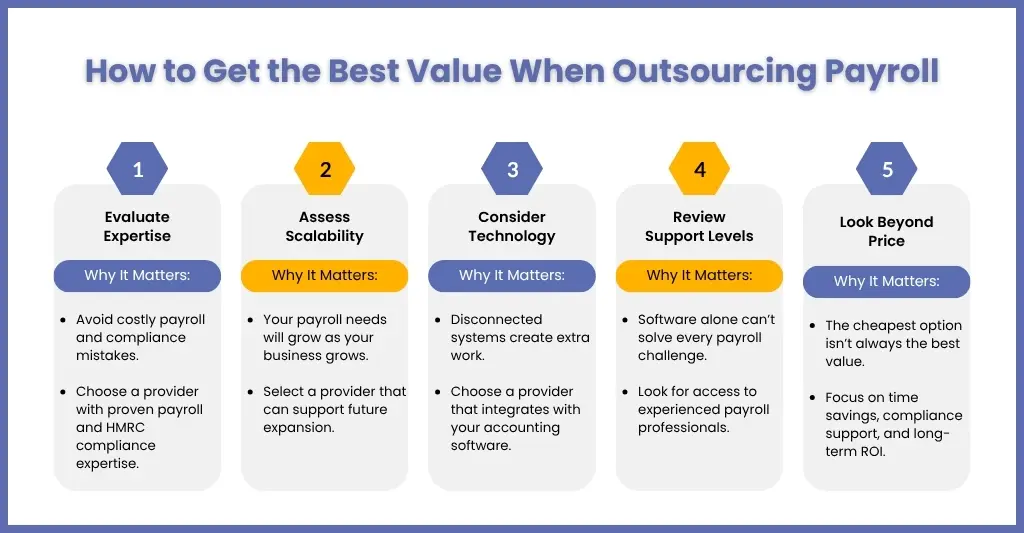
To get the best value when outsourcing payroll, UK accounting practices should evaluate five criteria beyond price: the provider’s HMRC compliance expertise, their software compatibility, their ability to scale with your practice, the qualifications of their payroll staff, and whether they offer white-label delivery that protects your client relationships.
Evaluate Expertise
Select from the best payroll providers the one that has expertise in handling complex payroll compliance with ease. This way, you will be able to avoid costly mistakes.
Assess Scalability
Don’t select a provider based on your current requirement, but also on its ability to fulfil your future requirements. Many times, we noticed practices expanding at a rapid pace, with providers unable to handle payroll tasks.
Consider Technology
Identify and partner with a payroll outsourcing provider that integrates without any problem with your existing accounting systems. This will reduce duplication and improve your efficiency.
Review Support Levels
Select a service provider that offers an experienced payroll professional who will deliver greater value than software alone.
Look Beyond Price
A provider that saves partner time, improves client service, and supports growth may generate a far stronger return than a lower-cost alternative.
Frequently Asked Questions
What is payroll outsourcing?
Payroll outsourcing is the process of delegating payroll processing responsibilities to a specialist third-party provider. Instead of managing wage calculations, tax deductions, RTI submissions, and pension compliance in-house, a business or accounting practice transfers these tasks to an expert team — reducing administrative burden, improving compliance accuracy, and freeing internal staff for higher-value advisory work.
What is the average cost of payroll outsourcing per employee in the UK?
Most payroll outsourcing providers charge between £3 and £15 per employee per month, depending on service complexity, support levels, and payroll volume. When compared to in-house payroll, it’s reasonable because you avoid recruitment and training of your employees and investments in payroll software and tools, thus saving time and cost.
How do payroll outsourcing fees vary between providers?
Payroll outsourcing fees vary based on the service model chosen. Software-only providers charge the lowest fees but require your team to manage processing. Managed payroll providers handle calculations and RTI submissions for mid-range fees. Fully outsourced partners manage the entire payroll function end-to-end, including compliance, pension administration, and reporting — commanding higher fees but delivering the strongest overall return on investment.
What factors influence the overall cost of payroll services?
The six key factors that influence payroll outsourcing costs are: employee headcount (more employees means higher fees, though volume discounts apply), payroll frequency (weekly payrolls cost more than monthly), complexity of pay arrangements, auto-enrolment pension management requirements, the level of HMRC compliance support included, and software integration requirements with your existing accounting platforms.
Why would you outsource payroll?
UK accounting practices outsource payroll to reduce overhead costs, eliminate recruitment and training expenses, access specialist HMRC compliance expertise, and scale payroll capacity without hiring permanent staff. Outsourcing also reduces the risk of costly RTI errors and auto-enrolment penalties, frees senior accountants for advisory work, and enables practices to take on more payroll clients without increasing internal workload.
Conclusion
The question “How much does it cost to outsource payroll?” will keep coming up because payroll outsourcing sounds expensive for many. However, keeping the payroll in-house and making mistakes is even more expensive.
For accounting practices, payroll outsourcing is increasingly becoming a strategic growth tool rather than a cost-saving exercise.
It enables you to:
- Increase capacity
- Improve compliance
- Reduce recruitment pressure
- Enhance client service
- Focus on advisory work
- Build stronger profit margins
If your practice is spending too much time managing payroll internally or struggling to scale without hiring, Corient can help. Imagine having a dedicated payroll team working behind the scenes, handling clients and compliance, while you focus on growth and advisory services.
That’s exactly what Corient delivers.
Book a free consultation with Corient today using our contact form and discover how outsourced payroll support can help your accounting practice increase profitability, improve efficiency, and confidently scale throughout 2026 and beyond.