
What are the pros and cons of outsourcing payroll? The pros are savings in time, reduction of compliance risk, and lower staff costs, while the cons are less day-to-day control, dependence on a third party, and the need to choose the right outsourcing provider. In short, if done well, outsourcing payroll can solve more problems than create new ones.
Here’s a scenario that many accounting practices face across the UK every month. It’s the 25th, and payday is coming up, and a bunch of payroll team employees who handle it are sick for the day. Suddenly, you have other employees with less experience of payroll trying to do the job and delays in payments and client frustration. It’s a situation where nobody is happy.
A 2025-26 survey by Moorepay from 445 professionals working within the payroll industry shows that outsourcing payroll to a provider in 2025 is 18%. But with the passing of the Employment Rights Bill, outsourcing is set to get more popular. That’s why so many practices are asking the question, what are the pros and cons of outsourcing payroll?
So, let’s answer it properly with the real pros, the real cons, and a clear-eyed look at whether outsourcing payroll is actually worth it for your practice.
What Is Payroll Outsourcing?
Payroll outsourcing is an exercise of handing over part or all of the responsibility of payroll processing to an external outsourcing provider, rather than handling it entirely in-house. This means that either you can choose full payroll outsourcing that will handle calculations, payslips, HMRC submissions, pension contributions, basically everything, or you can choose partial outsourcing where a provider will handle the heavy processing while your team handle client relationships and advisory work.
For accounting practices specifically, payroll outsourcing often means passing client payroll runs to a dedicated outsourcing partner, who works under your firm’s brand (white-labelled) so your clients never even know the processing has moved elsewhere. Therefore, it should not be misunderstood as giving up control over your clients’ payroll; it’s about freeing up your capacity for high-value advisory work.
How Does Payroll Outsourcing Work?
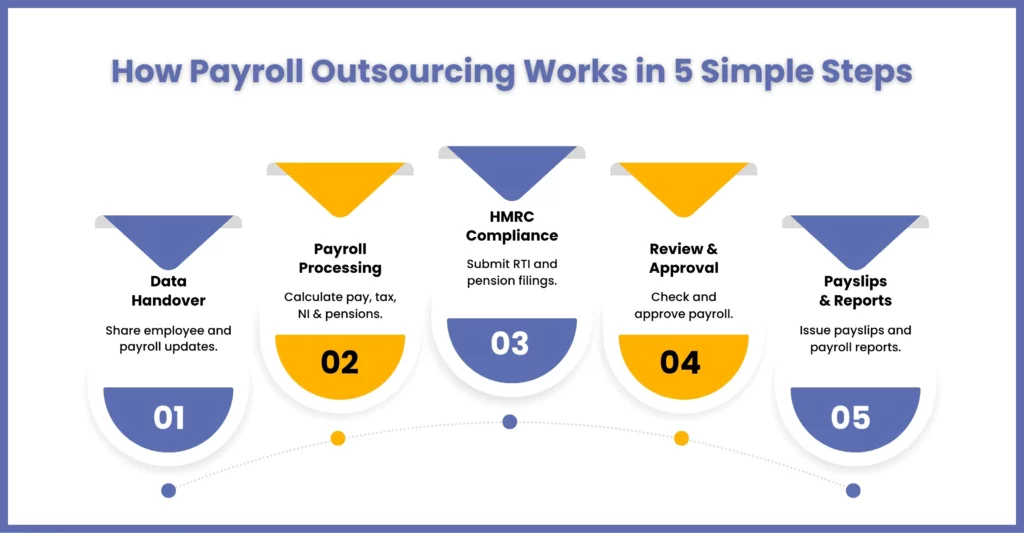
Payroll outsourcing works by transferring your clients’ payroll data, employee records, and processing schedule to your provider, who runs the calculations, submissions and reporting on your behalf, then returns everything ready for approval and payment. The typical process looks like this:
Data Handover
All the required details such as employee hours, new starters, leavers, and changes are shared with the provider each pay period.
Processing
The provider calculates gross-to-net pay, tax, National Insurance, and pension contributions.
Compliance Submissions
Real Time Information (RTI) reports are sent to HMRC using the approved payroll software, and pension contributions are submitted to the relevant scheme.
Review and Approval
Once all calculations are done, your team checks and signs off the output before payments go out.
Payslips and Reporting
The payslips are issued, and reports are provided for your records.
Good outsourcing partners integrate directly with the software your practice already uses, Xero, QuickBooks, Sage, BrightPay, and similar, so the process feels like an extension of your existing systems, not a separate, clunky add-on.
Pros and Cons of Outsourcing Payroll at a Glance
What are the pros and cons of outsourcing payroll? Before diving into the details, it helps to see the full picture side by side. Payroll outsourcing isn’t a one-size-fits-all decision; it comes with genuine advantages that solve real operational pain points, alongside trade-offs that deserve honest consideration.
The Pros
Frees Up Staff Time For Advisory And Client Work
Payroll work is highly time-consuming, and every hour spent on payroll means not spending on high-margin advisory services. Outsourcing saves your time, which can be refocussed on where you can profit and expand more.
Reduces Compliance And Penalty Risk
Payroll tasks such as RTI submissions, pension auto-enrolment, and meeting HMRC deadline demands require no errors, and specialist outsourcing providers ensure that through the use of AI tools and experienced professionals.
Access to Experienced Payroll Specialists
Rather than maintaining a generalist team or recruiting specialists, through outsourcing, you will have access to payroll professionals who will work like an extension of your team, so that you don’t have to chase behind legislation changes.
Scales Easily As Client Numbers Grow
It does not matter whether you handle payroll for 10 clients or 100; a professional outsourcing provider will scale up accordingly- no recruitment, no temporary hirings.
Often Cheaper Than Hiring In-House
Maintaining an in-house payroll team involves costs like salary, training, software, holiday cover, and sick leave. This makes outsourcing quite cost -effective by avoiding new recruitments completely.
Reduces Risk from Staff Absence Or Turnover
No more scrambling when your one payroll-trained team member is off sick or hands in their notice. Outsourced teams build in redundancy as standard.
The Cons
Less Hands-On, Day-To-Day Control
When you outsource payroll to your third-party service provider, you are giving away the control to manage the day-to-day affairs and control of payroll operations.
Dependent on Provider’s Accuracy and Reliability
You will be completely dependent on your outsourcing provider for payroll operations and accuracy. This makes the selection of a reliable provider important.
Requires Trust And Clear Onboarding
The first few pay runs with a new provider require careful data handover and communication to avoid early hiccups.
Data-Sharing Requires Proper Due Diligence
You will need to share your client’s employees’ sensitive payroll data to an external provider, which means you need to have confidence in their data security measures and compliance standards.
Switching Providers Later Can Take
Switching from one provider to another is not easy, and therefore careful selection is important.
Some Loss Of “In-House” Feel If Not White-Labelled
If a provider doesn’t operate under your brand, clients may notice the shift, which is why white-labelled delivery matters so much for accounting practices specifically.
| Pros | Cons |
| Frees up staff time for advisory and client work | Less hands-on, day-to-day control |
| Reduces errors, compliance and penalty risk | Dependent on provider’s accuracy and reliability |
| Access to experienced payroll specialists | Requires trust and clear onboarding |
| Scales easily as client numbers grow | Data-sharing requires proper due diligence |
| Often cheaper than hiring in-house | Switching providers later can take time |
| Reduces risk from staff absence or turnover | Some loss of “in-house” service feel if not white-labelled |
According to the Filling the Gap report of the Association of Accounting Technicians, 34% of employers struggled to recruit for finance and accounting positions in the UK.
Is Outsourcing Payroll Worth It? In-House vs Outsourced
When it comes to in-house payroll vs outsourced payroll, it’s worth exploring payroll outsourcing because it saves a considerable amount of time and money, and reduces the risks involved in day-to-day payroll operations. However, the perfect answer will still depend on your firm size and client base. Consider how the two models typically compare:
In-house payroll gives you full control and quick access to your team, which many practices prefer in the first place. But it involves considerable costs in the form of salaries, training, software licenses, and benefits. Plus, the risk of losing employees who are holding a lot of knowledge.
On the other hand, through outsourcing payroll, you get built-in redundancy, predictable costs, and access to expertise without the need for recruiting or long-term commitments. The only thing is you will need to maintain a working relationship with your service provider for regular reports and query resolution.
How to Decide If You Should Outsource Payroll
You should decide to outsource payroll if your team is regularly under pressure at pay run deadlines, if payroll knowledge sits with only one or two people, or if you’re turning away new payroll clients due to capacity. Ask yourself:
- Is payroll currently a source of stress rather than steady, predictable work?
- Would losing one staff member seriously disrupt your ability to process payroll on time?
- Are you spending partner-level time on payroll queries instead of advisory conversations?
- Could your margins improve if payroll costs were more predictable and processing-linked, rather than fixed salary costs?
Suppose most of these questions are answered as yes; then that’s a signal that you need outsourcing, either partial or full. Here’s where approaching professional payroll outsourcing service providers like Corient makes sense. Through its flexible payroll outsourcing services, it has helped multiple practices handle payroll for multiple clients without the need for recruiting, training, or managing in-house.
Frequently Asked Questions
What are the pros and cons of outsourcing payroll?
The main pros are time savings, reduced compliance risk, access to specialist expertise, and lower overall cost compared to hiring in-house. The main cons are slightly less day-to-day control and the need to choose a reliable, trustworthy provider. For most UK accounting practices, the pros significantly outweigh the cons when the right partner is in place.
How much does it cost to outsource payroll in the UK?
The typical costs will be £4 to £12 per employee per month (PEPM) for a standard managed service. However, costs vary depending on employee numbers and complexity, but many UK providers charge per payslip or a fixed monthly fee, often working out considerably cheaper than the fully loaded cost of an in-house payroll hire once salary, training, software, and cover are factored in.
What percentage of companies outsource payroll?
Around 40 to 50% of businesses outsource their payroll. While exact figures vary by survey, industry research, including CIPP member surveys, consistently shows a significant and growing proportion of UK businesses and accounting practices now outsource some or all of their payroll function, driven largely by staffing pressures and rising compliance complexity and with the passing of the Employment Rights Bill in 2025, payroll outsourcing is set to become more preferable.
Is it worth outsourcing payroll?
Outsourcing your payroll eliminates the cost involved in recruiting, training, salaries, and benefits for in-house staff and manual errors. Thus, helping your clients to avoid penalties over tax compliance. By outsourcing, you benefit from the additional skills of specialists in payroll, while avoiding the extra costs of hiring an in-house team.
Conclusion — Should You Outsource Payroll?
If your payroll team is doubtful about the smooth and predictable running of your payroll processes, then it’s a sign that your current model is not working, and it’s time to outsource payroll. When it comes to the pros and cons of outsourcing payroll, it’s real on both sides, but for you and many accounting practices it saves time, reduces risks, and frees up internal capacity for high-value advisory work.
Corient has helped UK accounting practices do exactly this, taking payroll off their plate with dedicated, white-labelled support that works within their existing systems and scales as their client base grows: no recruitment delays, no single point of failure, just dependable payroll capacity when you need it.
Curious whether outsourcing payroll makes sense for your practice? Get in touch with Corient today for a free, no-obligation payroll review.