
To plan payroll and accounting around HMRC deadlines, build a single master compliance calendar, set internal deadlines 5 days ahead of each HMRC date, automate RTI and VAT workflows, and review quarterly. In 2026/27, PAYE is due by the 22nd, VAT one month and seven days after period end, and Corporation Tax nine months and one day after year end.
To run payroll and accounting around HMRC compliance deadlines, you will need to invest in creating structured processes that will streamline and ensure timely payroll submissions, payment of taxes, VAT returns, and statutory filings. For your practice, it’s important to stay one step ahead of deadlines to avoid penalties and unnecessary stress for your clients and a bad reputation for your practice.
In this guide, we’ll explore how accounting practices can plan payroll and accounting activities around HMRC deadlines, reduce payroll compliance risks, and create more efficient workflows.
What are the HMRC compliance deadlines large practices must manage in 2026/27?
Five dates come round again and again: RTI submissions (due on or before payday), PAYE payments (the 22nd), VAT returns (a month and seven days after the period ends), Corporation Tax (nine months and a day after year end) and Self Assessment (31 January).
A compliance deadline is simply the date HMRC gives you to file a return or pay what’s owed. Miss it, and you’ll usually face a penalty, interest, or both.
| What’s due | When | Worth knowing |
|---|---|---|
| RTI Full Payment Submission (FPS) | On or before each payday | HMRC can penalise a late FPS even when the PAYE itself arrived on time |
| Employer Payment Summary (EPS) | By the 19th of the following tax month, if one is needed | Used when there were no payments in a month, or you’re reclaiming something |
| PAYE and Class 1 NIC payment | The 22nd of the next tax month if you pay monthly, or the 22nd after quarter end if you pay quarterly | Quarterly payers: your next date is 22 October 2026, covering 6 July to 5 October |
| VAT return and payment | One calendar month and seven days after the accounting period ends | You must register once rolling 12-month turnover goes over £90,000 |
| Corporation Tax payment | Nine months and one day after the accounting period ends | Companies with profits over £1.5 million pay in quarterly instalments instead |
| Corporation Tax return (CT600) | Within 12 months of the accounting period ending | Filed online, together with the accounts |
| Self Assessment | 31 January 2027 for the 2025/26 return and balancing payment | Mainly directors and owner-managers |
| Final FPS/EPS for 2026/27 | 19 April 2027 | Wraps up the 2026/27 tax year |
| P11D benefits reporting | 6 July 2027 | Payrolling benefits becomes mandatory from April 2027, which will replace this |
Dates correct as at 13 October 2026. It’s worth a quick check on GOV.UK before you file.
HMRC compliance is not limited to just tax return filing once a year. When you handle HMRC compliance for your clients, your team of accountants have to deal with multiple deadlines throughout the year, including payroll submissions, tax payments, VAT obligations, and corporation tax requirements.
Some of the most important deadlines include:
PAYE and Payroll Deadlines
Clients operating PAYE must submit payroll information through Real Time Information (RTI) on or before the employees are paid.
Key payroll obligations include:
- Full Payment Submission (FPS)
- Employer Payment Summary (EPS), where applicable
- PAYE and National Insurance payments
- Pension contribution reporting
The PAYE bill must be paid to HM Revenue and Customs (HMRC) by:
- The 22nd of the next tax month, if you pay monthly
- The 22nd after the end of the quarter, if you pay quarterly – for example, 22 July for the 6 April to 5 July quarter
If you pay by cheque through the post, it must reach HMRC by the 19th of the month.
VAT Deadlines
All your clients who are running businesses and whose turnover exceeds £90,000 in a rolling 12-month period will have to submit their VAT returns and make payments as per the reporting schedule.
The deadline for submitting VAT returns online is usually one calendar month and 7 days after the end of an accounting period. This is also the deadline for paying HMRC.
Corporation Tax Deadlines
Companies generally need to:
- Pay Corporation Tax within 9 months and 1 day after their accounting period ends. Companies with profits above £1.5 million pay in quarterly instalments instead.
- Submit a Corporation Tax Return (CT600) within 12 months of the accounting period end.
Self-Assessment Deadlines
Business owners, directors and the self-employed often have personal tax to sort out as well, and it pays to plan for it early. For the 2025/26 tax year, both the online return and the balancing payment are due by 31 January 2027. Miss that date, or any of the others in this guide, and you can expect penalties, interest and a lot of avoidable admin.
Why do large practices struggle with payroll and accounting compliance?
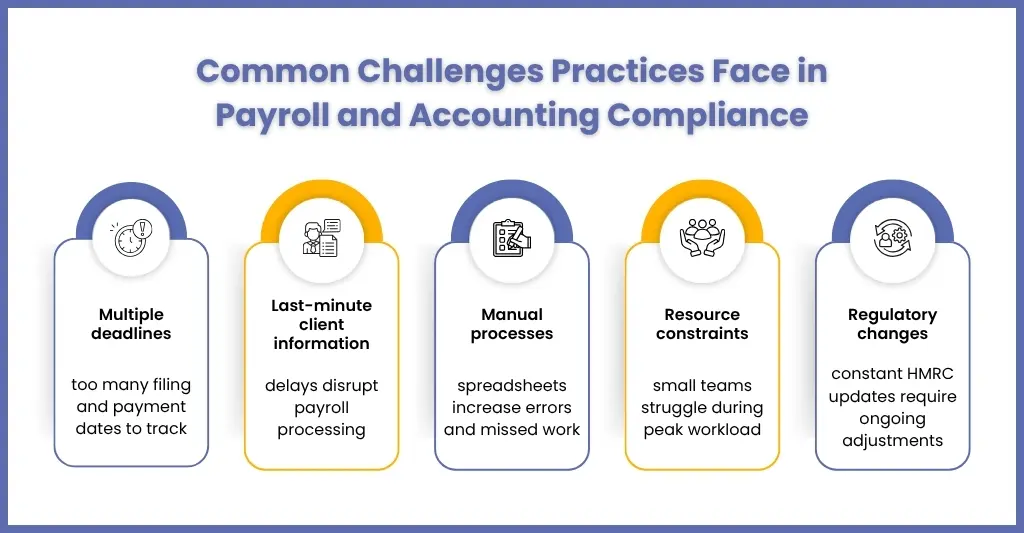
Large practices struggle because more clients means more risk. Hundreds of client deadlines, late data, manual processes, stretched teams and constant rule changes all land in the same few busy weeks. Finity’s research shows how often it goes wrong: 89% of the 342 UK finance and payroll professionals it surveyed had a payment error in the past year (IT Brief UK, 25 March 2026).
Even after knowing the importance of maintaining compliance with HMRC payroll and accounting deadlines, we have found practices struggling with meeting them due to multiple challenges. Let’s understand each of the common challenges.
Managing Multiple Deadlines
One of the biggest hurdles in the path of maintaining compliance with HMRC deadlines is keeping track of numerous filing and payment dates.
You will have to manage:
- Weekly payrolls
- Monthly payrolls
- Quarterly VAT returns
- Annual accounts
- Corporation Tax returns
- Self-Assessment deadlines
Without advanced planning important dates can be easily missed.
Last-Minute Client Information
You might have missed on deadlines due to delayed communication from your clients.
The client has to provide critical information, such as:
- Payroll changes
- Employee information
- Expense records
- VAT documents
When this information is provided at the last minute, it leaves your accountants with limited time to process the information accurately.
Manual Processes
It will be hard to believe, but we have found a few practices still relying on spreadsheets and manual workflows. It increases the risk of:
- Data entry errors
- Missed deadlines
- Duplicate work
- Compliance mistakes
As client numbers grow, these inefficiencies become more significant.
Resource Constraints
Recruitment of accounting talent in the UK is a big challenge, and getting expert talent is neither easy nor reasonable. Many practices operating small accounting teams and try to manage increasing compliance demands. As a result, staff get overwhelmed during peak seasons, which increases the chances of human errors.
Constant Regulatory Changes
UK payroll and tax regulations are constantly evolving.
Keeping up with:
- PAYE changes
- National Insurance updates
- Pension requirements
- HMRC guidance
requires continuous monitoring and training.
What happens if you miss an HMRC payroll or accounting deadline?
Missing an HMRC deadline hits your pocket in three ways. There’s a fixed penalty for filing late, a percentage penalty for paying late, and interest that builds up daily on anything still unpaid (7.75% a year since 9 January 2026). For payroll, a late RTI submission costs £100 to £400 for each tax month it runs late, depending on how many people you employ.
| Employees in the PAYE scheme | Late FPS penalty per tax month |
|---|---|
| 1 to 9 | £100 |
| 10 to 49 | £200 |
| 50 to 249 | £300 |
| 250 or more | £400 |
Source: HMRC Compliance Handbook CH62840, accessed 13 October 2026. HMRC charges one penalty per tax month for each PAYE scheme, however many late submissions there are in that month.
It can get worse if a return is more than three months late. HMRC can add a further penalty of 5% of the PAYE tax and Class 1 National Insurance that should have been reported (HMRC Compliance Handbook CH401222).
Interest is the other cost to watch. HMRC charges the Bank of England base rate plus 4 percentage points on late payments. The base rate dropped to 3.75% on 18 December 2025, so the rate has been 7.75% since 9 January 2026 (GOV.UK, 19 December 2025).
Late VAT works differently, with its own points and penalty system. GOV.UK explains how it works.
How do you align payroll and accounting with HMRC deadlines?
You can line up payroll and accounting with HMRC deadlines in six steps. Build a master compliance calendar, set your own internal deadlines, standardise how you talk to clients, automate the repetitive tasks, review quarterly, and have contingency plans ready.
The only way to overcome the above challenges in meeting compliance with HMRC payroll and accounting deadlines is proactive planning.
Here is a practical framework your practice can follow.
Step 1: Create a Master Compliance Calendar
Create a calendar that centralises all the deadlines. It should include:
- Payroll processing dates
- RTI submission deadlines
- PAYE payment dates
- VAT deadlines
- Corporation Tax deadlines
- Accounts filing dates
- Self-Assessment deadlines
A centralised calendar provides visibility across the entire practice, leaving no scope for confusion.
Step 2: Build Internal Deadlines Before HMRC Deadlines
Waiting for the official deadline backfires. You end up rushing, and rushed work is where the mistakes creep in. Set your own internal deadlines a few days earlier than the submission dates instead.
For example:
- Client payroll information due by the 20th
- Payroll processing is completed by the 25th
HMRC submissions completed before the official deadline. This creates a buffer for unexpected issues.
Step 3: Standardise Client Communication
Most compliance problems occur because your clients don’t know what information you provide and when.
Therefore, create standard communication processes such as:
- Monthly payroll reminders
- VAT document requests
- Year-end information checklists
Through clear communication, delays are avoided and accuracy improves.
Step 4: Automate Where Possible with Accounting Automation Software
Accounting automation software is software that automates repetitive accounting tasks such as bank feeds, reconciliations, VAT calculations and RTI submissions.
Automate all the tasks that can be automated, especially repetitive ones, so that the workload is reduced.
Modern payroll and accounting systems can automate:
- Payroll calculations
- RTI submissions
- Client reminders
- Payroll reporting
- Workflow tracking
Our guide to payroll automation shows where to start.
Step 5: Conduct Regular Compliance Reviews
Don’t conduct reviews to identify issues at the end of the year. Conduct frequent reviews, quarterly one to ensure:
- Payroll records remain accurate
- VAT obligations are met
- Tax liabilities are understood
- Compliance risks are identified early
Such regular reviews support better decision-making and minimise surprises.
Step 6: Develop Contingency Plans
Always build some contingency plan to cater to unexpected events that can disrupt compliance processes.
Examples include:
- Staff absences
- Software issues
- Client delays
- Cybersecurity incidents
A well-written contingency plan helps maintain continuity when challenges arise.
Which accounting automation software helps with HMRC compliance?
The most useful accounting automation software for HMRC compliance combines three layers: cloud accounting (Xero, QuickBooks, Sage), HMRC-recognised payroll software for RTI and pensions, and workflow tools that track deadlines across clients.
| Tool type | What it automates | Examples |
| Payroll software | PAYE calculations, RTI submissions, pension processing, payslips | HMRC-recognised payroll software |
| Cloud accounting platforms | Bank feeds, real-time financial visibility, VAT reporting | Xero, QuickBooks, Sage |
| Workflow management | Deadline tracking, task allocation, progress monitoring | Practice management software; Galaxy by Corient |
| AI assistants | Invoice processing, reconciliation, year-end, error detection | Corient AI Crew: Billy, Corby X, Luca, Sherlock |
Handling so many deadlines along with catering to clients’ demand for reports, services, and insights is not humanly possible. You will need tools and additional resources for handling compliance effectively.
Payroll Software
A modern payroll software can automate:
- PAYE calculations
- RTI submissions
- Pension processing
- Payslip generation
Cloud Accounting Platforms
Solutions such as Xero, QuickBooks, and Sage provide:
- Real-time financial visibility
- Automated bank feeds
- VAT reporting functionality
Workflow Management Systems
Many practices have started using practice management software, which can help you in:
- Tracking deadlines
- Allocate tasks
- Monitor progress
- Improve accountability
HMRC Resources
HMRC keeps updating its tax rates, deadlines and guidance, and it’s easy to miss a change if you aren’t checking its pages. The benefits-in-kind delay is a good example. HMRC has moved mandatory payrolling from April 2026 to April 2027. That buys you some time, but don’t leave it late: test your payroll system well before the new date (Moorepay).
Combining technology with structured processes creates a stronger compliance framework.
How does a practice avoid penalties in practice? (Illustrative example)
An accounting practice managing payroll and bookkeeping of 30 SME clients was meeting their deadlines using spreadsheets and email reminders.
As the client base grew, problems emerged:
- Late client submissions
- Missed follow-ups
- Increased stress around payroll periods
The practice implemented:
- A central compliance calendar
- Automated client reminders
- Cloud payroll software
- Monthly workflow reviews
Within six months, payroll processing became more predictable, deadline compliance improved, and staff spent less time chasing information. More importantly, the practice reduced the risk of penalties and improved client satisfaction.
This example demonstrates that compliance success often comes down to planning and process improvements rather than simply working harder.
What are the benefits of planning payroll and accounting around HMRC deadlines?
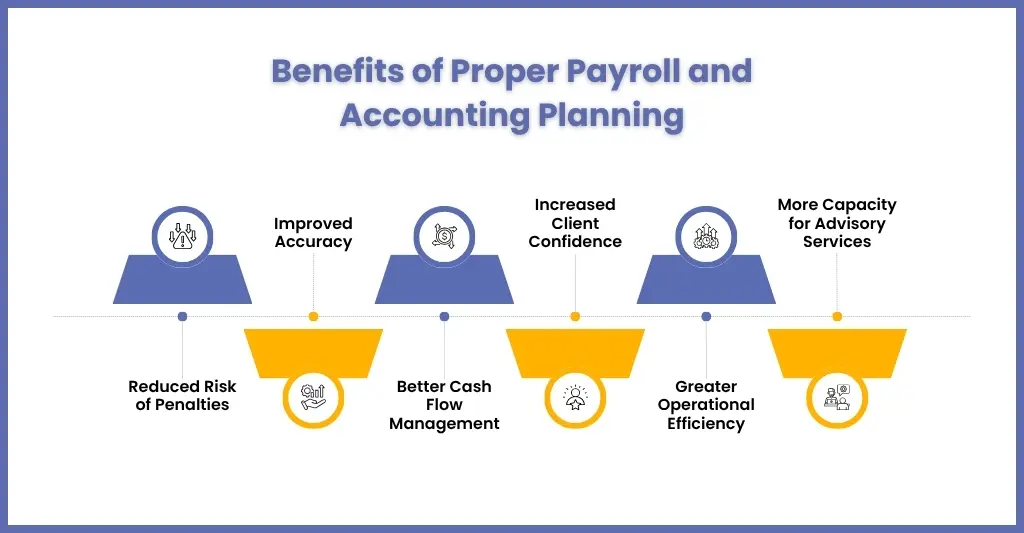
Planning reduces penalty risk, improves accuracy and frees capacity for advisory work, which benefits both the practice and its clients.
Having a proper payroll and accounting plan will benefit both you and your clients. Some of the major benefits are:
Reduced Risk of Penalties
Meeting deadlines consistently helps you avoid:
- Late filing penalties
- Interest charges
- Compliance investigations
Improved Accuracy
With planned workflows in place that achieve deadlines with a buffer time, it will reduce panic among your clients and inside your team, avoiding rushed processing and minimising errors.
Better Cash Flow Management
Through proper payroll and accounting planning, you will understand tax liabilities better enabling you to provide your clients with insights that will help them financially.
Increased Client Confidence
Planning gives you high insights and tools to provide high-value support to your clients, which will be highly appreciated, increasing their trust in you.
Greater Operational Efficiency
Without payroll and accounting planning, your accountants will be bogged down with firefighting multiple deadlines, instead of focusing on high-value services.
More Capacity for Advisory Services
As compliance processes become more efficient, you can dedicate more resources to:
- Tax planning
- Business advisory
- Forecasting
- Growth support
This shift is increasingly important as clients seek more strategic guidance from their accountants.
Many firms are achieving this by combining technology with outsourced support from professional providers like Corient. Through a reliable payroll outsourcing services and many other accounting services, Corient has managed compliance workload with ease, freeing up practice’s internal resources for advisory and client relationship.
For practices that are expanding, outsourcing provides additional capacity without the challenges associated with recruitment and training.
How can Corient help large practices stay compliant with HMRC deadlines?
Corient is a UK accounting and payroll outsourcing provider, based in Coventry, that supports accountancy firms with people and AI. Large practices use Corient to add capacity for peak periods without the cost of recruitment and training.
Our payroll team is led by Rupesh Nagvekar, who brings 13 years of accounting and finance experience. Our payroll outsourcing services cover RTI submissions, PAYE and pension reporting, while our VAT outsourcing and wider accounting services cover returns, year-end accounts and management reporting.
Corient’s AI Crew tools (Billy, Corby X, Luca, Sherlock, Smarty and Galaxy) automate invoices, reconciliations, year-end work, error detection and task management, so every deadline is tracked and reviewed before submission.
People Also Ask
How can Accounting Outsourcing Services help with HMRC compliance?
Accounting outsourcing gives your practice extra hands for payroll, bookkeeping, VAT returns and management accounts. For large practices, a partner like Corient takes on the peak-season crunch, runs the same review checks every time and gets submissions in well before HMRC’s deadlines. That leaves your own team free to advise clients instead of chasing them for data.
What are the most important HMRC compliance deadlines to remember?
The main dates to diarise are RTI Full Payment Submissions, due on or before every payday, and PAYE and National Insurance payments, due by the 22nd. VAT returns follow one month and seven days after the period ends. Corporation Tax is payable nine months and one day after year end, the CT600 within 12 months, and Self Assessment by 31 January.
What are the risks of missing payroll and accounting deadlines?
Missing a deadline can trigger fixed late filing penalties, percentage-based late payment penalties, and daily interest, currently 7.75% on unpaid tax. It can also invite closer HMRC scrutiny, extra administration and reputational damage. Repeated failures erode client trust, which is especially costly for large practices managing many clients at once.
How much is the penalty for filing an FPS late?
HMRC charges one fixed penalty per tax month for each PAYE scheme: £100 for 1 to 9 employees, £200 for 10 to 49, £300 for 50 to 249, and £400 for 250 or more. A further penalty of 5% of the tax and National Insurance due can apply if the return is over three months late.
When does mandatory payrolling of benefits in kind start?
Mandatory payrolling of benefits in kind is now due to start on 6 April 2027, after HMRC delayed it from April 2026. From then, employers must report and pay tax on most benefits through payroll software rather than P11D forms. Practices should confirm now that their payroll software supports it.
Conclusion
Achieving HMRC compliance in advance cannot happen without investing in payroll and accounting, which includes consistent communication, processes, and tech.
When compliance structures are in place, the risk of non-compliance with deadlines goes down significantly, and efficiency goes up. These structures have to be flexible in design to evolve with the regulatory environment so they serve your clients better, preventing penalties and creating capacity for growth.
For practices looking to scale without increasing internal pressures, partnering with a specialist outsourcing provider such as Corient can provide the expertise and operational support needed to maintain compliance while focusing on higher-value client services.
Want to stay ahead of deadlines? Contact us for effective payroll and accounting planning and transform compliance from a source of stress into a competitive advantage.