

The VAT return deadline is one calendar month and seven days after the end of your VAT period. For the quarter ending 30 September 2026, both the return and the payment are due by 7 November 2026. Late returns earn penalty points, and payments more than 15 days overdue attract penalties plus interest
For large practices, one missed VAT deadline is rarely a single-client problem: stagger groups, payments on account and Direct Debit timing multiply the risk across the whole portfolio. Businesses liable for VAT must submit VAT returns and pay on time. But that’s easier said than done. Frequent updates in VAT forms and processes by the HMRC and a lack of time have made it necessary to hand over the VAT return responsibility to accounting firms.
These days, accounting firms are managing a considerable VAT return workload on behalf of their business clients. However, VAT regulation complexities are taking a toll on the efficiency of their VAT performance. Among the multiple aspects that require focus, the VAT return deadline needs the most attention. This 2026 guide sets out the VAT return deadline, the current penalty and interest rules, key dates, and how practices can avoid late filing and late payment across a large client base.
What is a VAT Return?
A VAT return is a report that VAT-registered UK businesses submit to HMRC, usually every quarter, showing the VAT charged on sales, the VAT reclaimable on purchases, and the net amount payable to or refundable from HMRC.
A VAT Return is a tax report that businesses registered for Value Added Tax (VAT) in the UK must submit to HMRC (His Majesty’s Revenue and Customs). It summarises a business’s VAT transactions over a specific period, typically quarterly. The VAT return form contains calculations related to total sales and purchases (including VAT), VAT owed to HMRC (on sales), VAT reclaimed from HMRC (on business purchases), and total VAT payable or refundable.
Businesses must register for VAT when taxable turnover exceeds £90,000 in a rolling 12-month period, a threshold unchanged since 1 April 2024. Check the GOV. UK VAT guidance for current figures.
VAT in numbers (latest published data)
| Statistic | Figure | Source |
| UK VAT traders (active), 2024–25 | 2,330,400 traders | HMRC, Annual UK VAT statistics 2024 to 2025 (updated 3 Dec 2025) |
| Share of net Home VAT liability paid by traders with turnover above £10m, 2024–25 | 75% (£133 billion) | HMRC, Annual UK VAT statistics 2024 to 2025 (updated 3 Dec 2025) |
| UK businesses registered for VAT and/or PAYE, March 2025 | 2.73 million (up 0.4% on March 2024) | ONS, UK business: activity, size and location: 2025 |
What Is the Deadline for Submitting a VAT Return?
VAT returns and payments are due one calendar month and seven days after the end of the VAT accounting period. For a quarter ending 31 March 2026, the deadline is 7 May 2026.
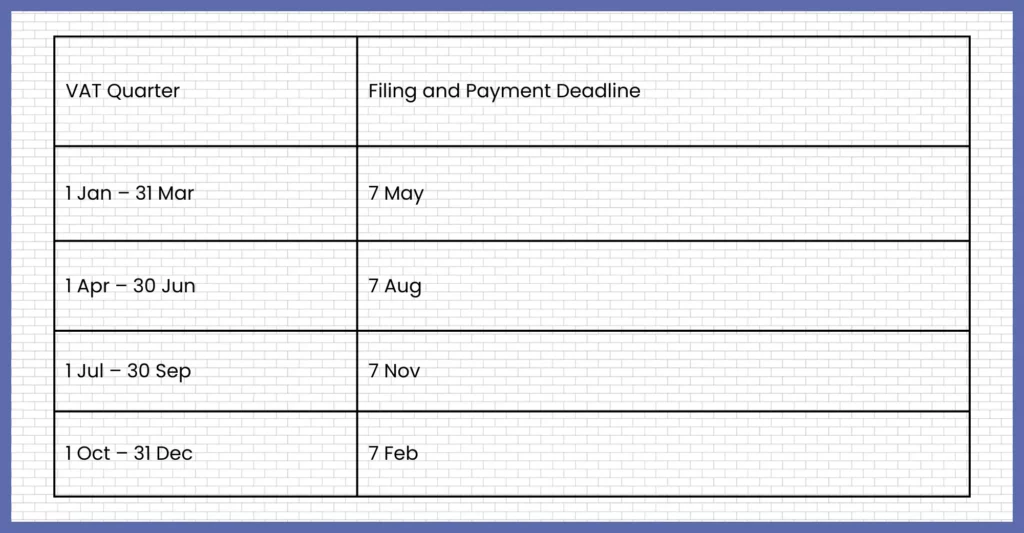
The deadline for submitting the VAT return and making payments is one month and seven days after the end of the VAT period. Most businesses file quarterly, so the 2026–27 dates for the standard March, June, September and December quarters are below. It is important to note that the deadline for submitting the VAT return also includes the time taken for the payments to reach HMRC; hence, make sure you make payments for your clients as soon as possible.
VAT return deadlines, standard quarterly filers (2026–27)
| VAT quarter ends | Return and payment due | Day of week |
| 31 March 2026 | 7 May 2026 | Thursday |
| 30 June 2026 | 7 August 2026 | Friday |
| 30 September 2026 | 7 November 2026 | Saturday: pay by Friday 6 November unless using Faster Payments |
| 31 December 2026 | 7 February 2027 | Sunday: plan to file and clear payment by Friday 5 February |
HMRC assigns clients to one of three standard stagger groups, so a client’s quarter-end may fall in a different month; the “one month and seven days” rule applies to every group. Where the due date falls on a weekend or bank holiday, HMRC guidance says payment should clear on the previous working day unless your bank supports weekend Faster Payments.
Deadlines by filing frequency
| Filing arrangement | Return and payment deadline |
| Quarterly or monthly returns | One calendar month and seven days after the end of each period. |
| Annual Accounting Scheme | Return and balancing payment two months after the end of the annual accounting period; interim instalments are paid during the year. |
| Payments on account (annual VAT liability above £2.3m, quarterly returns) | Payments on account fall due in the second and third months of each quarter, and the balancing payment is due earlier than the standard date. See HMRC payments on account guidance. |
When Is VAT Payable, and Does Direct Debit Give Extra Time?
VAT must reach HMRC by the same deadline as the return: one calendar month and seven days after the period ends. Direct Debit is the exception, as HMRC collects it three working days after the deadline. Bacs and standing orders take about three working days to arrive, so pay earlier.
Many accounting firms make the mistake of thinking that the deadlines for VAT payment and VAT return submission are the same, but that’s not true. Yes, the dates often overlap each other, but just scratch the surface, and you will find some important differences.
The payment method decides when funds actually reach HMRC, so choose it when you schedule the filing, not after.
| Payment method | When HMRC receives or collects it | Practice note |
| Direct Debit | Collected three working days after the payment deadline on the return | Set up at least three working days before filing. Not available for payments on account, paper returns or overseas bank accounts. |
| Bacs | Usually three working days | Allow at least three working days before the deadline. |
| Standing order | Three working days | Treat as a Bacs-style payment when scheduling. |
| Faster Payments / CHAPS | Usually same or next working day | Use for last-minute payments and weekend deadlines where your bank supports them. |
Source: GOV.UK, Pay your VAT bill and Pay by Direct Debit.
What Is the Penalty for Paying VAT Late?
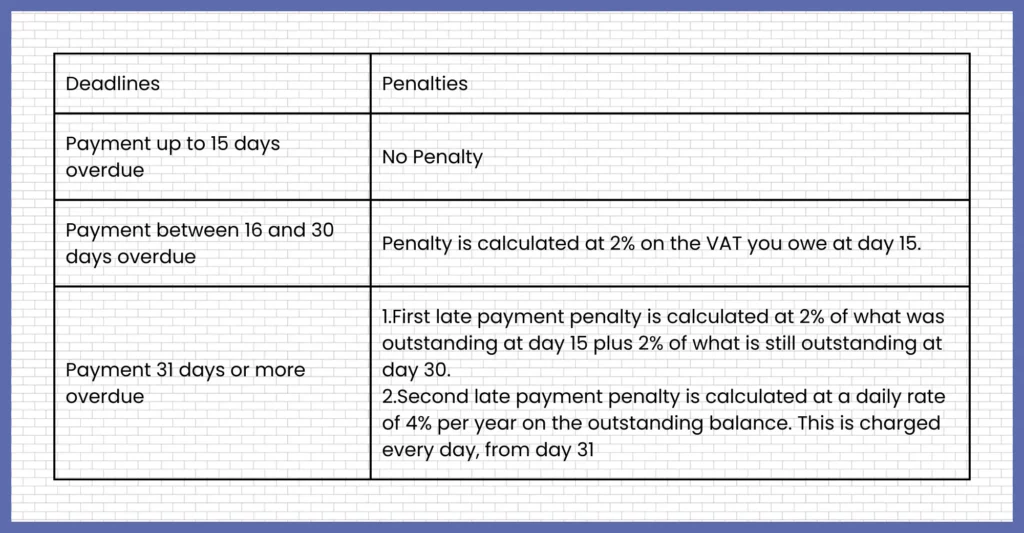
HMRC charges no late payment penalty if VAT is paid within 15 days of the due date. From day 16, a first penalty of 3% applies, rising to 6% from day 31, alongside a second penalty of 10% a year on the balance. Late payment interest, at Bank of England base rate plus 4%, runs from day one.
HMRC will charge late payment interest from the first day your payment is overdue until it is fully paid. Hence, if your clients find it difficult to pay the VAT before the deadline, it must be communicated to HMRC. This may stop more penalty charges from being added to the VAT owed. You can ask for a flexible payment plan such as a Time to Pay Arrangement, which can accommodate a client’s specific financial circumstances. If HMRC agrees a Time to Pay arrangement, it can mean lower or no late payment penalties, but a broken arrangement can bring them back as if it never existed.
| Days overdue | First late payment penalty | Second penalty and interest |
| 1 to 15 days | None | No penalty. Interest runs from day one. |
| 16 to 30 days | 3% of the VAT outstanding at day 15 | None. Interest continues. |
| 31 days or more | 3% of the balance at day 15 plus 3% of the balance at day 30 | 10% a year on the outstanding balance, charged daily from day 31 until paid. Interest continues. |
Worked example. HMRC’s own example: £15,000 of VAT paid 51 days late incurs a first penalty of £900 (£450 + £450) plus a second penalty of £86.30, a total of £986.30, before interest. Sources: HMRC late payment penalties and late payment interest (Bank of England base rate plus 4%).
How do VAT penalty points work for late returns?
Each late return earns one penalty point. Once you reach the threshold, HMRC charges £200 and a further £200 for every later late return while you remain at the threshold. The threshold depends on how often you file.
| Filing frequency | Points threshold | Penalty at threshold |
| Annual | 2 points | £200 |
| Quarterly | 4 points | £200 |
| Monthly | 5 points | £200 |
Source: HMRC, penalty points and penalties if you submit your VAT Return late. Practices should also note that if the representative member of a VAT group changes, accumulated points transfer to the new representative member.
Complying with all the VAT Returns and payment deadlines is already quite complex and time-consuming. Adding to the complexity is the high volume of VAT-related tasks you will be handling for your clients.
Many practices reduce this risk by using VAT outsourcing services alongside Making Tax Digital support. First, here is how to file correctly and on time.
How to Submit Your VAT Return on Time?
Submit through MTD-compatible software that connects to HMRC, after reconciling the period’s records and reviewing every box on the return. File before the deadline and pay by a method that clears in time.
Submitting your client’s VAT return on time with HMRC is crucial to avoid penalties or interest charges. For that, you will have to follow the below-listed steps:
Identify the VAT Period and Deadline
Your client’s VAT period can be monthly, quarterly, or annual and ends on a specific date. The deadline for the VAT return is always one month and seven days after the end of the VAT period. For example, if your VAT period is two months for the Annual Accounting Scheme. For example, if your VAT period ends on March 31, 2026, the return is due by May 7, 2026.
Use MTD-Compatible Accounting Software
Manually calculating VAT is out of the question; choose VAT-compliant accounting software that will make your VAT calculations on sales and purchases easier. Many of these tools can be integrated, making the submission of returns through MTD easy.
Keep the Records of Your Client Accurate and in Order
Before you submit your client’s VAT return, ensure that your client’s invoices for the period are accurate and recorded and double-check for corrections or adjustments.
Review Your VAT Return
Conduct a thorough review of the VAT return before submission to avoid delays or costly penalties. Ensure the following:
- Sales VAT collected is accurately recorded
- Purchases VAT paid can be reclaimed (where applicable)
- All figures match your accounting records
For a step-by-step walk-through of the nine boxes, see our guide to completing a VAT return.
Submit Your VAT Return Online (MTD)
Making Tax Digital for VAT applies to all VAT-registered businesses unless HMRC has granted an exemption. Do it flawlessly by following the steps below:
- HMRC’s Online Portal: Login to your HMRC account and submit the VAT return directly.
- VAT-compliant accounting software: Submit through integrated systems directly linking to HMRC, ensuring compliance and faster filing.
Set Reminders for Future VAT Returns
To avoid future missing of deadlines, you can set some calendar alerts when VAT returns are due. The good news is that many accounting software tools have built-in reminder features, so investing in something new is unnecessary. You can buy accounting software with such in-built features or access it through VAT outsourcing services offered by accounting outsourcing services.
How Can Large Practices Manage VAT Deadlines Across Many Clients?
Large practices manage VAT deadlines by grouping clients by stagger group, setting internal cut-offs at least five working days before HMRC’s deadline, and using one central tracker with maker-checker review. Automated reconciliation and error checks reduce late filings across high-volume, multi-entity portfolios.
Group clients by stagger group and filing frequency. Monthly, quarterly and annual filers have different deadlines, and payments-on-account clients (annual VAT liability above £2.3m) pay on different, earlier dates. A single calendar by client avoids surprises.
Set internal deadlines ahead of HMRC’s. A cut-off five working days earlier gives time for review, client approval and payments that clear in time, especially when 7 November 2026 and 7 February 2027 fall at weekends.
Use maker-checker review. A preparer completes the return, and a senior reviewer signs it off before submission. This is the simplest control against errors that lead to corrections and penalties.
Automate reconciliation and error detection. Established in 2011 and based in Coventry, Corient supports UK accounting practices with bookkeeping, VAT, payroll, audit and corporation tax outsourcing. Our AI tools, including Corby X for reconciliation and Sherlock for error detection, help practices catch exceptions before a return is filed. Read more about our tax outsourcing support.
Best Practices to Avoid VAT Late Payment Penalties
The most effective way to avoid VAT penalties is to set internal deadlines ahead of HMRC’s, automate reminders, collect by Direct Debit, review returns before filing, and agree a payment plan early when cash is tight.
Businesses in the UK are increasingly finding it difficult to singlehandedly manage VAT compliance, so they are depending on the experience of accounting practices like yours to handle it well. It will be your responsibility to handle the VAT payments. Any delays on your part will lead to penalties and interest charges on your client, which will affect your reputation and client relations.
However, these days even you are finding it difficult to handle VAT-related tasks and payments due to complex VAT regulations. You can get valuable assistance from accounting outsourcing service providers offering bookkeeping, VAT, and payroll outsourcing services. However, before that, we recommend you incorporate some best practices to reduce or eliminate the chances of late VAT payments. Let’s get into it.
Focus on Automated Reminders and Alerts
Setting up automated reminders has made a considerable difference for many practices and businesses. Hence, you will not need any specialised tools. Accounting software like Xero, QuickBooks, or Sage has built-in reminder features that will help you track deadlines and send notifications to your clients for timely submissions.
Guide Your Clients in Setting Up a Direct Debit
Direct debit allows VAT payments to be made automatically on the due date, thus reducing the risk of missing deadlines. Make your clients aware of this hassle-free payment option. Set it up at least three working days before filing the first return.
Plan for VAT Liabilities in Advance
We advise you to inform your client to maintain a reserve VAT account for collecting VAT from sales. These funds will be crucial for paying dues and avoiding last-minute cash flow issues.
Monitor HMRC Updates and VAT Regulations
VAT regulations in the UK change frequently, impacting deadlines and penalties. To avoid confusion, you must monitor the latest HMRC updates to maintain compliance and must promptly inform your clients of the changes.
Ensure Accurate VAT Calculations
Use the latest accounting software tools to avoid errors in VAT calculations. These tools have VAT compliance features to ensure accurate reporting and check VAT return figures before submission.
Create Awareness About Time-to-Pay (TTP) Arrangements
If your clients cannot pay VAT on time, they can opt for time-to-pay arrangements with HMRC. This beneficial option will allow HMRC to collect the payment cost-effectively by spreading it over a few months, thus reducing their financial strain. Propose the arrangement within 15 days of the due date to avoid the first late payment penalty (see HMRC guidance on paying in instalments).
Regular VAT Compliance Reviews
By conducting compliance audits on VAT for your clients, you will identify and preempt potential risks. This protects your clients from future penalties.
Educate Clients on VAT Compliance
Most VAT penalties occur due to a lack of awareness, so it is important for you to communicate updates on new payment methods, VAT obligations, and best practices to ensure full compliance.
Consider Outsourcing VAT Work
We understand that managing VAT returns can be time-consuming and overwhelming. Such situations will increase the frequency of missing out on specific calculations or errors. You can outsource the VAT return processing to an accounting outsourcing provider and get access to the expertise of professional accountants.
Corient’s VAT outsourcing team works as an extension of your practice, preparing returns, flagging exceptions and meeting your internal cut-offs so your senior staff can focus on advisory work.
Frequently Asked Questions (FAQ)
How do I check my VAT return due date?
Log in to your VAT online account. The due date is shown there and on each return. If you file quarterly, you generally get one month and seven days after the period ends, so a quarter ending 30 September 2026 is due by 7 November 2026. If you’re on the Annual Accounting Scheme, you get two months after your year end.
What happens if I miss the VAT return deadline?
Every late return earns you a penalty point. Once you hit the limit (2 points if you file annually, 4 if quarterly, 5 if monthly), HMRC charges £200, and another £200 for each further late return while you’re still at the limit. If the VAT itself is still unpaid after 15 days, late payment penalties and interest start to build up too.
Does HMRC offer payment plans for overdue VAT?
Yes. HMRC offers Time to Pay, which lets you spread the bill over instalments. If you contact them within 15 days of the due date and stick to the plan, you won’t get a late payment penalty. Interest still runs on whatever you owe, and if you break the arrangement, the penalties can come back.
Can you submit a VAT return on the 7th?
Yes, the 7th is the last day. For a quarter ending 31 March 2026, that’s 7 May 2026, and you need to file and have the money with HMRC by then. The exception is Direct Debit, where HMRC collects the payment about three working days later. Still, it’s smarter not to leave it to the last minute, especially if the 7th lands on a weekend.
Which firms offer taxation and VAT outsourcing in UK?
Several UK providers offer VAT and tax outsourcing to accounting practices, covering registration, return preparation, Making Tax Digital compliance and corporation tax. Corient, established in 2011, supports UK practices with VAT, bookkeeping, payroll and audit outsourcing, combining experienced accountants with AI tools such as Sherlock for error detection, so practices keep pace with HMRC requirements.
Does Direct Debit give extra time to pay VAT?
Yes. Once your Direct Debit is set up and the return is filed, HMRC collects payment three working days after the deadline on the return. You must set it up at least three working days before you file, or the first payment will not be taken. It cannot be used with payments on account.
Conclusion
The VAT return deadline is simple to state, but hard to manage across a large client base: file and pay within one month and seven days of each period end, allow for payment method timing, and know the late filing and late payment penalties. The next standard quarterly deadline is 7 November 2026.
Established in 2011, Corientbs is an accounting outsourcing service provider offering all-around and tech-savvy accounting services to practices in the UK. From bookkeeping and payroll to VAT, audit, and corporation tax service, we have got it all covered. Share your problems or queries on our website contact form, and our executive will get in touch with you as soon as possible.
