
Most companies must make payment of Corporation Tax 9 months and 1 day after their accounting period ends, as long as taxable profits are £1.5 million or less. Bigger companies pay in quarterly instalments instead. The money goes to HMRC electronically with the company’s 17-character reference, and if it’s late, HMRC adds interest at 7.75% a year.
Big respect to your accounting firm for handling the responsibility of corporation tax on behalf of your client’s. Knowing how vital corporation tax compliance is for them, they have placed this important responsibility in your able hands, which shows they have faith in your experience. The reason for such handing over of the payment of Corporation Tax responsibilities is the increase in complexities and the lack of time to handle it.
However, it has created a situation where you get a high volume of corporation tax responsibilities. Also, there is no relaxation in corporation tax compliance from HMRC, which has made the process time-consuming and resource-intensive. You will have to incorporate some important changes to quicken your corporation tax service process. While there are multiple aspects of corporation tax to look into, the least attention is paid to the corporation tax payment. In this blog, we will explore how to streamline your corporation tax services by elaborating on corporation tax, due dates, penalties, and payment procedures. We’ve pulled this together from what we see every day at Corient, where we’ve been doing corporation tax work for UK practices since 2011. Let’s begin.
Key Takeaways
- The tax is due 9 months and 1 day after the year end. The CT600 isn’t due until 12 months, so the money goes first.
- Profits over £1.5 million? Your client pays in quarterly instalments. Over £20 million, they start four months earlier.
- HMRC charges 7.75% interest on late tax from 9 January 2026, which is the Bank of England base rate plus 4%.
- Late CT600 penalties doubled on 1 April 2026. It’s £200 straight away and £400 once the return is three months late.
- Pay by Faster Payments, CHAPS, Bacs, Direct Debit or corporate card, and always use the 17-character reference.
- If a client can’t pay, speak to HMRC about Time to Pay before the deadline, not after it.
What is Corporation Tax in the UK?
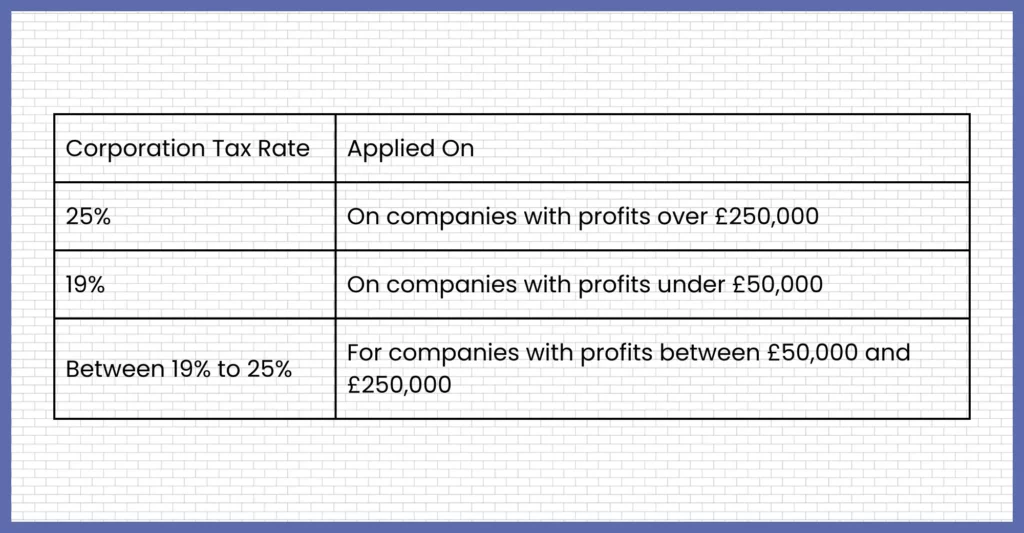
In simple terms, Corporation Tax is the tax a company pays on its profits. It applies to UK limited companies, foreign companies with a UK branch, and some clubs and associations. Since 1 April 2023, profits over £250,000 are taxed at 25%, and profits of £50,000 or less at 19%.
Before discussing the penalties, deadlines, and payment mechanisms, let’s clarify the corporation tax in the United Kingdom. Corporation tax is a tax paid by businesses on their annual profits, and the rates vary based on the amount of profits made. All limited companies based in the UK, foreign companies with UK branches, and certain clubs and co-operative associations, such as sports clubs and community groups, must pay corporation tax.
It’s also a big earner for the Treasury. HMRC’s Corporation Tax Statistics 2025 (published 25 September 2025) put it at roughly 10% of everything HMRC collects, and HMRC’s receipts bulletin of 20 February 2026 shows total tax receipts of £858.6 billion for 2024–25, 3.6% up on the year before.
Here are the current corporation tax rates in the UK:
| Taxable profits | Rate (financial years 2025 and 2026) |
| £0 – £50,000 | Small profits rate: 19% |
| £50,001 – £250,000 | Main rate 25%, reduced by marginal relief |
| Over £250,000 | Main rate: 25% |
When is the Due Date for Corporation Tax Payment?
For a company with taxable profits up to £1.5 million, the tax is due 9 months and 1 day after the accounting period ends. Plenty of clients mix this up with the CT600 deadline, which is 12 months after the year end. The payment deadline always comes first.
Are your clients confused about their due dates for corporation tax payments? We are sure they are seeking your help. The due date is 9 months and 1 day after the end of the accounting period, so please make a note of it.
Let’s explain it more simply:
If the financial year of your client ends on 31 May 2024, you’ll need to:
- File the annual accounts with Companies House by 28 February 2025
- Pay the corporation tax due to HMRC or tell them that no payment is due by 1 March 2025
- File a company tax return for this financial year by 31 May 2025
The key dates for a company with a 31 March 2026 year end
| Obligation | Deadline rule | Example date |
| Pay Corporation Tax (profits up to £1.5m) | 9 months and 1 day after period end | 1 January 2027 |
| File accounts at Companies House (private company) | 9 months after period end | 31 December 2026 |
| File Company Tax Return (CT600) | 12 months after period end | 31 March 2027 |
If you want more detail on the return itself, our CT600 guide for UK accountants walks through it.
What Are the Penalties for Late Payment of Corporation Tax?
If the tax isn’t paid on time, HMRC charges interest from the day after the deadline until the money arrives. The rate has been 7.75% a year since 9 January 2026 (the Bank of England base rate of 3.75% plus 4%). That’s separate from late filing penalties, which doubled on 1 April 2026.
None of your clients will be interested in paying corporation tax penalties for missing the deadline. Since 6 April 2025, HMRC has set late payment interest at base rate plus 4%, up from plus 2.5%. After the Bank of England cut the base rate to 3.75% in December 2025, HMRC’s published interest rates show late payment interest at 7.75% from 9 January 2026. If HMRC owes your client money, it only pays 2.75%, so being late costs far more than paying early. Ensure your client’s Corporation Tax payments are made on time to avoid these interest charges.
To put numbers on it: a £20,000 bill paid 90 days late picks up roughly £382 in interest (£20,000 × 7.75% × 90 ÷ 365). HMRC works it out daily and there’s no grace period, so even a few weeks adds up.
Interest and penalties are two different things
| Charge | Trigger | Amount (from 1 April 2026) |
| Late payment interest | Tax unpaid after 9 months and 1 day | 7.75% a year, charged daily |
| Late filing penalty | CT600 filed 1 day late | £200 (was £100) |
| Late filing penalty | CT600 more than 3 months late | Another £200, so £400 in total (was £200) |
| Repeat late filing | 3rd consecutive late return | £1,000, or £2,000 if 3+ months late |
| Tax-geared penalty | Return 6 months late | 10% of unpaid tax |
| Tax-geared penalty | Return 12 months late | Further 10% of unpaid tax |
How Do You Pay Corporation Tax to HMRC?
Corporation Tax has to be paid electronically. Your client can use Faster Payments, CHAPS, Bacs, Direct Debit or a corporate card online, and they must quote their 17-character payment reference. Bacs and card payments can take 3 working days to clear and a brand-new Direct Debit takes 5, so don’t leave it to the last day.
Before your clients even think of paying corporation tax, they will have to go through a time-consuming process of meeting certain obligations. Here, you will play a very important role in managing the entire process on behalf of your clients so that, in the end, there is no hassle when it comes to payment of corporation tax.
The process is as follows:
Gather the Relevant Data
Start by collecting relevant financial records from your clients, such as profit and loss statements, balance sheets, and so on. Also, ensure that deductions, allowable expenses, and reliefs are accounted for, minimising tax liability.
Calculating Corporation Tax Liability
Calculate the corporation tax due based on your client’s taxable profits and apply any available tax reliefs, for example., R&D tax credits to reduce tax burdens
Preparing and Filing the Corporation Tax Return (CT600)
You will have to complete the CT600 form and submit it electronically to HMRC via the online portal on behalf of your clients. Plus, keep an eye on the submission deadlines (usually 12 months after the end of the accounting period) to avoid penalties. It all starts with accurate year-end accounts, and if your team is stretched at peak times, year end accounts outsourcing can take some of that pressure off.
Inform the Client of the Tax Due
Inform your clients about the amount due and the payment deadline. The deadline is 9 months and 1 day, so they are ready for it.
Assisting with Payment Setup
If your client authorised it, you can assist them in setting up direct payment. However, if you are unable to offer this service, you can avail yourself of the corporation tax outsourcing service and cover for it.
You must pay corporation tax through:
- Bank transfer (Faster Payments, CHAPS, BACS)
- Direct debit
- HMRC’s online payment system
- Corporate debit or credit card online (HMRC doesn’t charge a fee, but it won’t take personal credit cards)
How long each method takes to reach HMRC
| Payment method | Time for funds to reach HMRC |
| Faster Payments (online or telephone banking) | Same or next day |
| CHAPS | Same day, if paid within the bank’s cut-off |
| Bacs | 3 working days |
| Direct Debit – first payment | 5 working days |
| Direct Debit – already set up | 3 working days |
| Corporate debit or credit card online | 3 working days |
If your client pays by bank transfer, HMRC’s Corporation Tax account is sort code 08 32 10, account number 12001039, account name HMRC Cumbernauld. It’s worth double-checking these and the reference on GOV.UK’s Pay your Corporation Tax bill page before sending anything.
Handling Payment Deadlines and Reminders
It is your responsibility to track upcoming deadlines and send reminders to your clients to avoid payment delays. Furthermore, you can advise your clients on payment strategies to improve cash flow.
Handling HMRC Correspondence and Compliance
Expect your clients to trust your service by giving you the responsibility to handle HMRC inquiries, audits, and compliance checks on their behalf. You can seek assistance from corporation tax outsourcing services from service providers and ensure quality for your clients. At Corient, our tax outsourcing support team prepares the computations and CT600s and deals with HMRC queries, while your firm keeps the final review.
Another important point to remember is that corporation tax must be paid either fully or in instalments, depending on your client’s profits.
Taxable profits of up to £1.5 million
As per the current rules, if your clients’ taxable profits are up to £1.5 million, pay corporation tax by 9 months and 1 day after the end of your accounting period.
Taxable profits are between £1.5 million and £20 million
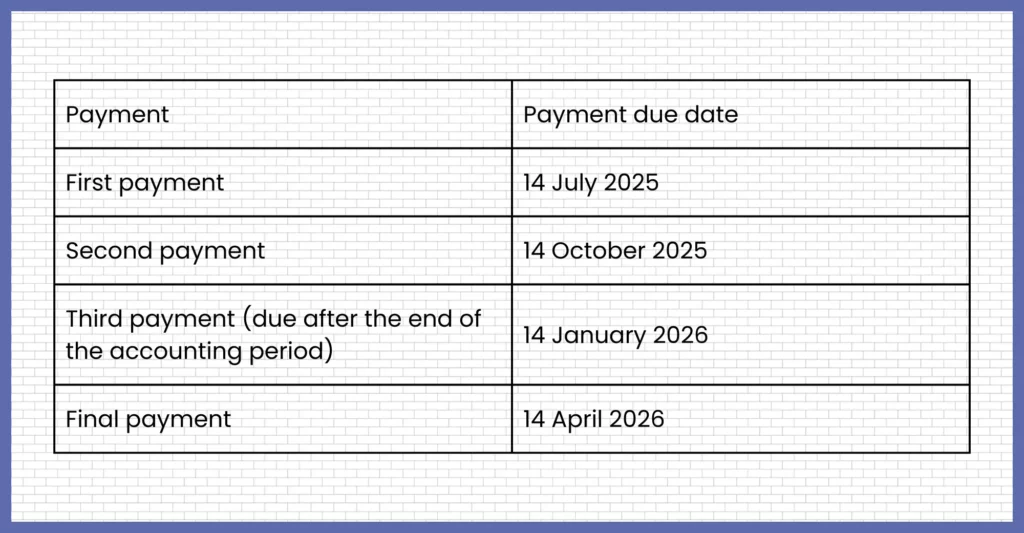
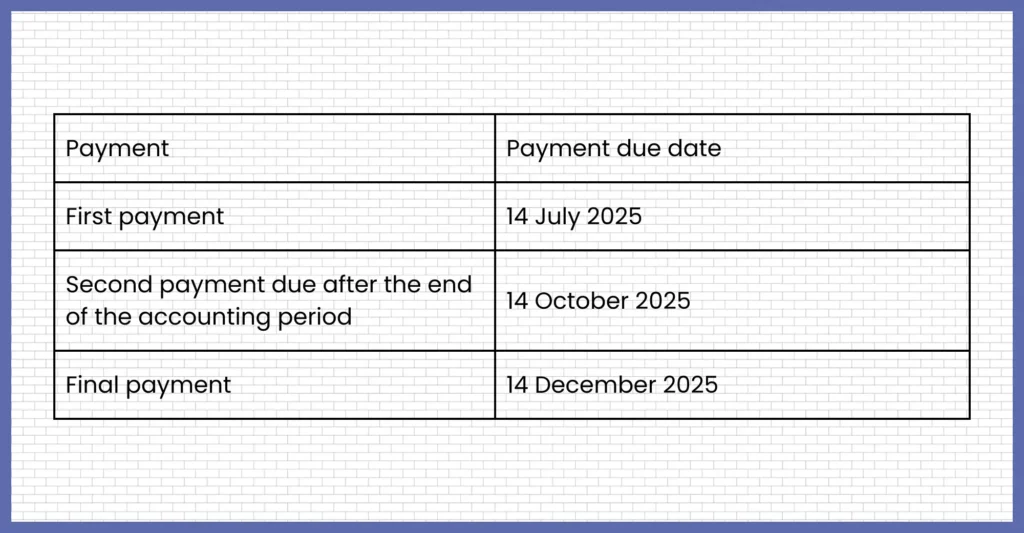
For those of your clients whose profits for an accounting period are at an annual rate of more than £1.5 million. Pay corporation tax electronically in four instalments for a 12-month accounting period, three instalments for a less than 12-month period.
If your client’s accounting period is from 1 January 2025 to 31 December 2025. The four installment schedules will be as follows:
If your client’s accounting period starts from 1 January 2025 to 31 August 2025. The three corporation tax installment schedule is as follows:
Taxable profits are more than £20 million
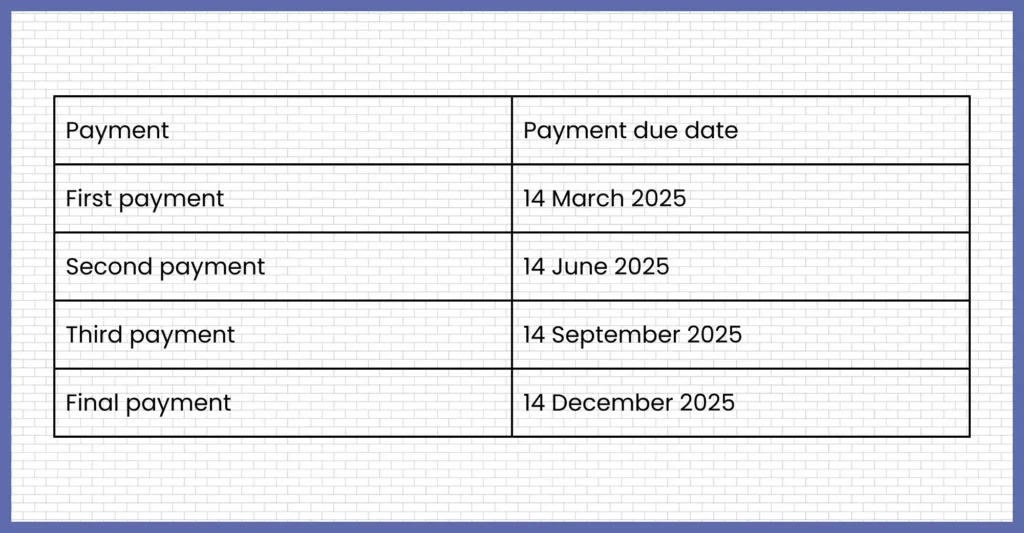
If your client’s profits exceed £20 million annually for an accounting period starting on or after 1 April 2019. They must pay corporation tax in four equal installments.
If your client’s accounting period is from 1 January 2025 to 31 December 2025. The installment payments will be on the following dates.
Frequently Asked Questions (FAQ)
How do I pay an HMRC late payment penalty?
The same way you’d pay the tax itself. Your client can pay online by Faster Payments, CHAPS, Bacs, Direct Debit or corporate card. Just make sure they use the payment reference printed on the penalty notice, otherwise HMRC may put the money against the wrong charge. Interest keeps running at 7.75% until the payment actually reaches HMRC.
Can I pay tax penalties in instalments?
Yes. If your client can’t clear a Corporation Tax bill or penalty in one go, they can ask HMRC for a Time to Pay arrangement and spread it over monthly payments. It’s best to call before the deadline, explain the cash flow problem and suggest an amount they can genuinely afford. Interest is still charged on whatever remains unpaid.
How do I get a repayment of Corporation Tax?
Your client claims it through their Company Tax Return (CT600). Show the overpayment on the return and include the company’s bank details, and HMRC will pay the refund straight into that account once the return is processed. If the tax was overpaid, HMRC may also add repayment interest, which has been 2.75% since 9 January 2026.
Can I set up a payment plan for Corporation Tax with HMRC?
Yes. If a company can’t pay on time, it can contact HMRC’s Payment Support Service and ask for a Time to Pay arrangement. Expect questions about income, outgoings and other debts. HMRC wants a plan that is realistic and clears the debt as quickly as possible, and every case is looked at individually. Interest carries on building in the meantime.
What is the deadline for payment of Corporation Tax?
For most companies, it’s 9 months and 1 day after the end of the accounting period. So a company with a 31 March 2026 year end needs to pay by 1 January 2027. Companies with profits over £1.5 million pay in quarterly instalments instead, and those over £20 million have to start paying even earlier.
How Can Corient Help Your Firm Manage Corporation Tax Payments?
This is the kind of work we do every day. Since 2011, Corient has helped UK accountancy firms with corporation tax computations, CT600 returns and payment schedules, from our base at The Techno Centre in Coventry. Our accountants work alongside our AI Crew tools, and your firm stays in charge of the final review and the client relationship.
Corporation tax is a vast ocean of procedures and regulations. Following them requires time, technology, and expertise, which is not your client’s cup of tea. That’s why they have placed their trust in your accounting firm. However, providing relief to your client, especially in corporate tax payment, is increasingly bogging you down. We have created this guide so that you don’t have to stress about corporation tax payment deadlines, penalties, and how to pay. Thus helping you concentrate on offering the best client services.
However, the corporation tax payment process can still tie you down since it is time-consuming. To avoid such a situation, you can outsource completely or specific aspects of corporation tax responsibility to an accounting outsourcing service provider. Speaking about service providers, have you tried the services of Corient, which is gaining considerable respect among accounting firms?
Established in 2011, we have made our name by offering tech-savvy and professional accounting services to accounting professionals based in the UK. Our operations are led by people like Sachin Lohade, who spent more than 19 years at firms including BDO International, PricewaterhouseCoopers and Serco Plc before joining us. Besides corporation tax services, our bookkeeping, payroll to audit, and year-end services have given our clients a good accounting experience. Write to us through our website contact form to understand our services in detail or clarify your doubts. Our executive will get in touch with you as soon as possible.
Best of luck and looking forward to a strong partnership.