

Making Tax Digital (MTD) for VAT requires every UK VAT-registered business, regardless of turnover, to keep digital accounting records and file VAT returns through HMRC-recognised software, with figures flowing through unbroken digital links rather than being retyped. The most common compliance failures are non-compliant software, manual data re-entry, and missed deadlines — all avoidable with the right setup and support.
Are you unsure if your clients fully comply with Making Tax Digital for VAT? This question arises among many accounting practices. Many practices in the UK are still adjusting to the ongoing changes brought by HMRC’s MTD initiative. Even accounting practices that believe they’re compliant often make costly but common mistakes like using the wrong accounting software, transferring data manually, or missing deadlines.
In this article, we’ll explain MTD for VAT, why it matters, the most common errors practices make, and how to avoid them. We’ll also recommend the best MTD-compatible software and show how Corient helps practices simplify compliance easily and confidently.
Key Takeaways
- All VAT-registered UK businesses, regardless of turnover, have had to comply with MTD for VAT since 1 April 2022.
- HMRC’s points-based penalty regime issues a £200 fixed penalty for each late VAT submission once a business crosses its filing-frequency threshold (HMRC/Price Bailey, 2026).
- The VAT registration threshold rose to £90,000 from April 2024 (Source: ACCA).
- MTD for Income Tax Self Assessment (ITSA) became mandatory from April 2026 for sole traders and landlords with qualifying income above £50,000 (Source: ACCA, June 2026).
- In HMRC’s own evaluation, 45% of businesses using fully functional MTD software said it saved them time (Source: HMRC/Verian research, gov.uk, 2025).
- Corient Business Solutions provides MTD-compliant VAT, bookkeeping, and ITSA outsourcing support for UK accounting practices.
What is Making Tax Digital for VAT?
Making Tax Digital for VAT is HMRC’s requirement that all VAT-registered UK businesses keep digital accounting records and submit VAT returns using approved software connected by unbroken digital links. It’s a UK government initiative introduced by HMRC to digitise tax administration, making the system more effective, efficient, and easier for businesses to get right.
As of April 2022, all VAT-registered businesses—regardless of turnover—must:
- Maintain digital VAT records.
- Use MTD-compatible software to submit VAT returns.
- Keep all data connected through digital links — a digital link is any electronic transfer of data between software programs, products, or applications that happens without manual copying, retyping, or cutting and pasting.
According to HMRC, over 1.8 million UK businesses have joined the MTD program, with more than 11.5 million VAT submissions completed through MTD-compatible software by the end of 2024.
Is Making Tax Digital Just for VAT?
Making Tax Digital is not limited to VAT. While it started with VAT compliance, MTD is part of HMRC’s broader strategy to digitise the UK tax system over the coming years fully.
The next major step is Making Tax Digital for Income Tax Self-Assessment (ITSA), scheduled to launch in April 2026. This phase will apply to self-employed individuals and landlords with a gross annual income of over £50,000. From April 2027, the threshold will be reduced to include those earning over £30,000. Affected taxpayers must keep digital records and submit quarterly income and expense updates to HMRC using MTD-compatible software, followed by a final end-of-year declaration.
In addition, Making Tax Digital for Corporation Tax is currently under consultation, with implementation expected sometime after 2026. Although no fixed timeline has been announced, accounting industry anticipates similar requirements to those for VAT and ITSA—namely, digital record-keeping, payment of corporation tax, and tax submissions via HMRC-recognised software.
Common Mistakes Accounting Practices Make with MTD for VAT
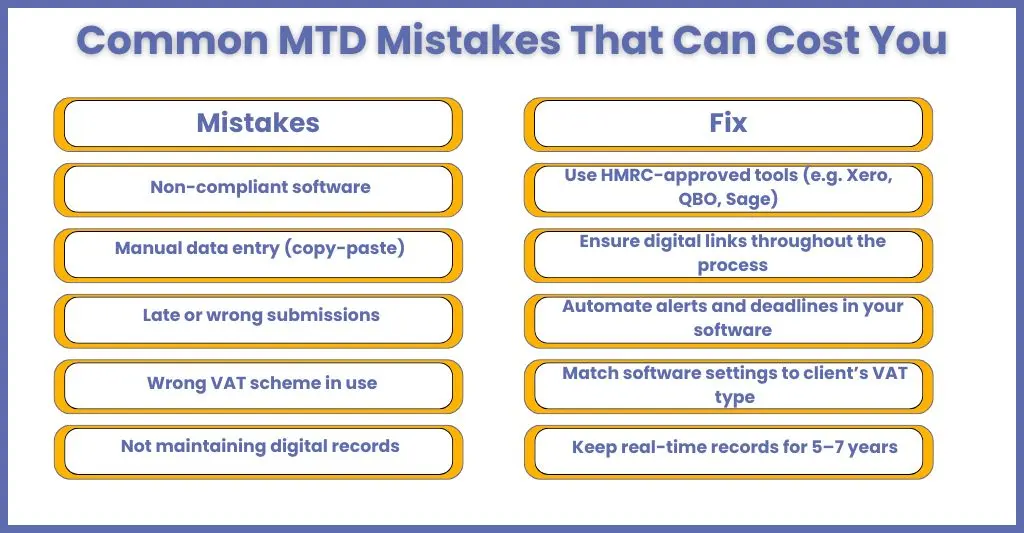
The five most common MTD for VAT mistakes are using non-compliant software, manual data entry that breaks the digital link, late or miscalculated submissions, misapplied VAT schemes, and failing to keep real-time digital records — all avoidable with the right software setup and review process.
These are the most common issues:
Using Non-Compliant Software
Using outdated accounting tools, especially those not recommended by HMRC, must be completely avoided. These systems lack the required features to send data directly to HMRC, thus adding to your work.
Solutions: Select cloud-based software that is recognised by HMRC and allows full digital record-keeping and submissions.
Manual Data Entry
With the introduction of MTD for VAT, manual data entry has become a thing of the past. Still, some accounting practices conduct manual data entry, breaking the digital link. Such breaks in the link cause data loss, manipulation, misreporting, and non-compliance.
Solutions: Hence, ensure that each step in your VAT reporting—from invoice input to submission—is digitally connected without any manual intervention through implementation of MTD.
Late or Incorrect Submissions
Miscalculating VAT or missing submission windows triggers HMRC’s points-based penalty system: every VAT-registered business earns one penalty point per late return, and once it reaches its filing-frequency threshold (2 for annual filers, 4 for quarterly, 5 for monthly), a fixed £200 penalty applies to that submission and every late one after it (Source: Price Bailey, citing HMRC, July 2026).
Solutions: By automating VAT calculations, filing schedules, and submission alerts using your accounting software, you can reduce the chances of human error or missing deadlines.
Incorrect Use of VAT Schemes
Incorrect application of VAT codes or applying the wrong scheme, such as flat rate or margin scheme, by practices in their software is a common mistake that leads to incorrect submissions.
Solutions: To avoid this mistake, you have to verify with your clients about their VAT schemes and adjust the settings in the software to ensure they align with the correct reporting requirements.
Failure to Maintain Real-Time Digital Records
The MTD initiative has made it mandatory for practices and clients to update and keep their records digitally. If you do not maintain digital records, HMRC can focus on you during audits.
Solutions: Maintain digital records for a few years, ideally for 5 to 7 years. If you are finding it difficult to get access to tools for maintaining digital records in real-time then get assistance from an accounting outsourcing service provider.
What Is the Best Software for Making Tax Digital for VAT?
Xero, QuickBooks Online, Sage Accounting, FreeAgent, and bridging tools such as BTCSoftware and TaxCalc are the software options most commonly recommended for MTD for VAT, each suited to a different practice size or client type.
- Xero: It offers real-time tracking, smart VAT rules, and seamless MTD compliance.
- QuickBooks Online: Highly user-friendly interface and excellent support for digital record-keeping and direct VAT submissions.
- Sage Accounting: Trusted by accounting firms that need robust reporting and compliance tracking.
- FreeAgent: Ideal for accounting practices that serve contractors, freelancers, and small businesses.
- BTCSoftware and TaxCalc: These tools are ideal for practices that are still dependent on Excel but seeking MTD compliance.
What Are the Benefits of Complying with MTD for VAT?
Beyond avoiding penalties, MTD compliance gives accounting practices faster VAT processing, real-time client visibility, fewer errors, and a stronger case for advisory-style client relationships.
Here are some key benefits for MTD for VAT and how it can transform your accounting operations.
Streamlining VAT Submission Process
MTD has simplified the entire VAT process by introducing digital record-keeping and filing through HMRC-compatible software. Such automation will eliminate the need for manual calculations and reduce repetitive tasks associated with VAT returns.
Real-Time Financial Visibility
Maintaining digital records and using the latest accounting tools allows your clients access to financial data in real-time. Such real-time information will allow you to advise and provide more proactive support.
Increased Accuracy and Compliance
With the introduction of MTD-compliant accounting software, all data entries are validated, ensuring that the data goes directly from the digital records to VAT returns. This process ensures lower chances of mistakes, omissions, and miscalculations, which in turn reduces the risk of penalties.
More Efficient Client Management
Digital records and automated workflows make it easier for practices to manage multiple clients without adding overhead costs. Standardised processes allow practices to serve more clients using the same resources.
Stronger Client Relationships
By adopting MTD, you are turning your practice from a once-a-year compliance provider into an all-year business advisor. You can communicate with your clients at regular intervals through regular digital submissions and offer continuous support. Such value-added services will lead to higher client retention and long-term engagement.
Reduced Risk of Late Submissions
An MTD-compliant accounting software will give you automated reminders and filing alerts so you do not miss out on HMRC deadlines. This reduces the pressure on your teams from last-minute filings and expensive oversights.
Future Readiness for Other MTD Mandates
MTD for VAT is just the beginning. By 2026, MTD for Income Tax Self-Assessment (ITSA) will be a reality, and plans are being made for corporation tax, too. Hence, it will invest in the tools required for the smooth implementation of MTD. This will make transitions smoother and maintain your competitive edge in digital compliance.
If implementing new processes or advanced MTD-compliant software is adding to your expenses then you can explore the option of VAT outsourcing services and get access to MTD-compliant accounting services and tools without compromising your budget and compliance.
Enhanced Practice Reputation
Clients trust accounting practices that stay ahead of regulations and adopt modern technologies. Offering MTD-compliant services positions your practice as reliable, forward-thinking, and digitally capable.
Why Partner with Corient for MTD Compliance?
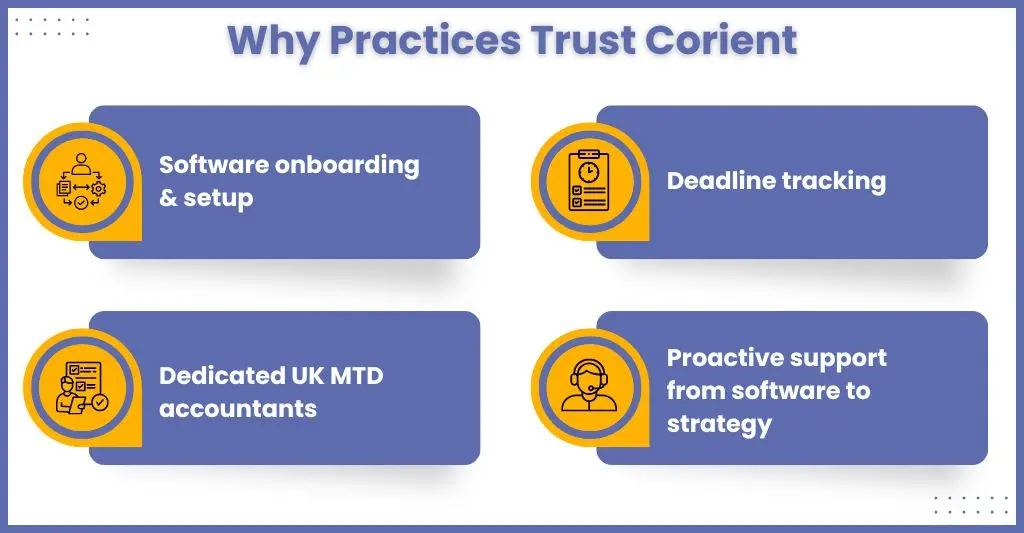
Corient helps UK accounting practices run MTD-compliant VAT, bookkeeping, and ITSA workflows through dedicated, trained teams — handling software onboarding, deadline tracking, and day-to-day submissions so practices don’t have to build that capacity in-house.
Corient has built its reputation not just as an accounting outsourcing service provider, but as a partner that stays one step ahead on compliance and technology, including MTD. We don’t just help clients stay compliant — we help practices become more efficient, scalable, and future-ready.
Here’s how we will help:
- Software Onboarding & Setup: We have earned the trust of accounting practices by professionally handling migration, setup, and training on cloud systems like Xero and QuickBooks
- Dedicated MTD Teams: MTD is becoming applicable to Income Tax and possibly corporation tax. To cater this demand, we have started investing in UK-focused accountants experienced in handling MTD compliance. These trained professionals will help you with every client submission accurately and promptly.
- Meeting Deadlines: We track all client VAT cycles and manage submissions to prevent any missed deadlines.
- Proactive Support: From software to strategy, we guide your practice on every step of the MTD journey — including the shift to Making Tax Digital for Income Tax and beyond.
Practices that want a lighter operational lift can also outsource day-to-day compliance work through our bookkeeping outsourcing service, which keeps digital records audit-ready between VAT periods.
Frequently Asked Questions (FAQ)
1. What is the deadline for Making Tax Digital?
MTD for VAT has applied to all VAT-registered businesses since 1 April 2022, regardless of turnover. MTD for Income Tax Self Assessment (ITSA) became mandatory from 1 April 2026 for sole traders and landlords with qualifying income above £50,000, dropping to £30,000 from April 2027 and £20,000 from April 2028. MTD for Corporation Tax has no confirmed start date yet.
2. How to register for Making Tax Digital for VAT?
Most VAT-registered businesses are automatically enrolled in MTD when they register for VAT through HMRC’s VAT registration service. If you registered before this became automatic, sign in to HMRC’s MTD portal with your Government Gateway ID and follow the sign-up prompts. Before registering, confirm your accounting software is MTD-compatible so you can file straight away without switching tools later.
3. What happens if I miss an MTD submission deadline?
HMRC uses a points-based penalty system: each late VAT return earns one point, and once you hit your filing-frequency threshold (2 for annual, 4 for quarterly, 5 for monthly filers), a fixed £200 penalty applies — repeated for every further late return until you reset. Late payment penalties and interest are calculated separately, on top of any submission penalty.
4. What does Making Tax Digital for VAT mean?
MTD doesn’t change what tax records a business must keep — only how those records are managed and submitted. Under MTD for VAT, businesses keep a digital record of specific data, including business name, address, VAT registration number, and a digital account of every VAT-rated transaction, all linked to submissions via HMRC-recognised software rather than manual re-entry.
5. Does Corient Business Solutions provide Making Tax Digital (MTD) support for VAT and Income Tax?
Yes. Corient provides dedicated MTD support for VAT, including software onboarding, deadline tracking, and submission management, and is building out equivalent support as MTD for Income Tax Self Assessment becomes mandatory. Practices can outsource as much or as little of the MTD workflow as they need, from one-off software migration to full ongoing compliance management.
6. Can I use third-party software for MTD VAT submissions?
Yes, you can use third-party software for Making Tax Digital for VAT (MTD VAT) submissions, in fact, you must.
7. How does Making Tax Digital impact VAT filing for small businesses?
MTD has fundamentally changed VAT filing for small businesses: digital record-keeping is now mandatory, returns must go through MTD-compatible software, and manual copy-paste between systems is no longer allowed. In exchange, businesses generally see fewer calculation errors and, per HMRC’s own research, meaningful time savings — though penalties now apply for missed deadlines or broken digital links.
Conclusion
Making Tax Digital for VAT is not just a regulatory requirement, it’s an opportunity for accounting practices to modernise, save time, and enhance accuracy for your clients. By avoiding common pitfalls and adopting the right technology, your firm can remain fully compliant and client-focused. Whether navigating MTD alone or seeking a trusted partner, Corient is here to help you every step of the way.
Corient has established itself as a trusted accounting outsourcing partner among multiple accounting practices in the UK. We have achieved that by proactively offering MTD-compliant VAT services along with bookkeeping, payroll, corporation tax, and more. If you have any queries, you can send them to us using our website contact form. Our executive will get in touch as soon as possible.
Looking forward to a long-term partnership.
