

UK bookkeeping outsourcing companies that support Xero and QuickBooks include Corient, Equallto, Probal Global, E-Tech Consultancy, Pearl Accountants, Q Accountants, and Kew Accounts. The right partner works inside your existing software, follows your review process, and holds ISO 27001 and GDPR credentials — so clients never need to change systems.
Imagine you have just onboarded 15 new clients. Some of these clients use Xero. Others use QuickBooks. A few still have Sage accounts. Bank reconciliations, VAT returns and month-end reports begin piling up, while your experienced accountants are spending more time processing transactions than speaking to clients.
This is where the choice of bookkeeping outsourcing partner becomes important.
The question is not simply, “Can they do bookkeeping?”
It is, “Can they do bookkeeping inside the systems my practice already uses?”
For UK accounting practices, software compatibility can make the difference between a genuinely useful outsourced service and another layer of work to manage. That matters because Xero and QuickBooks are widely used across the UK market.
Recruitment for UK accounting practices remains difficult. Government insights on Entry-level hiring in the UK show a 29% year-over-year decline in entry-level accountant hiring as of mid-2026
If you are dealing with these pressures, an experienced bookkeeping outsourcing partner can provide additional capacity without requiring every new client to trigger another recruitment exercise.
Why Does Software Compatibility Matter When Outsourcing Bookkeeping?
Software compatibility is important because your outsourcing partner should know your existing workflow rather than creating a new one. If you are already using Xero and QuickBooks, then your bookkeeping outsourcing partner should know how to use it in the real world.
A capable provider should understand bank feeds, reconciliations, transaction coding, VAT treatment, journals, reporting, supporting documents and month-end processes.
Which UK Bookkeeping Outsourcers Support Xero and QuickBooks?
| Provider | Xero & QuickBooks | Best suited to | Key point to consider |
| Corient | Xero, QuickBooks, Sage, FreeAgent, KashFlow and more | UK accounting practices needing scalable outsourced capacity | Dedicated teams, white-label delivery and UK GAAP, HMRC and MTD knowledge |
| Equallto | Xero, QuickBooks Online, Sage and hosted desktop | Small and micro accounting practices | Flexible bookkeeping support, including daily, weekly or monthly capacity |
| Probal Global | Xero, QuickBooks, Sage and FreeAgent | UK practices looking for offshore bookkeeping | Offers bookkeeping capacity within the client’s existing software |
| E-Tech Consultancy | Xero, QuickBooks, Sage and FreeAgent | UK practices seeking dedicated offshore teams | Dedicated remote bookkeeping teams working under the firm’s processes and branding |
| Pearl Accountants | Xero, QuickBooks, FreeAgent, Sage and others | Businesses and practices needing software-specific bookkeeping expertise | Strong focus on cloud accounting and QuickBooks/Xero support |
| Q Accountants | Xero and other bookkeeping platforms | Businesses seeking outsourced bookkeeping | ACCA-regulated provider with Xero Gold Partner status |
| Kew Accounts | Xero and QuickBooks Online | Smaller businesses and clients needing cloud bookkeeping | Specialist focus on Xero and QuickBooks, with VAT and CIS support |
How Much Does It Cost to Outsource Bookkeeping in the UK?
Outsourced bookkeeping in the UK typically costs between £50 and £3,500 per month, or £18 to £60+ per hour, depending on transaction volume, business size, and whether you choose a UK-based or offshore provider.
Pricing varies more than most practices expect, mainly because “bookkeeping” covers everything from a sole trader with a handful of transactions to a multi-entity client with daily reconciliations across several bank feeds. Here’s a rough breakdown:
| Client Profile | Typical Monthly Cost | Typical Hourly Rate | Notes |
| Sole trader / micro business | £50 – £250 | £18 – £25 | Low transaction volume, simple reconciliations |
| Small business (SME) | £250 – £800 | £25 – £35 | Regular VAT returns, monthly reporting |
| Growing practice-managed portfolio | £800 – £2,000 | £30 – £45 | Multiple clients, mixed software (Xero/QuickBooks/Sage) |
| High-volume or multi-entity clients | £2,000 – £3,500+ | £40 – £60+ | Daily reconciliations, complex reporting, dedicated team support |
The number on its own isn’t the full picture, though. A per-hour rate that looks cheap can work out expensive if turnaround is slow or errors require rework, while a higher rate from a dedicated, ISO 27001-certified team like Corient’s can often work out more cost-effective once recruitment, training, and error-correction costs are factored out of the equation entirely.
What Should You Check Before Choosing a Bookkeeping Outsourcer?
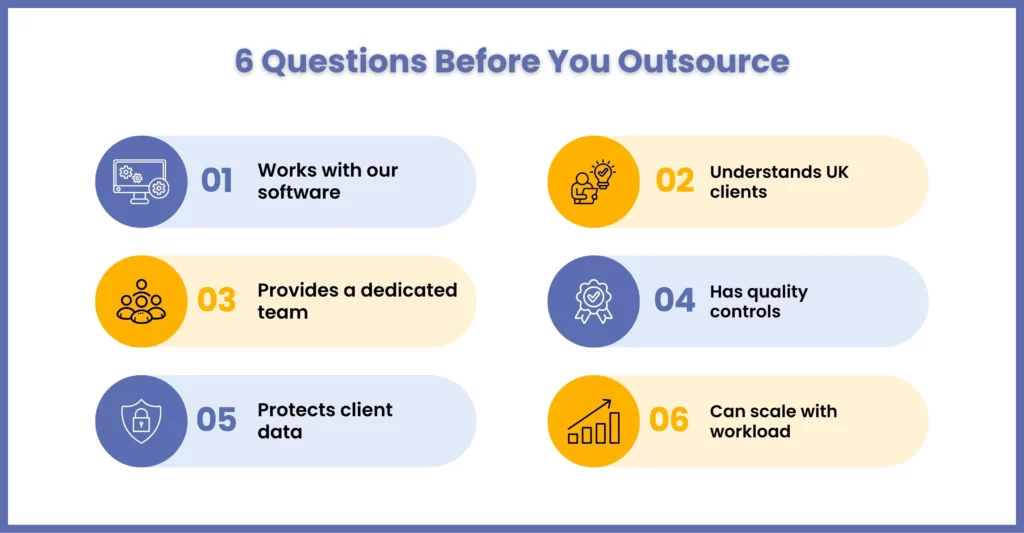
Due to talent shortages and high-cost in getting in experienced accountants, many practices are preferring outsourcing bookkeeping. However, before doing that there are certain points you must check that will help you identify the right bookkeeping outsourcing provider. These points are:
1. Can They Work in Your Software?
Ask them about their speciality in Xero and QuickBooks rather than accepting a general statement from them that they are cloud accounting experts. Find out how much practical experience the team has with each platform.
2. Do They Understand UK Clients?
Your provider should be well-versed in UK VAT, HMRC processes, MTD on Income Tax requirements, and bookkeeping standards that are applicable to your clients. Software knowledge without UK accounting knowledge is not enough.
3. Will You Get a Dedicated Team?
A dedicated team assigned to you will make handovers easier. The team will work only for you and gradually learn about your processes, client profiles, and review requirements.
4. How Is Quality Controlled?
Ask who will be responsible for checking the work done before it reaches you. You need to understand the review procedure, escalation procedure, and responsibility for correcting errors.
5. How Is Client Data Protected?
Client bookkeeping records contain sensitive financial information. Ask about security certifications, access controls, encryption, staff training, and data handling procedures.
6. Can Capacity Change With Your Workload?
A useful partner should be able to adapt to your changing needs without forcing you into a completely different operating model.
How to Make Outsourcing Work Smoothly
The success of outsourcing starts much before the first client file is transferred to your provider. It starts with identifying the right outsourcing provider, then documenting the process.
This should cover:
- What information the team receives
- Which software they use
- Who handles queries
- What deadlines apply
- What checks are required
- Who reviews the completed work
- How exceptions are escalated
Conduct a small pilot test to identify gaps without disrupting the wider practice.
Corient’s current onboarding process involves understanding the practice’s workflows and systems, mapping the work, assigning a dedicated team, and using a parallel period before going live.
Why Corient Works for Xero and QuickBooks Practices
Corient has made its name in the UK accounting market by providing accounting practices with outsourced bookkeeping and accounting services as a behind-the-scenes extension of their in-house teams.
Its current bookkeeping outsourcing service supports Xero, QuickBooks, Sage, FreeAgent, KashFlow, BrightPay and other UK accounting and tax platforms. Corient accounting team is well-versed with the latest UK GAAP, HMRC rules and MTD requirements.
The model is designed around dedicated teams rather than a shared queue. That matters when a practice wants consistency across its client portfolio.
Corient’s service is also white-label, meaning the outsourced team works under the accounting firm’s brand while the practice retains control of client relationships and delivery.
Its services are ISO 27001 certified, GDPR compliant, and Cyber Essentials certified, with controlled access and secure systems.
For practices already using Xero and QuickBooks, the practical benefit is straightforward: you can add bookkeeping capacity without asking clients to change the software they already know.
People Also Ask
Which accounting software is most used in the UK?
Xero and QuickBooks Online are the most widely used accounting software packages in the UK, closely followed by Sage. Most practices and outsourcing providers have expertise in all three of them so that their clients don’t have to change their accounting systems.
What accounting software does HMRC recommend?
HMRC does not recommend any specific brand or product. Instead, HM Revenue and Customs (HMRC) maintains a list of recognised commercial software that is compatible with Making Tax Digital (MTD). You can search and filter these options using the official GOV.UK Choose the right software guide.
Which is better, Xero or QuickBooks UK?
Xero is generally better for growing small businesses and collaboration because it offers unlimited users on all plans, while QuickBooks Online is often cheaper for sole traders and stronger for built-in inventory or mileage tracking. Both platforms are fully recognised by HMRC for Making Tax Digital (MTD), which covers VAT and Income Tax.
Conclusion
Choosing a bookkeeping outsourcing provider should not come down to asking, “Do you support Xero?”
The better question is:
“Can you work inside our software, follow our processes and deliver bookkeeping to the standard our clients expect?”
That distinction matters.
Xero and QuickBooks compatibility gives you the technical foundation, but UK accounting knowledge, quality control, security, communication and scalability determine whether the relationship actually works.
With recruitment pressures continuing across the profession, practices need more flexible ways to create capacity. If your client book is growing faster than your internal bookkeeping capacity, outsourcing can give your practice another option.
Corient works with accounting practices using Xero, QuickBooks and other major UK accounting platforms, providing dedicated, white-label bookkeeping capacity behind the scenes.
If you are considering outsourcing some or all of your bookkeeping, contact us to discuss your current software, workload and the level of support your practice needs.
