

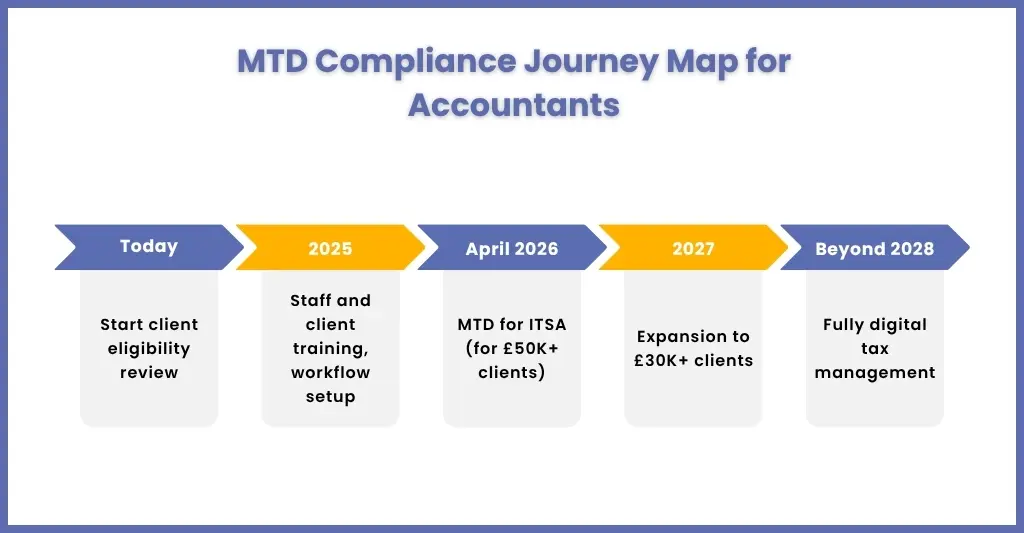
MTD for Income Tax became mandatory on 6 April 2026 for sole traders and landlords with qualifying income over £50,000, requiring digital record-keeping and quarterly HMRC submissions instead of one annual return. The threshold drops to £30,000 in April 2027 and £20,000 in April 2028, bringing in close to three million taxpayers.
The HMRC MTD Income Tax Changes 2026 are set to introduce fundamental reforms to the UK tax system. Initially announced in 2015, the Making Tax Digital (MTD) initiative began with VAT in 2019 and is now expanding further. Starting from April 2026, MTD for Income Tax Self-Assessment (ITSA) will become mandatory for sole traders and landlords earning over £50,000 annually, affecting around 1.7 million taxpayers across the UK, rising to nearly three million by 2028. If you run an accounting practice, your client list almost certainly includes people in scope from day one.
The Make Tax Digital (MTD) initiative presents challenges and opportunities for accounting practices. Therefore, to overcome the challenges and capitalise on the opportunities, you will need to be familiar with everything about MTD. In this blog, we will discuss this topic, highlighting its impact, how to prepare for it, and who can assist you in its implementation.
Key Takeaways
- 6 April 2026: MTD for Income Tax is mandatory for sole traders and landlords with income over £50,000.
- Quarterly deadlines: 7 August, 7 November, 7 February, and 7 May each year.
- Around 780,000 taxpayers entered the MTD regime in April 2026 (HMRC estimate).
- Thresholds reduce: £30,000 from April 2027, £20,000 from April 2028.
- MTD-compatible software is mandatory — Xero, QuickBooks, and Sage are all HMRC-recognised.
- Corient supports UK accounting practices with outsourced MTD compliance from Coventry.
Understanding the MTD for Income Tax Self-Assessment (ITSA) Reforms
MTD for ITSA replaces the single annual Self Assessment return with digital record-keeping, four quarterly updates and a year-end final declaration, all filed through HMRC-recognised software.
If your clients are eligible for MTD for income tax self-assessment, then they are, or you can do the following things on their behalf:
- Maintain Digital Records: All records, especially income and expenses, will be stored in digital format using MTD-compliant software.
- Submit Quarterly Updates: Under MTD for Income Tax, self-assessment must be done every three months instead of once a year to the HMRC. From April 2026, the deadlines for the quarterly submissions will be 7th August, 7th November, 7th February, and 7th May.
- File an Annual Final Declaration: At the end of the tax year, a final declaration summarising the year’s financial activities must be submitted.
These reforms have been brought in to provide clarity on tax liabilities, reduce errors, and simplify the entire UK tax process.
MTD for Income Tax: The Numbers So Far
Three figures show how the rollout is actually going, not just how it was planned:
- 864,000 sole traders and landlords were estimated to need to comply from April 2026, based on 2023/24 Self Assessment data — HMRC estimate, published August 2025, cited by ICAEW, 19 August 2025.
- As of 12 August 2026, over 570,000 taxpayers had signed up and 436,000 had filed their first quarterly update by the 7 August 2026 deadline — GOV.UK / HMRC press release, 12 August 2026.
- From September 2026, HMRC began automatically signing up the roughly 290,000 taxpayers who should already be using MTD for Income Tax but had not registered themselves — same GOV.UK press release, 12 August 2026
Impact of HMRC MTD Income Tax Changes 2026 on UK Accountants
MTD for ITSA increases practices’ quarterly workload and software requirements, but it also opens the door to advisory revenue by automating routine compliance tasks.
The introduction of MTD for ITSA will bring transformational changes to the way accounting practices in the UK operate. The goal of MTD is to simplify the tax process; however, it has unintentionally created some implications for your accountants. Let’s go through them:
Increased Workload
Quarterly reporting means more interaction with clients, keeping digital records, and submitting updates to HMRC. Unlike the self-assessment, which is done once a year, quarterly submissions require regular engagement with your clients throughout the year. Such reporting and maintenance of digital records demands enhanced organisational workflows and proactive management to ensure no deadlines are missed.
Need for MTD-Compatible Software
Under MTD, you will need to use HMRC-approved software for real-time data submission and record-keeping. It is crucial to select the right one for the sake of efficiency and accuracy. The software should integrate seamlessly with the existing accounting systems, automate calculations, and streamline the whole submission process.
Client Education
It is essential to educate your clients about MTD and its responsibilities. You must guide your clients on maintaining digital records, using MTD-compliant software, and submitting quarterly updates. By informing your clients (sole traders and landlords) about it, you will prevent errors and ensure full compliance. Maintain regular communication with your clients along with accounting practices.
Potential for Advisory Services
Yes, MTD will increase your accountant’s administrative burden, but it will also allow you to shift towards advisory services. MTD will automate calculations and data entry, allowing your accountants to focus more on providing insights on tax planning, cash flow management, and financial decision-making. Such a transition will create more revenue opportunities, add value to your clients and enhance your relationship with them.
Preparing for HMRC’s 2026 MTD Income Tax Deadline
Practices prepare for MTD by assessing client eligibility, selecting HMRC-recognised software, training staff and clients, building quarterly workflows and monitoring ongoing compliance.
Now is the time to prepare your accountant and your clients for the 2026 MTD Income Tax, especially if they are eligible. To ensure a smooth process, you will need to:
Assess Client Eligibility
Start by listing which of your clients will be eligible for the upcoming MTD Income Tax requirements and communicate this to your clients.
Select Compatible Software
Select the best accounting software that is MTD-compliant and meets your and your clients’ accounting requirements.
Train Staff and Clients
Create training modules for your accounting staff and clients on the new MTD process and software.
Establish New Processes
Start creating new workflows for quarterly submissions and final declarations.
Monitor Compliance
Keep a constant watch on all your clients regarding the following new accounting and MTD compliance requirements.
For clients whose Income Tax filing sits alongside a wider personal tax workload, our Personal Tax Outsourcing service and dedicated Making Tax Digital service page cover both the quarterly submission work and the surrounding return.
How These Changes Impact UK Accountants and Their Clients
MTD pushes accountants toward more frequent, structured client communication, since quarterly reporting depends on clients supplying timely digital records.
Like MTD VAT, the MTD for ITSA is becoming compulsory soon, it is prompting accountants to foster a more open, flexible, and communicative relationship with clients. Maintaining such a relationship with clients is necessary because MTD mandates quarterly reporting, along with effective data management.
With robust communication, your clients will receive more timely insights into their tax position in real-time, enabling them to plan more effectively and reduce the likelihood of penalties.
Why Partner with Us for MTD Compliance?
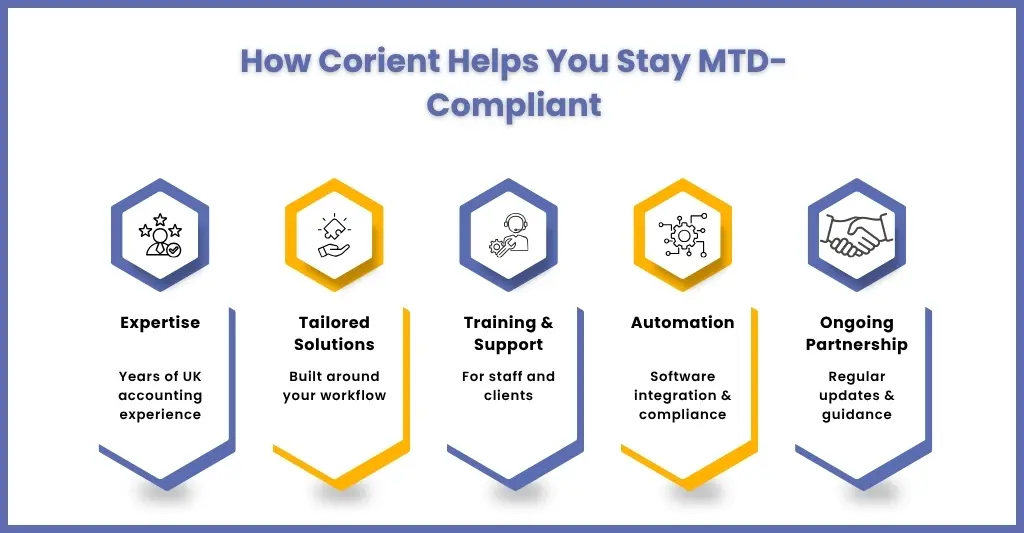
Corient handles MTD-compliant digital record-keeping, quarterly update preparation and HMRC submissions for UK accounting practices, so in-house teams aren’t stretched thin during the transition.
Tuning yourself with the new MTD for ITSA compliance is easy. We wish it were a yes, but it’s not. We understand that it’s not your accountant’s expertise to maintain regular communication with your clients.
To put it simply, transitioning to MTD for Income Tax Self-Assessment (ITSA) in 2026 is a complex task which can be achieved only by partnering with a professional service provider. Corient can help ensure that your practice navigates this transition smoothly.
Here’s how we support UK accountants:
Expertise
Our accounting team has experience in handling MTD VAT and has deep knowledge of MTD regulations related to ITSA. Our accountants are familiar with the quarterly reporting requirements and the importance of managing digital record-keeping. We will provide you with guidance through our accounting outsourcing services to keep your practice compliant and prevent penalties.
Corient’s team — certified in Xero and QuickBooks and based at our Coventry office — has already guided UK practices through the MTD VAT rollout, and applies that same playbook to MTD for Income Tax Self-Assessment.
Tailored Solutions
Each practice has different requirements, and Corient is capable of offering MTD-compliant solutions tailored to your workflow, client base, and operational needs. This way, seamless integration is achieved with existing systems, simplifying the process.
Training and Support
To successfully adopt MTD, you will need to train your staff and your clients to understand the new process. This training can be provided by us, along with all-around comprehensive support, to ensure assistance when using new software or during quarterly reporting.
Ongoing Assistance
Our partnership extends beyond implementation. We offer all-around support to tackle any challenges, troubleshoot issues, and provide updates on regulatory changes. The assistance we provide will help with compliance, improve efficiency, and enable your accountants to focus on strategic advisory services.
People Also Ask
1. What records do clients need to maintain under MTD?
Under MTD, your clients will be required to maintain digital records of income and expenses related to their business or property income. This includes sales invoices, purchase receipts, bank statements, and mileage or expense logs, all stored in HMRC-recognised software rather than spreadsheets or paper files, ready for each quarterly update.
2. Is MTD for Income Tax mandatory from April 2026?
Yes. MTD for Income Tax Self-Assessment is mandatory from 6 April 2026 for sole traders and landlords with qualifying income above £50,000. There are no opt-outs. HMRC is not issuing penalty points for late quarterly updates during 2026/27, but points-based penalties start from April 2027. The threshold drops to £30,000 in April 2027 and £20,000 in April 2028.
3. How can outsourcing help accounting practices manage the MTD workload?
Outsourcing MTD-related work to a specialist firm like Corient allows practices to handle the additional quarterly submission volume without hiring extra staff. Corient’s Coventry-based team manages digital record-keeping support, quarterly update preparation and HMRC submissions on your behalf, working inside Xero, QuickBooks and Sage, freeing your accountants for higher-value advisory work.
4. What MTD-compatible software do I need for Income Tax?
Yes, MTD-compatible software is mandatory — HMRC does not provide free software for Income Tax. HMRC-recognised options include Xero, QuickBooks, Sage, FreeAgent, and IRIS. Clients who wish to keep using spreadsheets can do so with bridging software that links their records to HMRC’s API. Software must support quarterly submissions, bank feed automation, and direct HMRC API integration.
5. Who is affected by the MTD income tax changes from April 2026?
MTD for Income Tax affects self-employed individuals and landlords in the UK. Phased rollout: qualifying income over £50,000 from April 2026; over £30,000 from April 2027; over £20,000 from April 2028. HMRC originally estimated around 864,000 taxpayers would enter the regime in 2026, rising toward three million by full rollout. Note: Qualifying income is gross, not net profit. Partnerships are not yet included.
6. What are the benefits of MTD for Income Tax for accounting practices?
MTD for Income Tax benefits accounting practices in several ways, turning a compliance burden into a source of recurring client contact and revenue:
a. Real-time visibility of clients’ tax positions throughout the year
b. Fewer year-end errors due to ongoing digital record-keeping
c. More touchpoints with clients, opening the door to advisory conversations
d. Reduced risk of HMRC penalties through timely quarterly submissions
e. Improved practice efficiency through automation of routine calculations
Summing Up
The MTD Income Tax is coming in 2026, and it will change the entire UK tax landscape. For your accounting practice, these changes are more than just a compliance requirement; they are an opportunity to enhance client relationships and deliver greater value.
Practices that embrace these reforms early will stand out as forward-thinking and client-focused, gaining a competitive advantage in an increasingly digital tax environment. When you embrace it, you will get a competitive advantage in an increasingly digital tax environment.
Partnering with Corient ensures that your firm is fully equipped to handle the transition smoothly. We will assign a dedicated accountant to handle your MTD requirements, allowing you to focus on other accounting tasks. Our staff will assist you in selecting the ideal software to record, review, and file VAT returns digitally. Moreover, our staff is also certified and trained in QuickBooks and Xero.
Turn MTD compliance into an opportunity by partnering with Corient. Connect with us and get a free trial to check out our services.
