
Accounting outsourcing firms are using artificial intelligence for automating repetitive accounting tasks, such as bookkeeping, invoice processing, bank reconciliations, payroll checks, and document extraction. This has allowed accountants to spare time for client advisory and strategic work. However, it would be unfair to say that AI is going to replace accountants; instead, it is making them more productive.
We have seen outsourcing firms stuck with hundreds of supplier invoices, bank statements, payroll updates, and VAT queries from their clients. It kept their accounting team occupied in repetitive tasks, such as entering data, matching transactions, checking invoices, and correcting manual errors.
Now imagine if AI is used in handling all the manual tasks instead of manually typing invoice details or reconciling bank feeds line by line. Multiple hours will be saved, and their accountants can focus on helping clients reduce tax liabilities, improve cash flow, and grow their businesses.
This shift is already happening across the accounting profession.
According to the 2025 Wolters Kluwer Future Ready Accountant Report, 66% of accountants are already using AI, including 69% of professionals working in accounting practices. This means AI has become more than just another technology trend; it is rapidly becoming a competitive advantage.
In this guide, we’ll explain how accounting outsourcing firms use AI, where it adds the most value, what AI still can’t replace, and why the most successful outsourcing providers combine AI with experienced accounting professionals rather than relying on automation alone.
Why AI Is Transforming Accounting Outsourcing
Outsourcing has always helped accounting practices in increasing their capacity while reducing operational pressure on their accounting teams, but AI has expanded those benefits even further. AI has now automated most of the repetitive processes that were deemed impossible in the past.
This creates three major advantages:
- Faster turnaround times
- Greater accuracy
- Improved scalability
Some accounting outsourcing service providers have already embraced AI to its fullest, like Corient, and are better positioned to deliver advisory services, improve efficiency, and create more value. This is particularly important for accounting practices like yours that want to grow without constantly increasing headcount.
What Does AI Actually Do in an Accounting Outsourcing Firm?
Don’t assume that AI will do all the accounting work; instead, it will handle all repetitive and rule-based tasks, while experienced accountants can review, interpret, and validate the results. AI works like an efficient assistant that will work 24/7 and process thousands of transactions in seconds.
Typical AI capabilities include:
- Reading invoices automatically
- Extracting financial data
- Categorising transactions
- Matching invoices with purchase orders
- Reconciling bank feeds
- Identifying duplicate transactions
- Flagging unusual activity
- Predicting cash flow trends
But professional accountants still make the final decisions. This human oversight remains important for ensuring compliance with HMRC regulations, UK GAAP, and handling client-specific accounting requirements. This combination of AI and human expertise (oversights) has been perfected by professional outsourcing providers like Corient.
8 Ways Accounting Outsourcing Firms Use AI
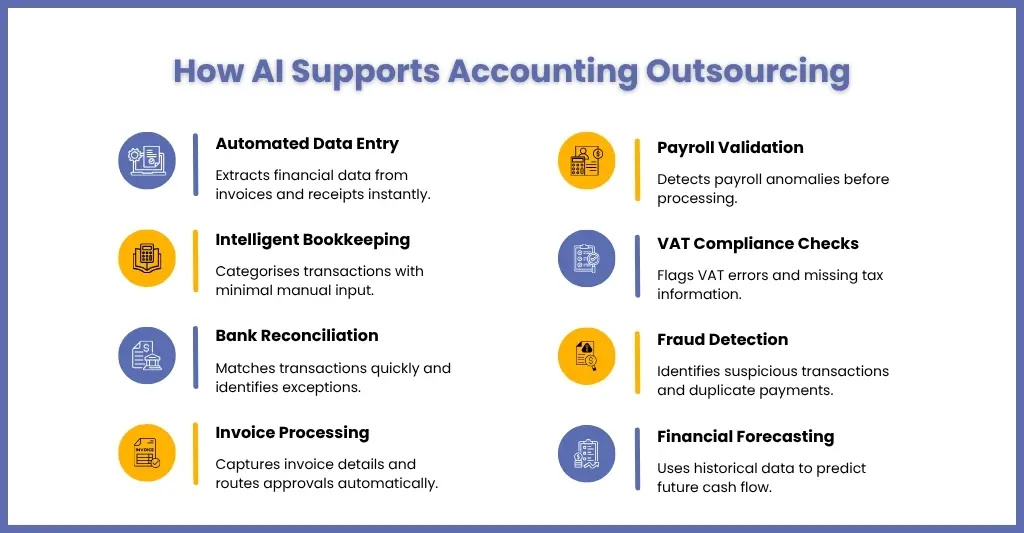
Accounting outsourcing providers have been quite creative when it comes to using AI to their advantage. Some of these interesting ways are:
1. Automated Data Entry
Manual data entry consumes a considerable amount of time while doing bookkeeping. AI technologies like Optical Character Recognition (OCR) and machine learning reduce human intervention by reading invoices, receipts, and financial documents automatically.
This reduces:
- Human error
- Processing time
- Administrative workload
2. Intelligent Bookkeeping
Modern AI tools like Digits are self-learning when they analyse previous accounting records. Over time, they learn how to categorise expenses to their nominal codes. Bookkeepers can then verify exceptions instead of processing every transaction manually.
3. Faster Bank Reconciliations
Outsourcing providers handle accounting work for multiple practices that includes reconciling hundreds or thousands of transactions every month, which is a time-consuming process.
But now providers are using AI to match automatically:
- Bank transactions
- Customer payments
- Supplier invoices
- Expenses
- Receipts
Only unmatched items require human investigation. This dramatically speeds up month-end processing.
4. Invoice Processing
AI has made the task of accounts payable teams of outsourcing providers easier. Now, invoices coming from email can be processed automatically.
AI is used for extracting:
- Supplier details
- Invoice numbers
- VAT amounts
- Payment dates
- Purchase values
The AI system then routes invoices through predefined approval workflows. This reduces bottlenecks while improving visibility.
5. Payroll Validation
Handling payroll processing requires experienced professionals, and AI has made their life easier by helping them reduce errors before submissions are made.
AI systems can identify:
- Duplicate employees
- Missing payroll data
- Unusual salary changes
- Tax code inconsistencies
- Pension anomalies
This additional layer of validation improves payroll accuracy.
6. VAT Compliance Checks
Preparing VAT returns involves reviewing thousands of financial transactions.
But when outsourcing providers started using AI, it simplified:
- Identification of incorrect VAT codes
- Highlighting of missing VAT information
- Detecting duplicate VAT claims
- Flagging unusual adjustments
Accountants can focus on investigating exceptions before submitting returns through Making Tax Digital.
7. Fraud Detection and Risk Monitoring
Professional accounting outsourcing providers have identified that AI is very good at spotting unusual behaviour.
It can identify:
- Duplicate invoices
- Suspicious payment patterns
- Unusual supplier activity
- Potential fraud indicators
- High-risk transactions
In fact, AI strengthens, not replaces, internal controls.
8. Financial Reporting and Forecasting
AI doesn’t just analyse historical data; it increasingly helps providers in predicting future performance.
By analysing trends, AI can support:
- Cash flow forecasting
- Budget analysis
- Spending patterns
- Revenue forecasting
- Client performance reporting
This allows accountants to provide more proactive advice rather than simply reporting past results.
AI vs Human Accountants: What’s the Difference?
| Task | AI | Human Accountant |
| Data entry | ✅ Excellent | Limited |
| Invoice processing | ✅ Fast | Reviews exceptions |
| Bank reconciliation | ✅ Automated | Investigates discrepancies |
| VAT calculations | ✅ Assists | Validates compliance |
| Payroll validation | ✅ Flags anomalies | Final approval |
| Advisory services | ❌ Limited | ✅ Expert judgement |
| Tax planning | ❌ Cannot replace expertise | ✅ Strategic advice |
| Client relationships | ❌ No | ✅ Essential |
| Complex accounting decisions | ❌ No | ✅ Required |
Most professional outsourcing firms do not choose between AI and people; they combine both.
- AI for repetitive accounting tasks
- Experienced accountants for handling complicated matters and delivering professional judgement.
That combination produces faster, more accurate, and more scalable accounting services.
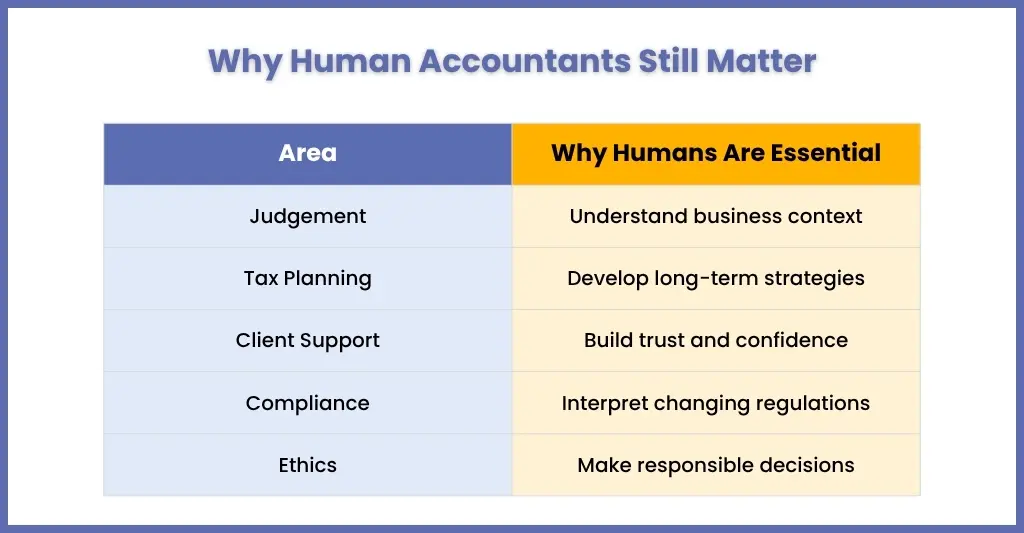
What AI Still Can’t Replace
AI is playing an important role for accounting outsourcing service providers in speeding up their work. But accounting remains a profession built on trust, judgement, and relationships, and that trust is generated when providers have experienced accounting talent for the job. That’s many professional accounting outsourcing providers like Corient have not done away with their accounting talent and use them in combination with AI tools.
There are several areas where experienced accountants remain indispensable.
Professional Judgement
AI can only process the information; it can never understand the context behind every transaction. Determining the correct accounting treatment often requires experience and professional reasoning.
Tax Planning
AI can calculate taxes based on the existing rules but cannot do strategic planning, which can be done only by accountants. Helping clients minimise liabilities, structure businesses efficiently, or plan future investments requires human expertise.
Client Relationships
Your clients don’t simply want accurate accounts. They want someone who understands their business and helps them during uncertain times. Such assurance cannot be given by a tool.
Complex Compliance
UK accounting involves constantly changing regulations from HMRC, Companies House, and other regulatory bodies. Experienced accountants interpret those changes and apply them correctly. AI follows programmed rules.
Ethical Decision-Making
Professional accountants regularly face situations where ethical judgement is needed. Whether advising clients or resolving unusual financial issues, these decisions require human sensibility and responsibility.
The future of accounting is human-led AI-enabled, not technology replacing professionals. Something that Corient as mastered effectively.
How Corient Combines AI with Human Expertise
We at Corient believe that the future of accounting will not be decided by AI alone but by a combination of AI and experienced accounting professionals. Our 600+ UK-qualified and ACCA certified accounting professionals use purpose-built AI tools like Billy and Corby X to deliver faster bookkeeping, payroll, and VAT services, all reviewed by experienced accountants before reaching you. Trusted by 200+ UK accounting practices. ISO 27001 certified.
AI supports our teams by automating repetitive processes such as:
- Data extraction
- Invoice processing
- Transaction matching
- Bank reconciliations
- Document organization
- Routine validation checks
All the critical accounting tasks are then reviewed by experienced professionals before they reach you.
This hybrid model delivers the best of both worlds:
- Faster turnaround times
- Greater consistency
- Reduced manual effort
- Improved accuracy
- Better scalability
- Professional oversight
Rather than sidelining accountants, AI allows them to spend more time focusing on quality, compliance, and client outcomes.
The Future of AI in Accounting Outsourcing
AI is evolving as we speak, and in the coming years more aspects of accounting will be covered by it.
Upcoming developments might include:
- More predictive financial insights.
- Enhanced fraud detection.
- Smarter cash flow forecasting.
- Improved document recognition.
- Greater workflow automation.
- Better integration between accounting platforms.
Only those accounting outsourcing providers will survive and thrive who will perfect the combination of AI tools with highly skilled professionals rather than choosing one over the other.
Frequently Asked Questions
Will AI replace accounting outsourcing firms?
No, AI will not replace accounting outsourcing firms. AI automates repetitive tasks such as data entry, invoice processing, and bank reconciliation, but experienced accountants remain essential for compliance decisions, tax planning, client advisory, and professional judgment. The most competitive outsourcing firms in 2026 combine AI efficiency with qualified human oversight rather than choosing one over the other.
Is AI safe for accounting?
Yes, AI is safe for accounting, and with safeguards in place, more accounting practices are finding confidence in using it. These safeguards include secure processes, GDPR-compliant systems, and experienced accounting professionals. Such safeguards will ensure no data theft, access controls, and professional oversight when needed.
Can accounting practices benefit from AI?
When used properly, AI offers maximum benefits to accounting practices of various sizes. These benefits will include capacity expansion, improved turnaround time, and the ability to compete with larger practices. Using AI, you can achieve this without team expansion and high-value investments in tools and infrastructure.
How do outsourced accounting firms use AI differently?
There is a difference in the way accounting practices and outsourced accounting firms use AI. Outsourced accounting firms use AI to automate repetitive processes like data entry, invoice processing, and so on. Automating them, especially when in high volume, speeds up the process. This allows accountants to review, validate, and interpret results only when required. This saves time for accountants who can focus on advisory work and planning.
Should accounting firms adopt AI now?
Yes. AI is no longer a future trend; it has become an essential tool for firms looking to improve productivity, meet growing client expectations, and remain competitive. The key is adopting AI as a support tool rather than viewing it as a replacement for professional expertise.
Most practices and outsourcing service providers are using AI tools along with professional accountants who are trained on it, enabling them to get the benefit of tech and human intelligence and judgment.
Conclusion
Artificial intelligence is not going anywhere, and many outsourcing firms have realized that. The smarter ones have started training their accountants on it so that they can work smarter, not harder.
Using AI tools, outsourcing providers are in the position of automating important but repetitive tasks like data entry, invoice processing, and reconciliations. This freed their accountants to focus on high-value tasks like client relationships and advisory roles.
Corient follows the same approach: if you need support with bookkeeping, payroll, VAT, and management accounts, our team works like your extended team without quality compromises.
Ready to Build a Smarter, More Scalable Practice? Contact us and see how Corient’s AI-powered team handles your bookkeeping, payroll and VAT.