
You’re winning new clients but can you actually deliver? Accounting practices have always been in a fix when it comes to choosing between growth and overloading their accountants. 2026 will be different: you will not need to choose between hiring more accountants or overloading your existing ones. Transforming your practice into a smarter practice will do the trick.
Right now, many UK accounting practices are stuck in a difficult cycle:
- More clients are coming in
- More compliance demands
- More deadlines
- More admin works
But the same-sized team is handling everything
Things look fine, and then suddenly you notice:
- Staff working late regularly
- Response times slow down
- Errors begin creeping in
- Client experience suffers
- And burnout becomes unavoidable
One thing is clear: getting clients is easy; the hard part is delivering consistent work without overwhelming your internal team.
Instead of hiring multiple full-time employees immediately, many practices have restructured workflows, automated repetitive processes, and outsourced overflow accounting work during peak periods.
The result was:
- Faster turnaround times
- Happier staff
- Better client retention
- And sustainable growth without increasing fixed overheads
That’s the future of accounting.
Why Accounting Teams Are Reaching a Breaking Point
Before getting to the solution, understand why this situation has arisen in accounting practices in the UK in the first place. The pressure on accounting practices has changed significantly over the last few years.
Teams are now expected to handle:
- Bookkeeping
- Payroll
- VAT compliance
- MTD requirements
- Advisory services
- Client communication
- Software management
- Reporting and audits
At the same time, clients are expecting:
- Faster responses
- Real-time insights
- More strategic advice
- Lower turnaround times
This creates a dangerous situation, and lack of talent is not the issue; it is the workflows which were designed to handle a smaller client base. Without scaling the workflows, growth quickly creates chaos.
The Hidden Cost of Overloading Your Team
It’s time to take the hidden cost of overloading your accounting seriously. At first, it looks manageable, but with time, it leads to:
- Staff burnout
- Reduced productivity
- Increased errors
- Lower morale
- Missed deadlines
- Poor client experiences
- Higher employee turnover
For accounting firms, this creates a serious business risk.
It’s a serious risk for your business because when your teams are overloaded, you will see:
- A drop in quality
- Increase in compliance risks
- Profitability reduction
- Growth becomes unsustainable
It’s hard to believe that the very growth you strive for will create so many problems down the line.
Why Hiring More Staff Isn’t Always the Solution
We agree that hiring your way out was a good solution, but that was the past. In 2026, this approach is becoming difficult to follow due to the challenges that come along.
Recruitment Challenges
48% of practices say that the accounting talent shortage is noticeably worse than it was 3 years ago, according to the 2025 Accounting Talent Index. The UK accounting sector is not immune to significant talent shortages.
Practices are still struggling to find:
- Experienced accountants
- Payroll specialists
- Bookkeeping professionals
- VAT compliance experts
- And even when talent is available, recruitment takes time.
Rising Employment Costs
Hiring an experienced and talented accountant will cost you more than just salaries.
It also involves:
- National insurance contributions
- Pension obligations
- Software licences
- Office infrastructure costs
- Onboarding and training expenses
For smaller practices, these fixed costs create financial pressure.
Peak Season Problems
Most of the practices, no matter how well-prepared, will need additional support during:
- January tax season
- VAT periods
- Payroll cycles
- Year-end reporting
Hiring permanent employees for temporary workload spikes often doesn’t make financial sense.
How Smart Accounting Firms Are Scaling in 2026
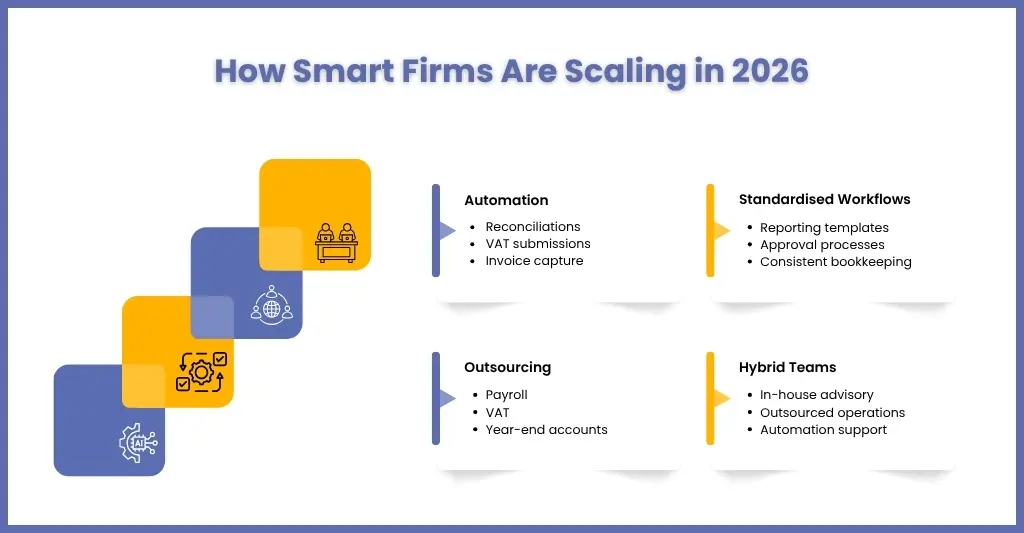
Smart accounting practices are not putting all their energies into increasing their headcounts with talented accountants.
They are also improving their:
- Systems
- Workflows
- Automation
- Outsourcing strategies
- Operational efficiency
Here’s how.
Automating Repetitive Work
The biggest contributor to the overloading of accountants is repetitive manual tasks.
Examples include:
- Invoice processing
- Bank reconciliations
- Payroll data entry
- VAT calculations
- Document collection
Adopting modern accounting automation tools can significantly reduce this workload.
The best accounting platforms like:
- Xero
- QuickBooks
- Sage
Will allow your practice to automate:
- Reconciliations
- Invoice capture
- Reporting workflows
- VAT submissions
These tools will never replace accountants, but free them from repetitive tasks so that they can focus on higher-value work.
Standardising Internal Processes
We found that multiple overloaded practices are due to inconsistent workflows.
Different team members often:
- Categorise data differently
- Follow different procedures
- Manage clients inconsistently
This creates confusion and inefficiency.
Standardised workflows improve:
- Consistency
- Speed
- Training efficiency
- Quality control
Examples of this include:
- Standard bookkeeping procedures
- Structured VAT workflows
- Consistent reporting templates
- Defined approval processes
When the workflow becomes predictable, scaling up becomes easier.
Outsourcing Overflow Work Strategically
Successful practices are no longer outsourcing simply to cut costs. Outsourcing has turned into a big strategic asset for practices that want to transform into modern accounting practices.
Outsourcing can:
- Increase capacity
- Reduce internal pressure
- Maintain turnaround times
- Access specialist expertise
- Improve scalability
This is especially useful for:
- Bookkeeping
- Payroll
- VAT returns
- Year-end accounts
- Accounts payable and receivable
Practices partnering with outsourcing providers like Corient gain access to scalable outsourced accounting support without increasing fixed staffing costs.
This allows internal teams to focus only on:
- Advisory services
- Client relationships
- Business development
Using a Hybrid Team Model
Smart accounting practices have also found another model, which is working wonders for them, especially in reducing the burden on the internal team, i.e., the hybrid team model.
This combines:
- Your in-house teams
- Outsourced specialists
- Automation tools
Why it works:
- Internal teams maintain client relationships
- Outsourced teams handle operational workload
- Automation reduces repetitive tasks
This creates flexibility without sacrificing quality, and the result is sustainable growth with lower operational stress.
Focusing on Higher-Value Services
Many practices are still trapped in doing low-value compliance work only, but practices that are growing are focusing more time on:
- Advisory services
- Tax planning
- Forecasting
- Strategic consulting
These services:
- Increase profitability
- Strengthen client relationships
- Create differentiation
The challenge is finding time.
That’s why reducing operational overload is so important.
Only when repetitive tasks are streamlined or outsourced can you focus on strategic work that actually drives growth.
The Role of Technology in Sustainable Firm Growth
If your goal is to scale, then you cannot achieve it without investing in technologies like:
- Cloud accounting
- Workflow automation
- AI-driven reporting
- Digital document management
- Client portals
Adopting these technologies improves:
- Visibility
- Collaboration
- Efficiency
- Compliance tracking
The above-mentioned technologies are available with outsourcing providers. When you combine these techs with structured outsourcing support and your internal teams, the scaling will be much faster than practices relying solely on internal resources.
Signs Your Firm Is Growing Too Fast for Its Current Team
Getting overloaded with work can happen very gradually, which is why it’s important to keep an eye on certain signs before it’s too late.
These signs are:
- Constant overtime
- Delayed client responses
- Recurring backlog issues
- Staff frustration
- Rising error rates
- Difficulty taking on new clients
- Burnout during peak seasons
If these issues are becoming normal, your practice likely needs operational restructuring, not just harder work.
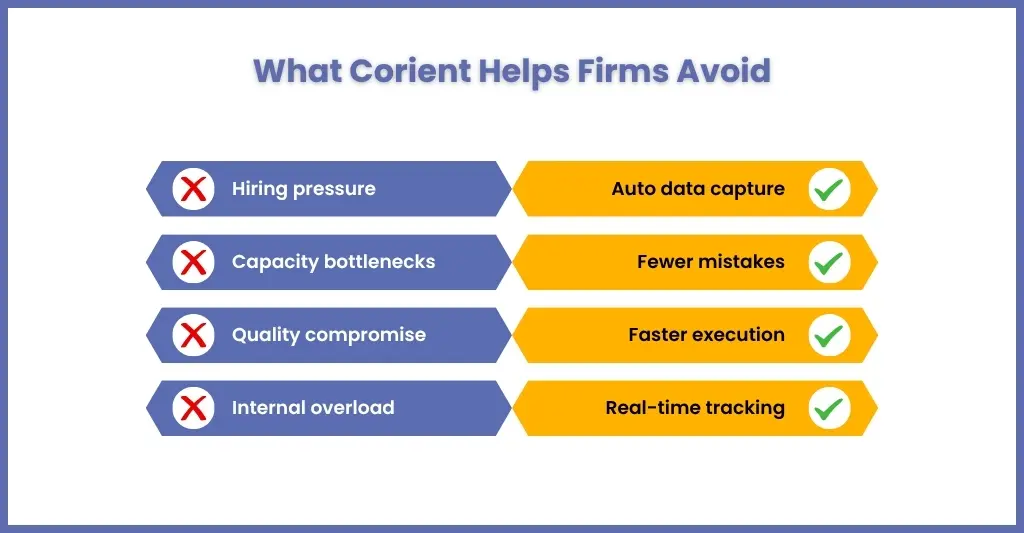
How Corient Helps Firms Scale Without Team Burnout
Many UK-based accounting practices are ambitious to grow, but worry about:
- Increasing operational pressure
- Hiring challenges
- Maintaining compliance
- Losing service quality
Here’s where Corient makes its mark in supporting practices by offering:
- Qualified, trained professionals aligned to your processes
- Named team members (full-time or part-time)
- Built-in review mechanisms for consistent, high-quality working files
- Reliable delivery so you can confidently take on more clients
- Corient offers white label accounting services meaning you will be interacting with your clients and all the services will be under your name, no Corient brand name will be used.
What this means for your practice:
- No hiring pressures
- No capacity bottlenecks
- No compromise on quality
- Freedom to grow without second-guessing delivery
Instead of forcing your teams to absorb endless work, scale up strategically while keeping internal operations manageable.
Frequently Asked Questions (FAQ)
Can accounting firms grow without hiring more staff
There was a time when hiring more staff was necessary to grow so that higher volumes of work could be done. But now, instead of relying completely on hiring, practices can resort to automation, outsourcing, and standardised workflows to get the job done without stressing on hiring.
Why are accounting teams becoming overloaded?
In the demanding accounting and business environment of the UK, accountants are not just dealing with numbers; they are also dealing with increased compliance requirements, manual workflows, staffing shortages, and growing client expectations. These factors are placing additional pressure on accounting teams.
Is outsourcing accounting work secure?
Professional outsourcing providers, like Corient, follow HMRC compliance strictly, maintain safeguards to protect their clients’ sensitive data, and integrate it with secure cloud accounting systems for additional security.
What work is commonly outsourced by accounting firms?
The majority of the repetitive accounting tasks associated with bookkeeping, payroll, VAT returns, year-end accounts, and accounts receivable can be outsourced, thus saving your time for advisory work and strategic planning.
How does automation help accounting practices grow?
Automation reduces repetitive manual tasks, improves efficiency, decreases errors, and allows teams to focus on advisory and higher-value services.
Conclusion
The future of accounting firm growth is not about pushing teams harder; it’s about working smarter by building smarter systems.
The practices scaling successfully in 2026 are:
- Automating repetitive work
- Standardising workflows
- Outsourcing strategically
- Reducing operational dependency on internal teams alone
Because sustainable growth requires:
- Efficiency
- Flexibility
- Scalability
- And operational control
Practices that continue relying entirely on overloaded internal teams will struggle to maintain quality as they grow. But practices embracing modern operational models, supported by partners like Corient, can increase capacity, improve profitability, and grow confidently without burning out their people.
If growth is overloading your accounting teams, then now is the right time to change it. Connect with us and see how you can scale your client base without increasing internal workload.