
The future of accounting for UK practices is digital, AI-assisted, and increasingly outsourced. Practices are combining cloud software with AI automation to cut manual processing, then outsourcing execution to specialist providers so in-house teams can focus on advisory work, real-time insight, and staying compliant with rules like Making Tax Digital.
The future of accounting is changing rapidly for UK practices. With AI, cloud systems, and outsourcing taking over traditional processes, firms must adapt to stay relevant. These new regulations, evolving technology, and shifting business requirements significantly impact the accounting industry. These forces are reshaping how accountants deliver services and create value.
So, will the life of your clients become tough? Not if you are one step ahead and start working on managing those influences that affect the future of accounting. In this blog, we will be focusing on multiple solutions, including outsourcing, through which you and your clients will be future-ready.
Let’s delve into it.
Key Takeaways
- 83% of accountants say clients now expect more than year-end compliance work — Sage, Practice of Now 2024.
- 95% of UK accountancy firms expect increased AI use, and 91% expect more automation, over the next three years — ICAEW, 22 May 2026
- 71% of UK & Ireland audit and accounting firms have already embedded AI into strategy or active pilots — Caseware, 28 April 2026
- Making Tax Digital for Income Tax became mandatory from 6 April 2026 for sole traders and landlords earning over £50,000 — GOV.UK
- Outsourcing lets practices combine AI and cloud accounting without building that expertise in-house — scaling client capacity without scaling headcount.
- Corient supports this shift directly through its AI Crew tools (Billy, Corby X, Luca, Sherlock, Smarty, Galaxy) alongside outsourced delivery.
How UK Businesses Are Rethinking Their Accounting Strategy
UK businesses are rethinking their accounting strategy because clients now expect more than compliance — they want real-time cash flow visibility and proactive advice, which is pushing practices to adopt technology and outsourcing to meet that demand without expanding headcount.
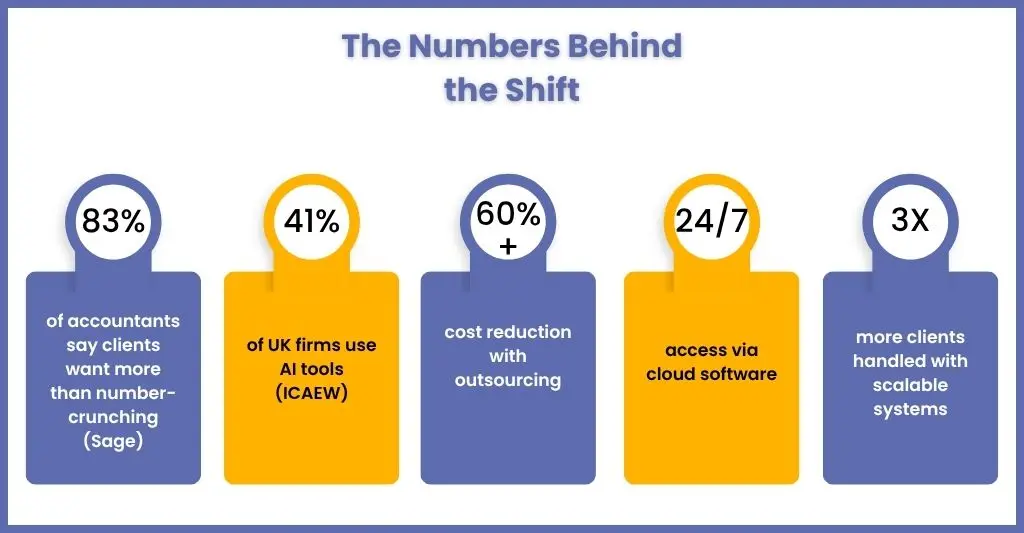
These days, your clients will not be satisfied with just year-end support, and it’s not just us saying this. According to Sage’s 2024 Practice of Now report, 83% of accountants say clients expect more than just number-crunching. With changing times, expectations and competition have increased, and your clients need real-time insights, cash flow visibility, and proactive advice to stay competitive.
These requirements from your clients have placed additional pressure on your practice to move beyond compliance and offer value-added services using technology and new procedures.
Currently, to keep up, businesses are:
- Moving away from manual, spreadsheet-heavy workflows
- Looking for ways to scale without hiring endlessly
- Embracing technology and outsourcing for core accounting tasks
The message is clear: adaptability isn’t optional. It’s essential. Accounting practices can fulfil the above-listed points only if they update themselves with new technology and methods.
How Is AI Changing Accounting for UK Practices?
AI is changing UK accounting by automating data entry, reconciliation and fraud detection — freeing accountants for advisory work. Adoption is accelerating fast: most firms now expect it to be central to their operating model within three years, not a future experiment.
Speaking of technologies that are impacting accounting, AI is one of them that is having a significant impact. We are not alone in this opinion; according to the 2023 ICAEW survey, around 41% of UK firms already use AI-powered tools, and this percentage is expected to rise further. Thanks to AI and related tools, accounting practices have been able to reduce manual efforts, boost productivity and reduce costs, which has positively impacted clients, including businesses.
Benefits of AI in accounting:
- Faster data entry and reconciliation through intelligent document processing.
- Error detection and fraud prevention using irregularity detection.
- Forecasting and decision support with real-time trend analysis.
95% of UK accountancy firms expect increased use of AI, and 91% expect more automation, in their operating models over the next three years; 86% already have AI adoption explicitly written into their tech strategy. Source: ICAEW, mid-tier firms research, 22 May 2026.
71% of audit and accounting firms in the UK & Ireland have already embedded AI into firm strategy or have active pilot programmes running — ahead of the 66% global average. Source: IDC study sponsored by Caseware, 28 April 2026.
Corient’s own AI Crew — including Billy for invoice processing, Corby X for reconciliation, and Sherlock for error detection — puts this kind of AI automation directly into client workflows rather than leaving practices to build it themselves.
Cloud-Based Accounting: Anytime, Anywhere Access
Many professional accounting practices have begun using top accounting software, such as Xero, QuickBooks, and FreeAgent, among others. This is because these software solutions offer cloud-based capabilities that have completely transformed how accountants perform their work. These tools have provided real-time access to ledgers, payroll, and tax data, thereby speeding up the entire accounting process.
Through cloud accounting:
- Your teams can collaborate in real-time across locations.
- Clients can upload documents and can view reports 24/7.
- Data backups and updates happen automatically.
- HMRC’s MTD compliance is built-in.
By switching to cloud-based systems, you will reduce overheads, scale up services faster, and deliver a seamless client experience.
What Happens When AI and Cloud Accounting Combine?

Combining AI automation with cloud accessibility lets practices handle more clients without adding headcount, cut compliance risk, and shift staff time toward advisory work — but building that combined capability in-house requires specialist skills most practices don’t have, which is why outsourcing has become the practical route to it.
Both AI and cloud are essential for the future of accounting, and the best way to use them is by combining AI automation with cloud accessibility. Such a combination of AI and cloud will create a strong ecosystem and help you tackle multiple challenges for your clients.
An AI/Cloud combo system will help you in:
- Handling more clients without increasing headcount
- Delivering real-time insights and reporting
- Minimising human error and compliance risks
- Focus on advisory roles instead of data entry
This blend supports scalability and client satisfaction, making your practice future-ready. The only issue is combining AI and the cloud requires a special type of skill set and experience, which neither your clients nor you possess. Only through outsourcing can you enjoy the benefits of both AI and cloud solutions.
Why Are More UK Firms Outsourcing Their Accounting?
More UK firms are outsourcing accounting because it delivers the benefits of AI and cloud technology without the cost of building that capability internally — improving scalability, cutting recruitment and software costs, and freeing staff for advisory work.
Outsourcing accounting is the future of accounting, and it’s gaining popularity among practices. It has not only combined the benefits of cloud and AI, it has also achieved that without costing too much. Such is the trust level among accounting practices that many have started relying on professional outsourced providers to handle all accounting functions, from bookkeeping and payroll to management accounts.
Not just that outsourcing offers many more benefits:
- Scalability: With an outsourcing partner by your side, you will be capable of handling extra work from your clients and onboarding new clients without expanding your staff.
- Saving on Costs: Outsourcing saves you from recruiting extra staff to cover additional workloads, thus saving costs on recruitment, training, equipment, salaries, and more.
- Attention to Value-Adding Services: While your outsourcing partner handles the day-to-day accounting activities, your team can focus on providing advisory and client relations services.
Select the right outsourcing partner to enjoy faster turnaround times and reduced processing costs.
How Do You Choose the Right Digital Accounting Partner?
Choose a digital accounting partner that offers API integrations with your existing software, AI-powered automation, UK GAAP and MTD-compliant processes, and a dedicated support team aligned to clear SLAs — not just lower cost.
To help your clients stay relevant in the UK’s competitive business environment, you will need to find an outsourcing partner that not only handles your accounting work but is also tech-savvy and compliant with the latest HMRC regulatory compliance.
Hence, look for a provider that offers:
- API integrations with Xero, QuickBooks, and Sage.
- AI-powered automation tools and dashboards.
- UK GAAP and MTD-compliant processes.
- Dedicated support teams aligned to your SLAs.
Your outsourcing partner must work like an extended team, thus making the lives of your clients and team members easier.
What is the Future of Accounting in the UK?
The future of accounting will be about delivering more value with less effort, which is also the expectation from your clients. Your clients will expect more from you in terms of speed, transparency, and input sharing. Therefore, if you are still stuck with manual accounting or your in-house team handles all accounting work, then it’s time to reassess.
To help your clients stay relevant in the modern business environment, you will have to offer them the latest accounting services by combining cloud accounting software and AI-powered tools. The best way to achieve that is through accounting outsourcing services, which will be flexible for you and your team.
Frequently Asked Questions (FAQ)
1. How does digital transformation affect accounting?
Digital transformation in accounting is transforming the financial sector, enabling practices to embrace efficiency, accuracy, and transparency. It replaces manual, paper-based processes with cloud software and automation, giving practices real-time visibility into client finances and freeing staff from repetitive data entry. For UK firms, it’s also become a compliance necessity, since HMRC’s Making Tax Digital rules now require digital record-keeping for a growing share of businesses.
2. Will accountants be replaced by outsourcing?
No, but it will transform their role. AI will automate tasks, but accountants will remain important for oversight, evaluation, and strategy. Outsourcing shifts routine processing — bookkeeping, reconciliations, payroll runs — to a specialist provider, which frees accountants to focus on advisory work, judgement calls, and client relationships rather than data entry. The role changes; it doesn’t disappear.
3. Why is accounting being outsourced?
Businesses and accounting practices outsource their accounting for various reasons, such as cost reduction, increased efficiency, or simply to gain access to specialised professionals in the field. Outsourcing also gives practices immediate access to AI and cloud expertise without the cost of building it internally, and lets firms scale to handle more clients without a matching increase in headcount or fixed salary costs.
4. What is a cloud-based accounting system?
Cloud accounting is a system that allows multi-user access and safe online or remote server storage. Users can send all their data to cloud providers where the same data is processed and safely stored, and returned.
5. Is outsourced accounting secure for UK businesses?
Yes, outsourced accounting is secure for UK businesses only if you choose the best service provider. These days many businesses are relying on outsourcing partners who follow regulations strictly like UK GDPR, Data Protection Act 2018, and ISO 27001 standards for information security.
6. What’s the difference between cloud-based and desktop accounting?
The main difference between cloud-based and desktop accounting lies in how and where the accounting data is stored. Under cloud-based accounting, you will get access to accounting data from anywhere and it is stored in strong data base. In desktop accounting, data is stored in a single computer thus accessible locally. While its faster offline, data updates, backups, and collaboration must be done manually.
7. Will AI replace accountants in the near future?
No, AI will never replace accountants instead it will reduce the workload and add value to accountants by making them more efficient, accurate, and insightful. Industry research backs this: ICAEW’s 2026 study found the vast majority of firms don’t expect AI to reduce overall accountant roles, even as most expect to increase AI use — the shift is toward judgement-based, advisory work rather than fewer jobs.
Conclusion
The UK accounting industry has already set its course for the future, it is becoming digital, data-driven, and advisory-focused. Advanced technologies, such as AI and cloud accounting platforms, are actively reshaping how accountants deliver their services. That’s why outsourcing is proving to be an effective and attractive option, where experts utilise advanced technology to provide cost-effective and compliant services.
As the influence of advanced technology on accounting increases, your clients will demand more strategic advisory services. That’s why outsourcing accounting is no longer just a cost-saving measure; it’s a strategic tool that can drive growth, compliance, and efficiency.
At Corient, we understand the challenges you face in offering value-added services to your clients. By partnering with us, you will receive compliant and tech-savvy outsourced accounting services provided by our experts. That includes direct access to our in-house AI Crew and a team built around UK GAAP and MTD compliance from day one. The time to future-proof your accounting practice is now. Go digital, go scalable, and explore the power of outsourcing. Your future-ready practice starts today. Get a free session from our accounting experts today.