

When it comes to the benefits of digital VAT reporting, they help in faster submissions, make fewer errors, maintain better compliance, and maintain financial visibility in real-time. But these benefits are just the tip of the iceberg.
Let’s look at an example of an accounting practice.
A growing accounting practice was handling VAT for more than 40 clients using nothing but spreadsheets and manual uploads. In all quarters, the same issues used to creep up.
- Chasing missing invoices
- Reconciling mismatched data
- Last-minute HMRC submissions
Even one small error will lead to a penalty notice from HMRC.
The firm didn’t suffer from a lack of expertise; it lacked a system.
It was understood that the switch towards digital VAT reporting under HMRC Making Tax Digital, and everything changed:
- VAT data flowed directly from the software
- Submissions became automated
- Errors dropped significantly
According to the Government of UK, in the 2023 to 2024 tax year, the tax gap for VAT was 5.0% of theoretical VAT liability, or £8.9 billion in absolute terms, falling from 13.8% in 2005 to 2006, and the government is interested in bringing it further down.
Since April 2022, HMRC has mandated all VAT-registered businesses to follow Making Tax Digital (MTD) for VAT rules, showing a clear shift toward digital compliance. It’s time to say to those clients who have newly registered their business for VAT and are wary of digitisation, how long can you afford to stay manual?
What is Digital VAT Reporting Under Making Tax Digital?
Digital VAT reporting is part of the UK government’s Making Tax Digital (MTD) initiative, with the goal of digitising the entire UK tax structure. With the implementation of MTD rules, all your clients must follow the following:
- Maintaining digital records of VAT transactions
- All VAT returns must be submitted using MTD-compliant software
- Manual submissions using spreadsheets or the HMRC portal are no longer allowed
Benefits of Digital VAT Reporting for UK Businesses
Let’s dive a bit deeper into the real benefits of digital VAT reporting. These benefits have changed the way UK-based businesses and accounting practices operate on a day-to-day basis.
Reduced Errors
Manual VAT processes have been the biggest source of avoidable mistakes, such as.
- Incorrect data in spreadsheets
- Formulas breaking or being overwritten
- Inconsistency in the application of VAT rates
- Duplication or missing of transactions
Digital VAT reporting has ensured:
- VAT is calculated automatically based on predefined rules
- Data flows directly from accounting software, reducing re-entry
- Built-in validation checks highlight inconsistencies before submission
What this means for your practice:
- Fewer corrections after submission
- Reduction in time spent fixing mistakes
- Reduction in risk of HMRC queries
Faster Submissions
Older VAT submission involved steps that delayed the entire submission process, such as:
- Collecting data from multiple sources
- Reconciling inconsistencies
- Manually preparing returns
Digital VAT reporting will ensure:
- All data is stored and organised in the system
- VAT returns are generated automatically
- Submissions are sent directly to HMRC via API
What this means for your practice:
- Submissions will be done in minutes
- No last-minute rush before deadlines
- Smoother workflow during peak VAT periods
Real-Time Financial Visibility
Along with errors, another big limitation of manual VAT reporting is a lack of visibility.
Under manual VAT reporting, you will not know:
- How much VAT is owed
- How much input VAT can be reclaimed
- The overall tax position of your client until quarter-end
Digital VAT reporting changes this completely:
- Real-time VAT liabilities through dashboards
- All transactions will be updated instantly
- Financial data is always updated and accessible
What this means for your practice:
- Better cash flow planning
- Fewer surprises at the end of the quarter
- More informed decisions for your clients
Improved Compliance
Being compliant is one of the major reasons for bringing in the Making Tax Digital initiative.
Manual systems often became the source of:
- Inconsistent record-keeping
- Missing transaction history
- Errors in VAT calculations
However, with digital VAT reporting:
- Maintains records in digital format
- All VAT submissions will follow standardised formats
- Returns will be submitted directly to HMRC systems
With the implementation of digital VAT reporting, you will experience a reduction in:
- Risk of penalties
- Rejected submissions
- Compliance errors
Better Client Experience
When errors are reduced, compliance is followed, and submissions are quick, your client will stand to benefit, and digital VAT reporting helps in achieving that.
It allows you to:
- Provide faster and more accurate updates to clients
- Deliver clear, structured reports
- Reduce repeated requests for missing data
What this means for your clients:
- They will get quicker answers to their questions
- Clear understanding of their financial position
- More confidence in your services
And for your practice:
- Fewer follow-ups
- Stronger relationships
- Higher client retention
How Digital VAT Reporting Improves Firm Performance
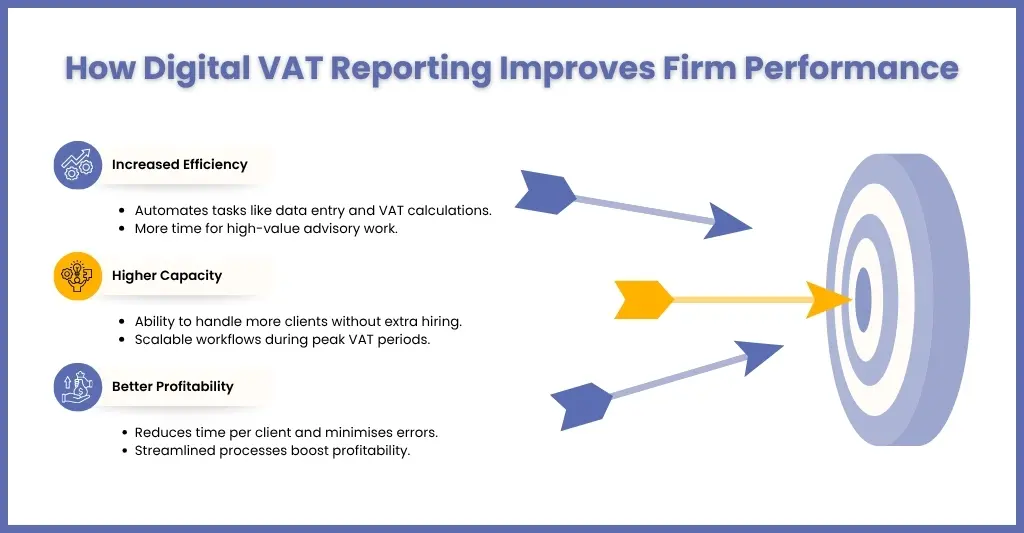
Digital VAT reporting is no longer optional; it’s an upgrade you cannot ignore. With the advent of MTD for VAT, manual spreadsheets have made way for structured, automated workflows. It has changed how your accounting team works, delivers, and affects profit margins.
Let’s break this down in a real-world context.
Increased Efficiency
Manual VAT is repetitive and time-consuming. It involves tasks such as:
- Pulling data from multiple sources
- Checking formulas and calculations
- Fixing errors before submission
With digital VAT reporting:
- VAT calculations are automated
- Data flows directly from accounting systems
- Reconciliation becomes faster and more accurate
For your accounting practice, this means:
- Less time spent on data entry
- Fewer manual checks
- Faster completion of VAT returns
Rather than spending numerous hours on preparing the return, the MTD initiative enables your team to complete it in minutes, freeing time for high-value advisory work.
Higher Capacity
Often, we have noticed accounting practices facing capacity constraints when clients demand more services.
On one hand, it’s an opportunity to grow and expand, but it also means:
- More staff to hire
- Increased costs
- Managing more complexity
Digital VAT reporting changes this dynamic through:
- Automation of repetitive tasks
- Fewer resources per client
- Workflows become scalable
What this means for your firm:
- You will be able to handle more clients without resorting to extra hiring
- Ability to handle peak VAT periods
- Workload will be distributed more efficiently
Through digital VAT reporting, you move from being capacity-constrained to growth and future-ready.
Better Profitability
As an accounting practice, you will earn profits only when you get the job done efficiently in less time. Unfortunately, manual VAT processes do not allow you to improve your margin because of:
- More hours are spent per client
- Errors require rework
- Deadlines create pressure and overtime
With digital VAT reporting, you will see:
- Reduction in time spent per client
- Reduction in errors
- Streamlining of the process
What financial gains will you see from it?
- Lower cost per job
- Higher margins
- Better utilisation of your team
It’s called working smartly and earning more without much effort.
Many practices want these benefits but fail to achieve them not due to lack of tools or trained resources but due to implementation. But outsourcing partners like Corient will help you implement digital VAT workflows, combining software with structured processes, through VAT outsourcing services, ensuring compliance is built into daily operations and boosting efficiency.
Common Challenges Practices Face When Moving to Digital VAT
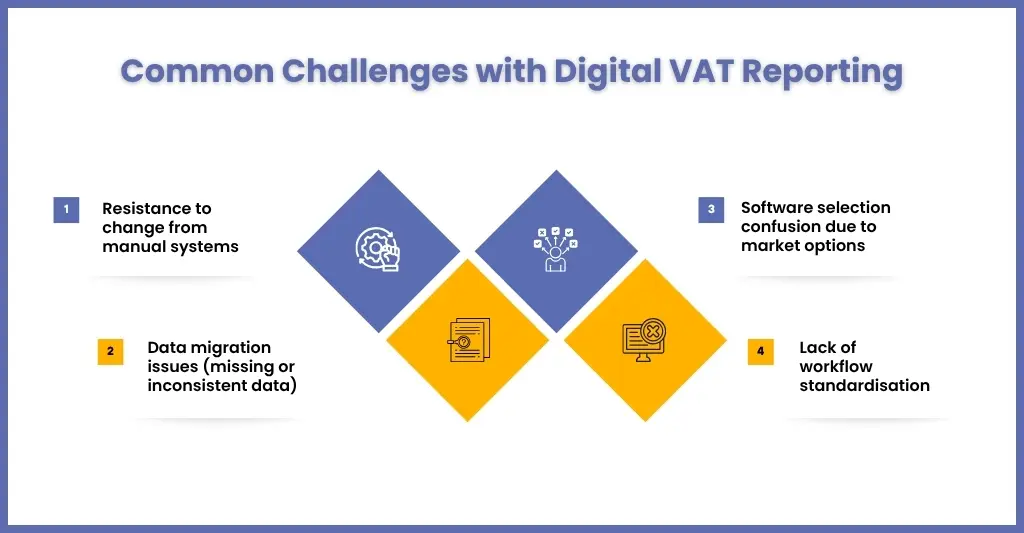
Despite these benefits, many practices had to face multiple hurdles while transitioning towards MTD for VAT. Some of those challenges are:
Resistance to Change
Many clients and their accounting teams are familiar with manual systems, which are simple to operate and easier to understand. Without awareness about digitisation benefits and MTD rules, pushing them towards digitisation will meet resistance or hiccups.
Data Migration Issues
Even when you decide to transition towards an MTD-compliant software, you will face issues related to:
- Data inconsistencies
- Missing data
- Formatting errors
Software Selection Confusion
With the UK market saturated with numerous MTD-compliant VAT software, getting the ideal one for making tax digital for VAT can become a difficult task.
Lack of Standardisation
Without having structured workflows:
- Automation may not work effectively
- Errors can still occur
How to Get Started with Digital VAT Reporting
Becoming MTD-compliant for VAT is important, but getting it done correctly is even more important. Here are a few steps that will get you started in the right way.
Step 1: Choose MTD-Compatible Software
This will be the base; the right software will determine the efficiency of your VAT process.
Therefore, look for tools that:
- Integrate directly with HMRC for API submissions
- Connect with your accounting systems (Xero, QuickBooks, Sage)
- Automate VAT calculations and reporting
- Provide real-time dashboards and insights
What most firms get wrong:
Many practices select the software based on price and popularity, which is the wrong way to select. Selection must be based on how the tool simplifies your process.
Step 2: Digitise Records
Under MTD rules, all VAT records and financial details must be recorded and managed in digital format.
This means:
- No manual spreadsheets
- All sales and purchase data are recorded within your accounting system
- Proper digital links between transactions and VAT calculations
What changes it brings:
- Elimination of duplicate data entry
- Reduction in risk of missing transactions
- Compliance with MTD rules
Step 3: Standardise Workflows
This step is neglected by most practices, and it’s here where real transformation happens.
Begin by creating clear processes for:
- Categorisation rules → how transactions are classified
- Reconciliation processes → how and when accounts are matched
- Reporting timelines → when VAT reviews and submissions happen
Without standardisation:
- Automation won’t work properly
- Errors will still occur
- Every client will be handled differently
With standardisation, your VAT process becomes repeatable, scalable, and efficient.
Step 4: Train Your Team
Even the best system fails when the team is not trained on it properly.
Therefore, make sure your team understands:
- MTD requirements and compliance rules
- How to use the MTD-compliant software effectively
- How workflows are structured and why they matter
Such training and familiarisation prevent:
- Inconsistent data entry
- Misuse of automation tools
- Compliance errors
Step 5: Test Before Going Live
Before the full transition to an MTD software, conduct a test. Such a test includes:
- Running trial of VAT returns
- Checking for data inconsistencies
- Validating calculations
- Ensuring submissions connect correctly with HMRC
Why this is critical:
- Identifies errors early
- Avoids issues during actual submissions
- Builds confidence in the system
How the Best Software for Making Tax Digital for VAT Helps
What is the best software for making tax digital for VAT? It’s a question that will keep coming up among practices. The answer depends on your workflow, but the right tools should offer some key features, such as:
- Direct HMRC integration (API submissions)
- Automated VAT calculations
- Real-time dashboards
- Bank feed integration
- Reconciliation automation
Popular software options include:
- Xero
- QuickBooks
- Sage
Software is not a magic wand that will smooth VAT submissions; without proper workflows, even the best tools can create messy data.
FAQs on Benefits of Digital VAT Reporting
Is using software mandatory for digital VAT reporting?
MTD rules are clear, VAT returns can only be submitted to the HMRC through MTD-compliant software. Manual submission is not permitted.
What is the best software for making tax digital for VAT?
The ideal software will be the one that meets your and your clients’ VAT requirements, along with practice size and workflow requirements. Yet, some of the reputed software for MTD for VAT are Xero, QuickBooks, and Sage.
Does digital VAT reporting reduce HMRC penalties?
Yes. Automated calculations and direct submissions reduce errors, which lowers the risk of penalties and compliance issues.
Why is HMRC introducing Making Tax Digital?
HMRC is introducing Making Tax Digital (MTD) to modernise the UK tax system, aiming to reduce tax errors by moving from manual, paper-based records to mandatory digital record-keeping.
Conclusion
Digital VAT reporting is one of the major aspects of the future of accounting, and it would be a big mistake to consider its impact limited to compliance.
By implementing MTD for VAT, you will be:
- Reducing errors
- Speed up submissions
- Get financial insights in real-time
- Improved client service
- Scalable operations
Without digital VAT reporting:
- Processes will remain manual
- Errors will increase
- Compliance risks grow
With the right approach, especially with support from Corient:
- Workflows become efficient
- Compliance becomes seamless
- Your practice becomes scalable
It’s time to base your success in accounting on not working harder but on building smart, digital systems that work for you. Wondering how? Use our contact form, and we will make it a reality.
