
One fine regular day, while your client, an accounting practice, calls you in panic about a situation, saying, “HMRC has sent a letter asking about my clients’ expense claims. They want proof for travel, meals, and purchases from two years ago.”
When you open the records for your client, you will find that some of their transactions are clear business expenses, others less so. It’s nothing unusual, since many businesses mix up personal expenses with business expenses without realising the consequences. But HMRC has now started taking it seriously.
In 2026, HMRC’s personal expenditure crackdown is going to increase, using advanced data analysis and compliance checks to identify irregular patterns. For accounting practices, this means:
- More HMRC enquiries
- More transaction reviews
- More client education
- More compliance pressures
Understanding the HMRC personal expenditure crackdown is now essential if you want to protect your clients and stay ahead of regulatory scrutiny.
What Is the HMRC Personal Expenditure Crackdown?
The HMRC personal expenditure crackdown is an intensification of a drive carried out by HMRC since 2025 to identify personal costs incorrectly claimed as business expenses. The aim is simple: to reduce the wrong claims and close the UK tax gap.
In the tax year of 2023-24, HMRC says that the total UK tax gap was estimated to be 5.3% of total theoretical tax liabilities, or £46.8 billion in absolute terms, which means HMRC collected 94.7% of all tax due. While some of the reasons for this tax gap are beyond the regulator’s control, HMRC believes that a large part of this gap is due to:
- Misclassified expenses
- Poor documentation
- Personal spending claimed as business deductions
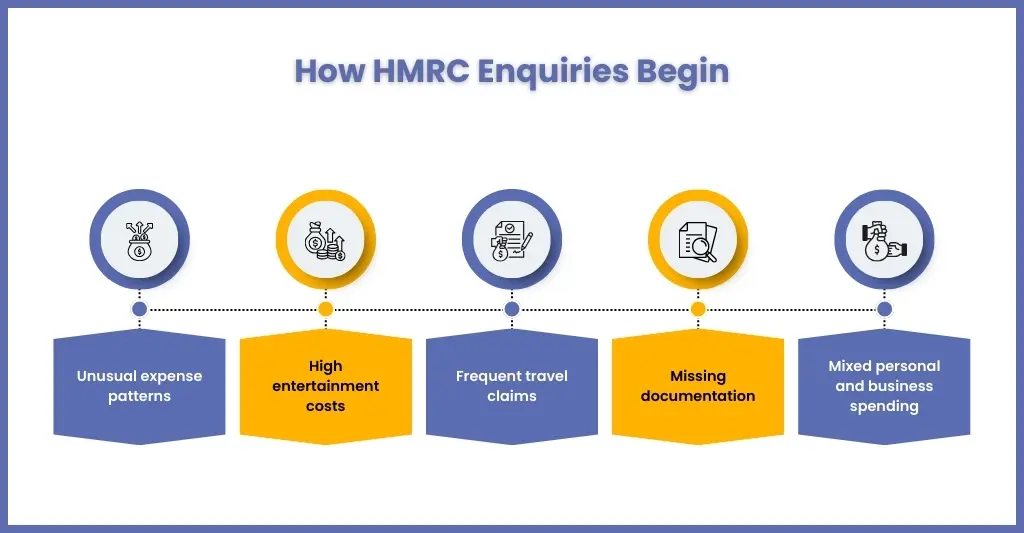
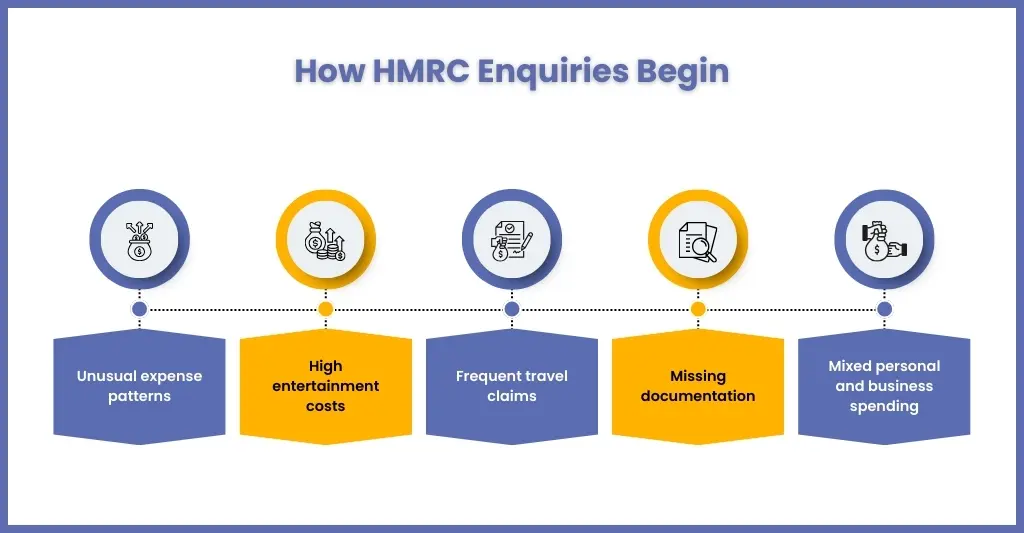
For this reason, HMRC has increased its scrutiny of:
- Travel and subsistence claims
- Personal vehicle costs
- Home utility expenses
- Director purchases on company cards
- Entertainment and hospitality
For accounting practices, the HMRC personal expenditure crackdown means a higher expectation of accurate expense classification and documentation.
Which of Your Clients Are at Highest Risk from the HMRC Personal Expenditure Crackdown?
Not all of your clients will face the same scrutiny from HMRC, but some of your clients will be under special focus during the HMRC personal expenditure crackdown. These clients would be:
Owner-Managed Limited Companies
Many directors use company accounts for day-to-day spending, which can blur the line between personal and business expenses.
Sole Traders and Freelancers
Self-employed individuals frequently claim home office costs, travel, and equipment expenses that require clear justification.
Property Investors and Landlords
Recent HMRC focus has highlighted expense claims related to property management and maintenance.
Businesses with High Card Usage
Where company credit cards are used frequently, personal purchases may slip into business accounts.
For your practice, it becomes necessary to identify these expenses by placing special attention on these categories of clients. It will help you in reducing potential compliance issues.
The Compliance Burden the Crackdown Places on Accounting Practices
The HMRC personal expenditure crackdown has made life stressful not only for your clients but also for practices. How? By increasing the workload of practices.
Here’s where the work of practices increased.
Increased Transaction Reviews
Due to increased scrutiny of expenses by HMRC, practices are increasingly expected by their clients to verify if their expenses are:
- Wholly and exclusively for business purposes
- Supported by receipts
- Properly categorised
Reviewing hundreds of transactions for each client is a time-consuming task.
More HMRC Enquiries
More HMRC enquiries mean spending more time preparing detailed documentation, explanations, and reconciliations. Such preparations will divert your attention away from other value-adding tasks.
Client Education
Many of your clients lack the awareness between personal expenses and allowable business expenses. You will need to create awareness among your clients to explain the latest HMRC personal expenditure crackdown and how to differentiate between personal and business spending. Such awareness is created via email alerts and training sessions, which consume time, people, and resources.
Additional Record-Keeping Requirements
MTD is already applicable to VAT, and in 2026 it will be extended to Income Tax, which means HMRC will expect from you clear audit trails. For your practice, which is already saddled with multiple deadlines, the HMRC personal expenditure crackdown adds another layer of compliance pressure.
Allowable vs Disallowable Expenses
| Category | Allowable Expenses | Disallowable Expenses |
| Definition | Costs incurred wholly and exclusively for business purposes and deductible from profits | Costs that are personal, capital, or not directly related to business and cannot be deducted |
| Tax Treatment | Reduce taxable profit and corporation tax liability | Must be added back to profits in the tax computation |
| Examples | Office rent, staff salaries, software subscriptions, business travel | Client entertainment, personal purchases, fines, penalties |
| Documentation | Must have invoices, receipts, and business justification | Often flagged during HMRC reviews if incorrectly claimed |
| Risk Level | Low risk if properly recorded | High risk during HMRC compliance checks |
How Accountants Can Protect Their Clients from the HMRC Crackdown
With HMRC not showing any leniency when it comes to identifying personal expenses shown as business expenses, it’s time for you to become proactive to reduce the penalty risk and HMRC enquiries.
Here’s how you are going to do that:
Establish Clear Expenses Guidelines
Your clients should know to differentiate between personal and business expenses (allowable expenses). For that, you will need to share with them clearly written guidelines to avoid claiming expenses.
Review Previous Expense Claims
Conduct a detailed review of your client’s expense claims for 2024/25. This will enable you to understand the expense trends and identify personal expenses, enabling better preparation for 2025/26 and in the near future.
Keeping Records
Ask your clients to retain:
- Receipts
- Invoices
- Travel details
- Business purpose explanations
Clear documentation protects both your clients and your practice if HMRC asks questions.
Voluntary Disclosures
Encourage your clients to disclose if past returns contained expense claim errors. Such disclosure will make you aware of the mistakes committed in the past and keep you alert so that such mistakes do not happen again.
Conduct Real-Time Expense Recording
In the fast-paced world, waiting for year-end to classify expenses will only increase the chance of errors. Using the latest tools, these expenses can be analysed and divided into personal and business expenses in real-time.
How Outsourcing Can Help Your Practice Handle the Increased Workload
For accounting practices based in the UK, the challenge of the HMRC personal expenditure crackdown is not the understanding of rules, because most practices get it. The real challenge is the volumes involved. You will now be required to give attention to every transaction more carefully, identify the expenses and document them properly in case HMRC raise an enquiry.
To stay compliant during the HMRC personal expenditure crackdown, you must now spend additional time on tasks such as:
- Reviewing company card transactions
- Identifying mixed personal and business expenses
- Checking supporting receipts and documentation
- Reclassifying incorrect expense categories
- Monitoring director loan accounts
- Preparing clean records ready for tax filings
These tasks are important, but they are also time-consuming and repetitive. This is where outsourcing comes to your rescue and many practices are preferring it.
A structured outsourcing team can support you by:
Maintaining Accurate Bookkeeping
All the transactions of your client will be recorded properly, right from the start, thus reducing the risk of incorrectly classifying personal expenses as business costs.
Categorising Expenses Correctly
Outsourced bookkeeping teams will thoroughly review and categorise expenses in real-time, thus ensuring only legitimate business expenses appear in the accounts.
Preparing Clean Financial Records
Through bookkeeping outsourcing services offered by a professional service provider, you can be assured of financial records arranged in a proper manner. Clean financial records will enable you to respond quickly to HMRC’s documentation request.
Supporting Year-End Reviews
You will get access to files that are properly structured and organised by your outsourcing partner. Thus, it saves your time and resources required for identifying personal expenses and categorising them accurately. It also helps in reducing the time required for year-end final review.
Through bookkeeping outsourcing services, you can fulfil the increased compliance requirements while keeping your internal teams focused on more value-adding strategic work. No wonder UK accounting practices are choosing outsourced bookkeeping in 2026.
Frequently Asked Questions: HMRC Personal Expenditure Crackdown
What expenses is HMRC currently targeting in its personal expenditure crackdown?
HMRC is focusing on travel expenses, meals, entertainment, personal vehicle costs, and household expenses that may have been incorrectly claimed as business deductions.
How does HMRC identify clients who may have overclaimed personal expenses?
HMRC identifies potential overclaimed personal expenses using a combination of data analytics, risk profiling, and compliance checks.
What are the penalties if HMRC finds a client has overclaimed personal expenses?
Penalties may include repayment of tax owed, interest charges, and additional financial penalties depending on the severity of the error.
How can my practice handle the increased workload from HMRC enquiries?
Improving documentation processes, educating clients about allowable expenses, and using additional support for bookkeeping and transaction review can help manage the workload.
What is allowable business expenditure?
If a cost is essential for carrying out a business operation, it must be called an allowable business operation. Such expenses can be deducted.
What cannot be written off as a business expense?
Non-allowable expenses like personal expenses, entertainment costs, and certain fines or penalties cannot be written off as business expenses.
The Crackdown Is Here — Is Your Practice Ready?
The HMRC personal expenses crackdown has signalled a change in tax compliance expectations. As we speak, HMRC is using data analysis and digital reporting to identify irregularities. For you, this means one thing: Compliance standards are rising.
Practices that have strengthened their process were able to:
- Reduce enquiry risks
- Protect client relationships
- Improve efficiency
Still, many practices have found themselves overwhelmed by transaction volumes to review, HMRC investigations and documentation requests. In such situations, only outsourcing can remove you from this quicksand.
At Corient UK, we support accounting practices by providing structured back-office accounting support tailored specifically for UK compliance requirements.
Our teams will assist you with:
- Bookkeeping and transaction categorisation
- Expense classification reviews
- Reconciliation and documentation preparation
- Organised records ready for accountant review
By handling these routine processes, we help you maintain compliance with evolving HMRC expectations while giving your accountants more time to focus on advisory services and client relationships.
Ready to turn HMRC personal expenses crackdown into an opportunity to expand? Connect with us, grab the opportunity to do just that.