
A Corporation Tax return is the annual Company Tax Return a UK company files with HMRC, made up of the CT600, accounts and tax computations. It is due 12 months after the accounting period ends, payment is normally due 9 months and 1 day after, and late filing now carries a £200 penalty from 1 April 2026.
We say with full responsibility that handling corporation tax compliance and running a business at the same time is not a joke. Agreed, many businesses successfully handle corporation tax returns themselves, but it comes at a cost in money and time. The cost of getting it wrong has also risen: for filing deadlines on or after 1 April 2026, the fixed penalty for a late Company Tax Return doubled from £100 to £200 (Accounting People).
Even so, businesses and accounting firms can improve the situation by understanding corporation tax complexities, especially corporation tax returns.The good news is that many businesses have realised this and are taking steps to manage it either on their own or through an accounting firm. Surprisingly, accounting firms are also finding it difficult to handle corporation tax returns due to high volumes and complexity. Therefore, to simplify things, we have developed a simple guide on corporation tax returns that will benefit businesses and accounting firms.
Key Takeaways
- A Corporation Tax return includes the CT600, the company’s accounts and tax computations; filing is due 12 months after the accounting period ends.
- Rates are unchanged for the financial year from 1 April 2026: 19% up to £50,000, 25% above £250,000, with marginal relief (3/200) between (GOV.UK).
- Fixed late filing penalties doubled for filing deadlines on or after 1 April 2026: £200, plus a further £200 after three months (Accounting People).
- HMRC has confirmed it does not intend to introduce Making Tax Digital for Corporation Tax (House of Commons Library).
- Large companies with profits over £1.5 million pay in quarterly instalments, not 9 months and 1 day after the period ends (VJM Global).
- Corient has supported UK accountancy firms since 2011, with corporation tax prepared using TaxCalc and Sage, so practices can add capacity without adding headcount.
What Is a Corporation Tax Return?
A Corporation Tax return, formally the Company Tax Return, is the annual filing a UK company or its accountant submits to HMRC to report profits and calculate Corporation Tax. It is due 12 months after the end of the accounting period it covers.
Corporation tax is a part and parcel of a business person’s professional life, and having an understanding of it will help in making your client’s business sustainable in the long run. But before that, let’s understand corporation tax returns. In layperson’s terms, the corporation tax return is a set of financial information that a business or an accounting firm on behalf of their client will have to provide to the HMRC every year. The financial information includes profit and loss, loans, and other relevant information used in calculating the corporation tax your business clients owe.
A corporation tax return includes the following:
- A CT600 form
- The company’s accounts
- The company’s tax computations
- Any supplementary documentation
If your business client gets a Notice to Deliver a Company Tax Return, it’s your responsibility to handle the corporation tax return. The deadline for completing a Corporation Tax Return is 12 months after the end of the accounting period that it covers.
Corporation Tax deadlines at a glance
| Requirement | Deadline or rule | Applies to |
| File the Company Tax Return (CT600) | 12 months after the accounting period ends | All companies |
| Pay Corporation Tax | 9 months and 1 day after the accounting period ends | Companies that are not large |
| Pay in quarterly instalments | Profits over £1.5 million (limit divided by number of associated companies, including the company) | Large companies |
| Accelerated instalments | Profits over £20 million | Very large companies |
| Keep records | 6 years from the end of the accounting period | All companies |
Sources: VJM Global; HMRC record-keeping guidance. Confirm instalment dates against GOV.UK for each client.
What Are the Steps to File a Corporation Tax Return?
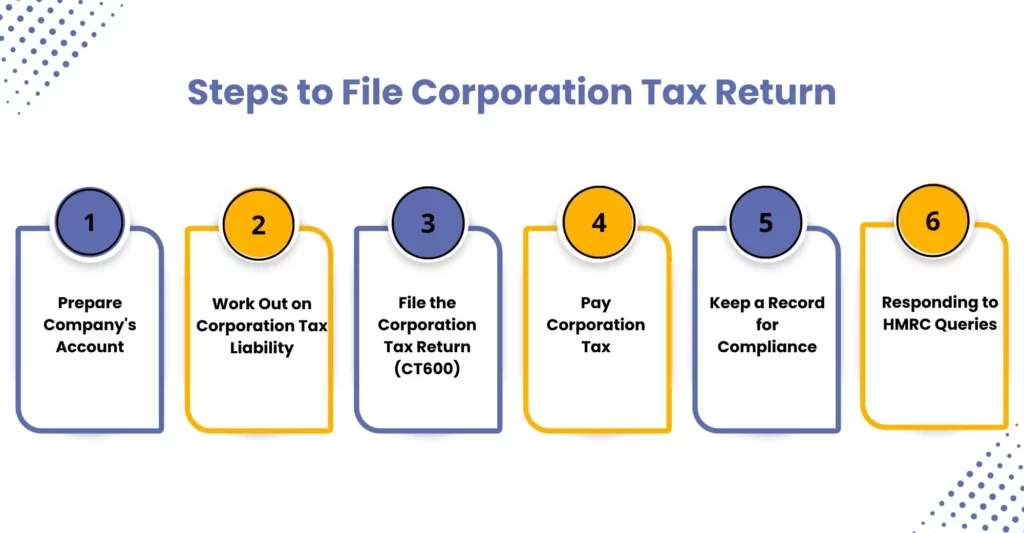
The steps are: prepare the accounts, work out the tax liability, file the CT600, pay the tax, keep records and respond to HMRC queries. Completing them in this order prevents most late filings and rework.
Filing a corporation tax return requires you to follow several key steps. The below-mentioned steps will ensure a smooth preparation and filing of the corporation tax return, thus preventing unwanted disruption to the business.
Prepare Company’s Account
Before starting with your client’s corporation tax return, ensure its records are in the proper place. Special emphasis should be placed on statutory accounts, which will cover your client’s entire financial year.
Work Out Corporation Tax Liability
Start calculating the taxable profits and apply any relevant deductions, allowances, and reliefs (e.g., capital allowances, R&D tax relief). Keep track of the current corporation tax rates and calculate accordingly.
File the Corporation Tax Return (CT600)
Once all the calculations are done, it’s time to file the return using HMRC-recognised software, with details like your client’s profits, losses, tax adjustments, and capital allowances.
Pay Corporation Tax
After the calculations, if you find that your client owes corporation tax, it must be paid. The payment of corporation tax must be made within 9 months and 1 day after the end of your accounting period for companies that are not large. Even if your client does not owe any corporation tax, it must be informed to HMRC.
Large companies work differently. Companies with profits over £1.5 million, with the limit divided by the number of associated companies, pay Corporation Tax in quarterly instalments, and very large companies (profits over £20 million) follow an accelerated schedule. Check each client’s status before setting payment reminders.
Keep a Record for Compliance
Always properly record all accounting records, invoices, and tax computations. This will come in handy when HMRC asks for them during an audit.
Responding to HMRC Queries
It is one of the major reasons why businesses these days are handing over corporation tax responsibility to accounting firms. HMRC may conduct surprise checks and ask for further details. You, as an accounting firm handling corporation tax responsibilities for your client, will be ready with all the supporting documents to satisfy any regulatory authorities.
How Do You Calculate Corporation Tax?
Calculate Corporation Tax by working out taxable profits, applying the correct rate for the accounting period, deducting reliefs and allowances, then filing the CT600. For 2026, the rate is 19%, 25% or a marginal relief rate between the two.
Calculations are crucial for the success of your client’s business. To help you do this, we have prepared some points that will smoothen the calculation process.
Identify Your Client’s Profits
It’s well-known that corporation tax is calculated on a business’s taxable profits. These profits include trading profits, investment income, and capital gains from selling assets. Hence, identify these profits in the first place.
Apply the Corporation Tax Rate
For the financial year starting 1 April 2026, the UK has two Corporation Tax rates, 19% and 25%, with marginal relief for profits in between (GOV.UK):
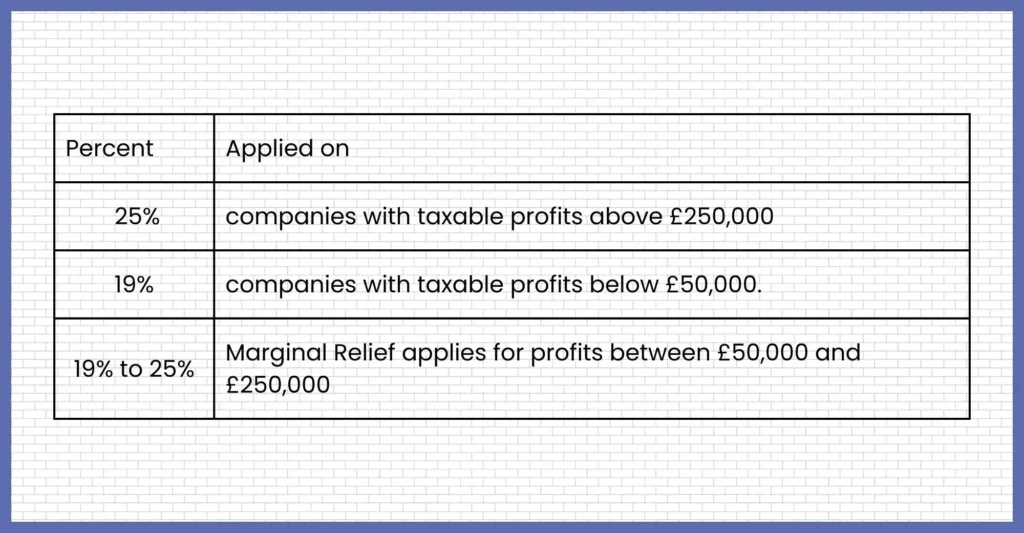
Select the applicable tax rate for your client based on the profits earned.
Adjust for Tax Deductions and Reliefs
Businesses rely on accounting firms for corporation tax work because these firms excel at reducing tax by identifying tax reliefs. Your clients will expect the same from you. Therefore, you must be able to identify the following.
- Capital allowances for, e.g., Annual Investment Allowance for business assets
- R&D tax credits for innovation-related expenses
- Loss relief
- Patent Box relief for profits derived from patented inventions taxed at 10%
Submit the Corporation Tax Return (CT600)
Once you complete the calculations and identify tax reliefs, file the corporation tax return (CT600) within 12 months of the accounting period’s end. After filing, your clients must pay the tax within 9 months and 1 day after the accounting period ends (unless they pay by quarterly instalments).
With your vital support, you can help your clients get relief that will help them minimise their tax liabilities while keeping them compliant with the latest HMRC regulations. If you require any assistance in tax calculations, then feel free to get expert help through corporation tax outsourcing services offered by service providers.
What Is the UK Corporation Tax Rate in 2026 and How Does It Affect Your Clients?
The UK Corporation Tax rate in 2026 is 19% on profits up to £50,000 and 25% on profits over £250,000, with marginal relief between. These rates apply to the financial year starting 1 April 2026 and are unchanged from 2023.
Corporation Tax rates, financial year starting 1 April 2026
| Taxable profits | Rate | How it works |
| Up to £50,000 | 19% | Small profits rate |
| £50,001 to £250,000 | Between 19% and 25% | Main rate of 25% reduced by marginal relief (fraction 3/200) |
| Over £250,000 | 25% | Main rate |
Source: HMRC on GOV.UK, Corporation Tax rates and allowances (updated 1 April 2026). Related: our Corporation Tax rates 2026 guide.
You need to understand the impact of corporation tax rates on your client’s business based on which you will be advising your clients. Any changes in tax rates impact your client’s investment decisions, profitability, and tax planning strategies negatively or positively.
To prevent your clients from panicking about changes in corporation tax rates, we advise you to understand the following important points.
Understanding Corporate Tax Rates
Corporation tax is applied to businesses’ profits; however, tax rates differ based on these profits. Currently, there are two headline corporation tax rates, 19% and 25%, with marginal relief between them.
Impact of Corporation Tax on Different Business Sizes
Corporation tax also impacts the future of your client’s business in the following way:
If your client’s business profits are £50,000 or below, they will enjoy a lower tax rate of 19%, leaving more profits in their hands for reinvestment. Those businesses with profits between £50,000 and £250,000 will pay an effective rate between 19% and 25%, leaving less funds for reinvestment. Each extra pound of profit in this band is effectively taxed at 26.5%, which is higher than the main rate. In such situations, the importance of deductions and reliefs rises.
25% is the primary corporation tax rate applicable if your client earns profits of more than £250,000. Such a tax rate will undoubtedly impact your client’s cash flow and investment decisions; hence, more focus will be placed on efficient tax strategies.
For groups, both limits are divided by the number of associated companies, so a company in a group of four has a lower limit of £12,500 and an upper limit of £62,500 (GOV.UK Marginal Relief guidance). Check associated companies before choosing the rate.
Other Considerations for Your Clients
You must devise new ways to reduce your client’s tax liabilities by focusing on claiming reliefs and reducing expenses. Also, note that a higher corporation tax will leave less funds for your clients for investment, hiring, and restructuring.
Which CT600 Software Should a Practice Use for Corporation Tax Filing?
Choose HMRC-recognised CT600 software that covers trading profit, capital allowances, R&D relief and marginal relief, integrates with your accounting platforms, and supports bulk filing. TaxCalc, BTCSoftware and IRIS Business Tax are common choices for practices.
As an accounting firm, you must understand the importance of choosing the right CT600 software. Its importance has grown with the increasing complexity of tax regulations. Using CT600 software, you can reduce errors and make timely client submissions.
To choose the best CT600 software, you will have to look for specific features in it, which are:
- HMRC-recognised software (and MTD-compatible where you also handle VAT)
- A software that covers all aspects such as trading profit calculations, capital allowances, R&D tax relief claims, and marginal relief computations.
- Integrates well with multiple accounting software
- Automates calculations and error checks
- Enables easy online filing with HMRC
- Data security by being GDPR compliant
CT600 software compared
| Software | Best suited to | Notable features (from the original post) |
| TaxCalc | Mid-sized accounting firms | In-built error checker; direct CT600 e-filing |
| BTCSoftware | Practices with bulk submissions | Supports multiple clients’ bulk submissions; integrates with Xero, Sage and others |
| IRIS Business Tax | Large accounting firms | Handles complex calculations and bulk transactions from multiple clients through automation |
Some of the best CT600 software in the market of corporation tax filing are:
TaxCalc
Ideal for mid-sized accounting firms, TaxCalc features an in-built error checker to avoid compliance issues. It is also recognised for its direct CT600 e-filing feature.
BTCSoftware
It supports multiple client’s bulk submissions and integrates well with Xero, Sage, and other accounting software.
IRIS Business Tax
Perfect for large accounting firms, the IRIS business tax software can handle complex calculations and bulk transactions from multiple clients through automation.
To choose the best CT600 software from the above, you have considered the following things:
- The size of your client’s business and the number of clients you are handling.
- Does it integrate well with multiple accounting software?
- Check whether it is light on your pockets.
- Ensure the software is recognised for CT600 filing and keeps pace with future HMRC changes.
What Are the Common Mistakes When Filing a Corporation Tax Return?
The most common mistakes are missing the filing deadline, miscalculating taxable profits, missing reliefs, entering incorrect data, using the wrong rate, keeping poor records and submitting incomplete CT600 forms.
As your experience will say, errors while filing corporation tax returns are bound to happen and remaining compliant with HMRC is important. Many accounting firms have made common mistakes that have led to penalties and delays for your clients. Those common mistakes are as follows:
Missing the Filing Deadline
The CT600 form must be submitted within 12 months of the accounting period’s end, however, many times delays lead to automatic penalties. For filing deadlines on or after 1 April 2026, the fixed penalty is £200, rising to £400 in total after three months, with 10% of unpaid tax added at six and twelve months. Reminders will help you keep track of the deadline, and CT600 software will help you streamline the submission.
Late filing penalties for the Company Tax Return
| How late | Before 1 April 2026 | Filing deadline on or after 1 April 2026 |
| 1 day late | £100 | £200 |
| More than 3 months late | £200 in total | £400 in total |
| 6 months late | 10% of unpaid tax | 10% of unpaid tax |
| 12 months late | A further 10% of unpaid tax | A further 10% of unpaid tax |
| Late three returns in a row | Higher fixed penalties | £1,000, or £2,000 if more than 3 months late |
Source: Accounting People. Penalties apply even if no tax is due. Check the current figures on GOV.UK before advising clients.
Wrong Calculations of Taxable Profits
Errors can occur in calculating allowable expenses, capital allowances, and reliefs, leading to overpayment or underpayment of tax. Only double-checking expenses, depreciation, and R&D tax relief and using accounting software for the correct application will do the trick.
Not Claiming tax Reliefs
It’s hard to believe, but many times, multiple accounting firms have been missing out on tax reliefs that clients are entitled to, such as R&D Tax Credits, Annual Investment Allowances (AIA), and Loss Relief. Only a thorough review and expert handling can prevent this error. Many accounting firms have relied on corporation tax outsourcing services for expert help in tax reliefs. Go through the case studies of accounting outsourcing service providers to know their experience before selection.
Incorrect Financial Data
Missing or entering incorrect financial data like revenue, costs, and profits will lead to miscalculations in tax profits and potential inquiries. Hence, inspecting the financial statements’ data thoroughly is important.
Using the Wrong Corporation Tax Rate
You must select the right corporation tax rate based on the profit; otherwise, your clients may overpay or underpay taxes, causing financial losses, penalties, and reputational damage to your accounting firm.
Not Maintaining Proper Records
Records must be maintained for 6 years from the end of the accounting period as per HMRC directives. Failure to do so will lead to penalties and difficulty claiming tax reliefs for your clients during the audit period. Hence, store all invoices, receipts, and financial statements, ideally in digital format. You can use cloud accounting software for better record-keeping and retrieval.
Submitting Incomplete CT600 Form
Leaving out important information like R&D tax relief and capital allowances must be avoided. To ensure it does not happen, you will be required to double-check the form for its completion. Make it foolproof using CT600 software, which will flag off any missing information.
Frequently Asked Questions (FAQ)
What records should I keep for corporation tax filing?
Keep sales and purchase invoices, receipts, bank statements, payroll records, asset registers, loan and investment income records, and the workings behind your tax computation. HMRC expects company records to be kept for six years from the end of the accounting period, so store them digitally and link each entry to its source document.
Will corporation tax rates change in 2026/27?
No. For the financial year beginning 1 April 2026, GOV.UK shows the small profits rate at 19% for profits up to £50,000 and the main rate at 25% above £250,000. Marginal relief applies between those limits using the 3/200 fraction. Always check GOV.UK before filing in case a future Budget changes the rates.
Can I do my own Corporation Tax return?
Yes, a company can prepare its own return, but the return must include accounts and tax computations in the right format, and errors in reliefs, rates or deadlines are costly. Late filing now carries a £200 penalty from 1 April 2026, so many companies use an accountant or software to reduce risk.
Does Making Tax Digital apply to corporation tax returns?
No. HMRC has confirmed it does not intend to introduce Making Tax Digital for Corporation Tax, so companies still file one annual CT600 with no quarterly updates. Making Tax Digital does apply to VAT, and Income Tax started on 6 April 2026, so many clients still need compatible software.
What is the deadline for a Corporation Tax return?
The Company Tax Return is due 12 months after the end of the accounting period it covers. Payment is normally due 9 months and 1 day after the period ends. Large companies with profits over £1.5 million, divided by the number of associated companies, pay in quarterly instalments instead, so their payment dates fall earlier.
Can Corient Business Solutions prepare year-end accounts and corporation tax using TaxCalc and Sage?
Yes. Corient prepares year-end accounts and corporation tax returns for UK accountancy firms using TaxCalc and Sage. Practices keep the client relationship and final review, while Corient’s team handles the preparation. You can discuss volumes, turnaround times and software on a short call before committing to anything.
Can I submit my corporation tax return through HMRC’s online system?
Most companies file using commercial tax software, because the return must be submitted with accounts and tax computations in the required online format. Practices usually choose HMRC-recognised software for CT600 filing, which also helps with error checks, bulk client submissions and keeping a clear audit trail for each return.
Should Your Practice Outsource Corporation Tax Returns?
Yes, if corporation tax volume, deadlines or reliefs are stretching your team. Outsourcing preparation adds capacity while you keep client relationships and final review, and it reduces the risk of late filing penalties that doubled from 1 April 2026.
Our experience while working with accounting firms has made us realise how corporation tax return responsibility might be taking a considerable amount of your time and resources. In addition to the misery, complexity, and volume of corporate tax return work given by your clients, it will be impossible to handle it alone. Therefore, to make life easier for you, we have developed a guide on corporation tax returns, how to handle the calculations, filing and mistakes to avoid, as explained in plain and simple language. We hope it makes a difference.
Speaking about making life easier, if you are interested in further streamlining your corporation tax return services, then why not get outside expertise in the form of corporation tax services and tax outsourcing support, or year-end accounts support? In the UK, you will be spoilt for choices; however, many accounting firms are placing their faith in the UK-focused Corient.
Since 2011, we have worked on establishing ourselves as a trusted accounting outsourcing service provider for accounting firms. Our tech-savvy bookkeeping, corporation tax, payroll, and other accounting services have had a considerable positive impact on multiple accounting firms. If you are interested in gaining benefits from us, then do contact us through our website contact form or book a 15-minute call. Our executive will get in touch with you.
Best of luck and looking forward to meeting you soon.