

AI in accounts payable means the use of artificial intelligence technology to automate invoice processing, data extraction, approvals, payment workflows, and exception management. This helps improve your efficiency, reduce errors, and handle larger client workloads without significantly expanding your workforce. For large UK practices in 2026, it also helps meet rising invoice volumes and the move to e-invoicing.
The good news is that it is increasingly preferred by practices all over. AI is already part of everyday work for most accountants. In Wolters Kluwer’s May 2025 survey of 100 UK accountants, 66% said they use it: 69% of those in practice and 63% in business finance. A further 25% are planning to, leaving just 9% who aren’t.
If your practice is stretched by more work, shorter deadlines, and a tough hiring market, AI in Accounts Payable isn’t a “someday” project anymore. The firms using it now are pulling ahead.
What is AI in Accounts Payable?
AI in accounts payable means the use of technologies like artificial intelligence tools, machine learning, and automation software technologies to streamline the accounts payable process.
Traditionally, accounts payable teams manually:
- Receive invoices
- Enter invoice data
- Match invoices to purchase orders
- Route documents for approval
- Process payments
- Handle exceptions
- Respond to supplier enquiries
Artificial intelligence significantly reduces the need for manual intervention.
Rather than making your accountant feed the invoice information into a system, AI will automatically:
- Read invoices using Optical Character Recognition (OCR)
- Extract supplier information
- Validate invoice details
- Match documents against records
- Identify anomalies
- Route invoices to appropriate approvers
The result is a faster, more accurate, and scalable accounts payable process.
In the same Wolters Kluwer survey, 46% of UK accountants already using AI said they use automation for routine tasks such as payroll, invoice processing and bookkeeping (Wolters Kluwer, 2025).
How Can AI Improve Efficiency in Accounts Payable?
AI improves efficiency by taking over the repetitive work that eats staff time: invoice capture, matching, approvals, exception checks and cash flow insight. Ardent Partners’ 2025 research found that best-in-class AP teams process invoices 79% faster and at 79% lower cost than their peers (Ardent Partners, June 2025). The study covered 204 AP and finance leaders worldwide.
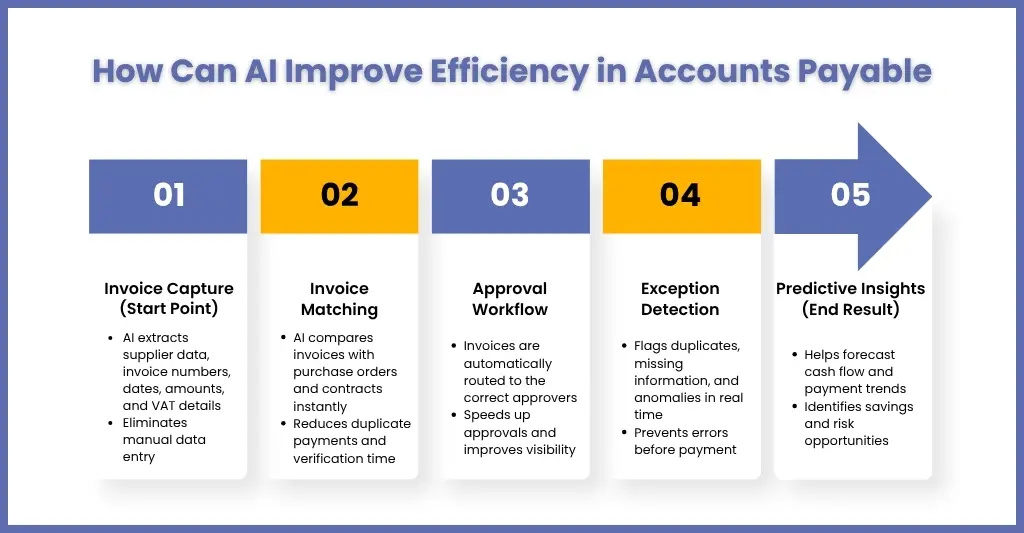
A question that crops up among practices that think about adopting AI is, ” How can AI improve efficiency in accounts payable? The answer lies in the automation of repetitive tasks that consume large amounts of staff time.
Automated Invoice Capture
AI tool can extract information from invoices sent by suppliers irrespective of the volume and format.
Instead of manually entering:
- Supplier names
- Invoice numbers
- Dates
- Amounts
- VAT details
The system captures and processes the data automatically, thus saving time.
Intelligent Invoice Matching
AI tools can, in seconds, compare invoices against:
- Purchase orders
- Contracts
- Previous transactions
Your team gets hours back from invoice checking, and double payments become a rare problem rather than a regular worry.
Automated Approval Workflows
AI tools will automatically route the invoices to relevant approvers based on set rules. These automated workflows reduce unnecessary delays and improve visibility.
Exception Detection
Even in high volumes, AI tools will easily identify unusual transactions, duplicate invoices, missing information, or payment anomalies, which can be rectified before they come to the attention of HMRC.
Predictive Insights
Advanced AI systems can analyse payment patterns and identify opportunities to:
- Improve cash flow
- Capture early payment discounts
- Reduce late payment risks
By reducing manual effort across these activities, accounting practices can handle higher transaction volumes without increasing staffing levels.
What Are the Key Benefits of AI in Accounts Payable for Accounting Practices?
The five key benefits are faster invoice processing, better accuracy, lower costs, fraud prevention, and real-time reporting.
Using AI tools, you can handle repetitive accounts payable tasks in a much faster, simpler, and smarter way. It’s not just about saving time but also about making the entire process reliable and efficient.
Here are five key reasons why AI is a valuable addition to AP teams:
- Faster Invoice Processing: AI tools will speed up the entire process by automating time-consuming tasks like data entry and verification, thus reducing the time taken in processing significantly.
- Improved Accuracy: With the introduction of AI in accounts payable, human intervention in the extraction and validation of invoice details goes down. It leads to minimal human errors and high accuracy.
- Cost Savings: Reduction in manual work and errors by AI tools means less rework and lower operational costs.
- Fraud Prevention: AI tools can easily identify errors and potential fraud, providing your clients with an additional layer of security.
- Enhanced Reporting and Insights: AI generates real-time analytics, offering valuable insights into your cash flow, payment trends, and vendor performance
What Are the Common Accounts Payable Challenges for Practices Without AI?
Without AI, practices usually face high processing costs, slow turnaround, limited visibility, compliance risks and staff burnout. Continuing to manage the accounts payable process manually will only create more challenges that will hinder the entire process. These common challenges are:
High Processing Costs
Manual invoice handling is a very time-consuming process, and when the number of clients grows, so will the volume of invoices. Manual handling will not be humanly possible, costly, and full of human errors.
Slow Turnaround Times
Without AI tools, invoices will not be automatically routed to relevant approvers; instead, they will be sitting in email boxes awaiting approvals. This will delay payments and frustrate your clients’ suppliers.
Limited Visibility
Manual accounts payable lacks accountability when it comes to the invoice processing status. AI tools, apart from automating the process, maintain transparency by keeping track of the invoice in real-time.
Compliance Risks
Without AI tools, there is a possibility of missing out on documentation or incorrect coding, especially when there are changes in regulations. It creates compliance issues and a bad reputation for your practice. The next big change is e-invoicing: from 1 April 2029, all UK B2B and B2G VAT invoices must be issued as structured, machine-readable e-invoices, and the government confirmed Peppol as the network in June 2026 (Dext, 17 September 2026). Corient’s VAT outsourcing team helps practices keep VAT coding consistent.
Staff Burnout
Repetitive administrative tasks can negatively affect employee engagement and productivity and reduce their focus on high-value advisory work.
These challenges become increasingly difficult to manage as you expand.
What Are Real Use Cases of AI in Accounts Payable for Practices?
The most common uses are multi-client invoice processing, automated approval routing, supplier query management, fraud detection, and VAT validation.
AI is quite heavily used across accounting and finance functions.
Here are some practical examples.
Multi-Client Invoice Processing
Accounting practices working on accounts payable are using AI to automatically sort hundreds of invoices and allocate them to the correct entity.
Automated Approval Routing
When invoices reach a specific threshold, they can be automatically escalated to designated approvers.
Supplier Query Management
AI-powered systems can provide status updates and respond to common supplier enquiries.
Fraud Detection
Machine learning algorithms can identify unusual payment patterns that may indicate fraud or duplicate invoices.
VAT Validation
AI tools can assist with validating VAT information and identifying inconsistencies.
These applications reduce administrative workload while improving control.
How Much Can AI in Accounts Payable Cut Costs for Firms?
Best-in-class AP teams process invoices at 79% lower cost than their peers, according to Ardent Partners’ 2025 research (Ardent Partners, June 2025). Your own savings depend on invoice volume and how much work is still manual.
Many practices assume that implementing AI in accounts payable is a costly affair and back out; it’s quite the opposite. Cost reduction is the strength of AI. Yes, implementation will require investments, but long-term savings are immense when compared with initial costs.
Potential savings come from:
- Reduced manual labour
- Faster processing
- Lower error rates
- Improved cash flow management
- Reduced rework
For you, it means more profitability while supporting growth.
Why Is AI Becoming Essential for Modern Accounting Practices?
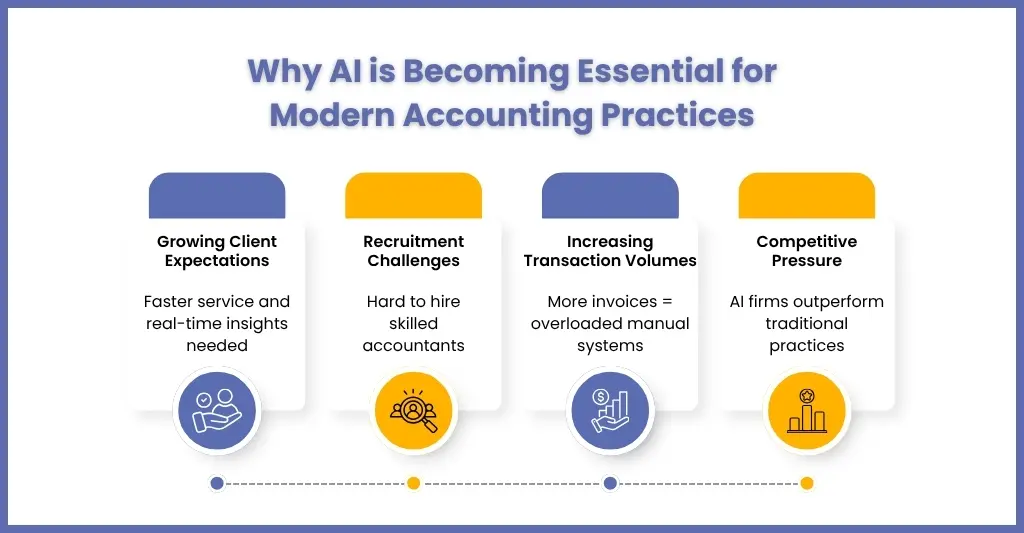
Because staff is scarce and invoice volumes keep rising. 91% of UK accountants in Wolters Kluwer’s 2025 survey were using AI or planned to (Wolters Kluwer, 28 May 2025), and e-invoicing becomes mandatory for VAT invoices from April 2029.
It’s a fact now that AI is heavily influencing the future of accounting, and there are many reasons that are pushing practices towards adopting AI technologies.
Some of those factors/reasons are:
Growing Client Expectations
Clients increasingly expect:
- Faster service
- Real-time information
- Greater accuracy
- Strategic advice
Manual accounts payable processes are unable to meet these expectations consistently.
Recruitment Challenges
Finding skilled accounting professionals remains difficult across the UK. Advancetrack’s 2026 Accounting Talent Index found that 73% of the 500 firms surveyed were turning away potential clients due to a lack of staff (Accountancy Today, 13 May 2026; the survey covers the UK, US, Canada and Australia). AI reduces the need for more resources and helps firms do more with existing ones.
Increasing Transaction Volumes
As your client grows or when you get in new clients, the volume of invoices rises; AI will immediately scale up your capacity to handle this growth well. Making Tax Digital for Income Tax started on 6 April 2026 for sole traders and landlords with qualifying income over £50,000, falling to £30,000 in April 2027 and £20,000 in April 2028 (GOV.UK), so practices will see more client data to process. Our Making Tax Digital service supports that work.
Competitive Pressure
Practices that embrace automation often gain operational advantages over competitors relying solely on traditional methods.
For many firms, AI is becoming a necessity rather than an optional enhancement.
What Is the Difference Between AI and Manual AP Processing for Accounting Firms?
AI-powered AP is faster, more accurate, and easier to scale than manual processing, which depends on staff time and email follow-ups. The table compares the two across eight areas.
| Area | Manual AP Processing | AI-Powered AP Processing |
| Invoice Data Entry | Manual | Automated |
| Processing Speed | Slower | Faster |
| Error Rate | Higher | Lower |
| Approval Workflow | Manual follow-up | Automated routing |
| Fraud Detection | Reactive | Proactive |
| Reporting | Time-consuming | Real-time visibility |
| Scalability | Limited by staff | Easily scalable |
| Operational Cost | Higher over time | Lower per transaction |
While manual processes may work for small invoice volumes, AI provides significant advantages as practices grow.
How Does Outsourced AP with AI Help Accounting Practices Scale?
Outsourced AP with AI pairs automation with experienced finance staff who review exceptions, manage suppliers, and keep work compliant, so a practice adds capacity without hiring.
Don’t assume that incorporating AI in the accounts payable process will solve all your problems. Even after getting the AI tools, you might struggle to operate it if your team lacks experience.
You will need experienced professionals to:
- Review exceptions
- Manage supplier relationships
- Handle complex transactions
- Ensure compliance
- Support clients
This is where accounts payable outsourcing can add value. It is cost-effective and offers multiple other benefits. By combining AI technology with specialist finance professionals, you can gain both automation and expertise.
For example, Corient supports accounting practices by providing bookkeeping outsourcing services that help firms expand capacity without increasing recruitment costs. Our wider accounting services cover the work around AP, from VAT to year-end.
Benefits include:
- Access to skilled AP professionals
- Faster turnaround times
- Scalable support
- Reduced operational pressure
- Improved service delivery
This hybrid approach will allow you to focus on client relationships and advisory services while routine AP work is managed efficiently. Rising volumes of invoices and client demands for insights in real-time have made combining AI with outsourced support an increasingly popular strategy.
How Does Corient Help Accounting Practices With AI-Powered Accounts Payable?
The combination of AI + outsourced expertise is quite powerful. For many firms, especially those handling growing client portfolios, Corient acts as an operational extension of their practice by combining structured finance processes with modern automation tools. Corient was established in 2011 and works in Xero, QuickBooks and Sage. Our AI Crew includes Billy for invoices, Corby for reconciliations, and Sherlock for error detection.
Handling Exceptions and Complex Transactions
Even with AI automation, human intervention is required.
Corient helps with that by managing:
- Invoice exceptions and discrepancies
- Supplier disputes and clarifications
- Complex multi-entity transactions
- Unusual or non-standard accounting entries
Automation does the routine. Your experts deal with the exceptions.
Improved Accuracy and Workflow Control
Along with a structured outsourcing process, Corient uses multiple AI tools to reduce:
- Data entry errors
- Processing delays
- Approval bottlenecks
- Compliance risks
Every stage of the accounts payable workflow is monitored and quality-checked, ensuring a consistent output across all clients.
Freeing Up Time for Advisory Work
Corient will enable you to shift your focus away from routine accounts payable processing so that you can focus on
- Client advisory services
- Financial planning and forecasting
- Tax strategy
- Business development
Frequently Asked Questions About AI in Accounts Payable
How can AI improve efficiency in accounts payable?
AI improves efficiency by automating invoice capture, data extraction, approvals, matching processes, and exception management. This reduces manual work, speeds up processing, and improves accuracy. The automation of accounts payable helps in getting valuable insights in real-time, which can be used in making informed decisions by your clients and making them more efficient.
Does AI reduce processing costs in accounts payable?
Yes. Less manual handling, fewer errors and faster workflows all bring the cost per invoice down. Ardent Partners’ 2025 research found that best-in-class AP teams process invoices at 79% lower cost than their peers. What you’ll actually save depends on your invoice volume and how much is still done by hand.
Can accounting practices use AI in accounts payable?
Absolutely. Accounting practices of all sizes can use AI-powered AP solutions to manage client invoice processing more efficiently, improve scalability, and enhance service delivery. Large practices gain most when invoice volumes are high, because approval routing and matching rules can be set once and applied across many client ledgers.
Is AI taking over accounts payable jobs?
No. It’s changing the job, not removing it. With the repetitive tasks automated, accountants get more time for advisory and financial planning work. The worry is out there, though: in Wolters Kluwer’s 2025 survey, 41% of UK accountants said they were concerned about AI taking their job.
Are accounts payable safe from AI?
There is a large number of accounting practices that are already using AI in accounts payable to monitor transactions for fraud and non-compliance. AI is meant to be merely an additional layer of security, not a replacement for human checks and critical thinking. Accuracy and data security are the top worries, so review outputs and check how vendors protect data.
How do I choose the right AI for accounts payable processes?
Choose a tool that integrates with the systems you already use, such as your ERP, accounting software, procurement tools and payment systems. That avoids data silos and duplicate entries. Also consider your IT resources, and ask each vendor whether they’re ready for e-invoicing in April 2029.
Is e-invoicing mandatory for UK accounts payable?
Yes, from 1 April 2029. UK B2B and B2G VAT invoices must be issued as structured, machine-readable e-invoices, and a PDF sent by email won’t qualify. The government confirmed Peppol as the network in June 2026, so ask every vendor about their Peppol support.
Is AI in Accounts Payable Worth It for UK Accounting Practices?
Yes. For practices facing rising invoice volumes and hiring gaps, AI in accounts payable cuts manual work and errors and lets teams take on more clients without a matching rise in headcount.
AI in accounts payable is changing how accounting practices are handling their client finance operations. By automating repetitive tasks, improving accuracy, reducing processing costs, and enabling greater scalability, AI helps firms deliver better outcomes without continuously increasing headcount.
With rising client expectations and recruitment challenges, practices that embrace AI-powered AP processes will be better positioned to improve efficiency, increase profitability, and scale their services.
For firms looking to accelerate growth while maintaining service quality, combining AI technology with outsourced expertise from Corient can provide a powerful solution. It allows accounting practices to reduce operational pressure, handle larger client workloads, and focus on what truly drives value: building stronger client relationships and delivering strategic financial advice.
Wanting to explore AI in accounts payable? Contact us and see the difference it creates.
