
HMRC wage raid payroll checks are short-notice or unannounced inspections of a client’s payroll records, RTI submissions, and National Minimum Wage compliance. In March 2026, HMRC named 389 employers and issued £12.6 million in penalties for underpayment. For accounting firms, the risk is firm-wide: one non-compliant client can expose your entire payroll book to scrutiny.
Have your clients ever heard about HMRC Wage Raid? It’s time to make them aware of it because in 2026, it’s going to happen more often. Let’s understand it even better. A mid-sized accounting practice is handling payroll for multiple SME clients. Things are good until one client gets a surprise visit from HMRC. Within hours, inspectors found discrepancies in National Insurance contributions and missing RTI submissions.
The result will be?
- Penalties issued
- Client trust shaken
- Urgent rework across multiple payrolls
The issue wasn’t intentional non-compliance. There were process gaps and a lack of regular checks. As an accounting practice handling the payroll of your clients, it’s your responsibility to ensure your clients do not fail in payroll compliance.
Key Takeaways
- 389 employers were named and £12.6 million in penalties issued in HMRC’s 19 March 2026 naming round — around 60,000 workers were underpaid.
- The Fair Work Agency launched on 7 April 2026 with 550+ inspectors and £60.1 million in funding, extending checks to holiday pay and Statutory Sick Pay.
- From April 2026, employers must keep holiday pay and annual leave records for a minimum of six years.
- Penalties can reach 200% of arrears (capped at £20,000 per worker); underpayments above £500 lead to public naming.
- Regular payroll audits and outsourced compliance reviews are the most effective way to catch issues before HMRC does.
What Are HMRC Wage Raid Payroll Checks?
In short: they are unannounced or short-notice HMRC inspections of a client’s payroll records, RTI submissions, and NMW compliance — designed to catch errors before they turn into underpayments.
HMRC wage raid payroll checks are surprise inspections conducted by HMRC officers at your client’s office. The goal of these surprise checks is to ensure:
- Paying employees correctly
- Applying tax codes accurately
- Submitting payroll data on time
- Complying with PAYE, National Insurance, and statutory obligations
These checks can include:
- Reviewing payroll records
- Checking employee classifications
- Verifying tax and NI calculations
- Inspecting RTI submissions
In simple words, HMRC is verifying that your payroll processes are accurate, compliant, and transparent.
Why HMRC Is Increasing Payroll Compliance Checks in 2026
Real-time payroll data, a widening tax gap, and increasingly complex employment structures mean HMRC now has both the data and the incentive to check more payrolls, more often.
The increase in HMRC wage raid payroll checks is not a coincidence. HMRC has the responsibility to ensure all hours worked are paid by law, and certain factors have pushed HMRC into conducting these raids in 2026 with increased frequency. These factors are:
Increased Use of Digital Reporting
Using real-time information from payroll submissions, HMRC now has continuous access to payroll data, making it easy to identify discrepancies between declared hours and pay levels.
Focus on Revenue Protection
The tax gap is estimated to be 5.3% of total theoretical tax liabilities, or £46.8 billion in absolute terms, in the 2023 to 2024 tax year, leading to a loss of revenue. HMRC is tightening enforcement to reduce this gap.
Complex Employment Structures
The rise of complex employment structures like hybrid workers, contractors, and umbrella companies has increased the risk of misclassification and incorrect payroll handling.
Scale of what’s now visible to HMRC: the UK had 30.3 million payrolled employees as of the ONS/HMRC PAYE RTI release for May 2026 — every one of those records now flows into HMRC’s real-time data-matching systems, which is why discrepancies surface faster than they did even two or three years ago (ONS, PAYE RTI statistics, June 2026)
The Fair Work Agency: A Payroll Game-Changer in 2026
From 7 April 2026, the Fair Work Agency merges NMW, holiday pay, and SSP enforcement into one body with over 550 inspectors and £60.1 million in funding — meaning clients can now be inspected for issues HMRC never used to chase.
Your clients are going to need to get to grips with a key development: the launch of the Fair Work Agency (FWA). This new body officially came into existence on 7th April 2026 under the Employment Rights Act 2025, and it’s the result of bringing together bits of the old enforcement system that were all over the place:
- HMRC’s National Minimum Wage enforcement team
- The Employment Agency Standards Inspectorate (EASI)
- The Gangmasters and Labour Abuse Authority (GLAA)
- New enforcement of holiday pay and Statutory Sick Pay (SSP)
So what does this mean for payroll? Unlike the way it was before, where HMRC were often only reacting to problems after someone complained – the Fair Work Agency is going to be able to swoop in on a workplace and do unannounced inspections without needing someone to complain first. It launched with a team of over 550 inspectors and £60.1 million from the government to make it all happen.
For the next year at least – 2026 to 2027 – HMRC are still going to be dealing with NMW enforcement – but the FWA are getting set to take over in full in April 2027. But even from this spring, they’re already going after holiday pay and SSP compliance – areas that have traditionally got a bit of a free pass. And from April 2026, all UK employers need to be holding onto their holiday pay and annual leave records for a minimum of six years now.
What Triggers an HMRC Wage Raid Payroll Check?
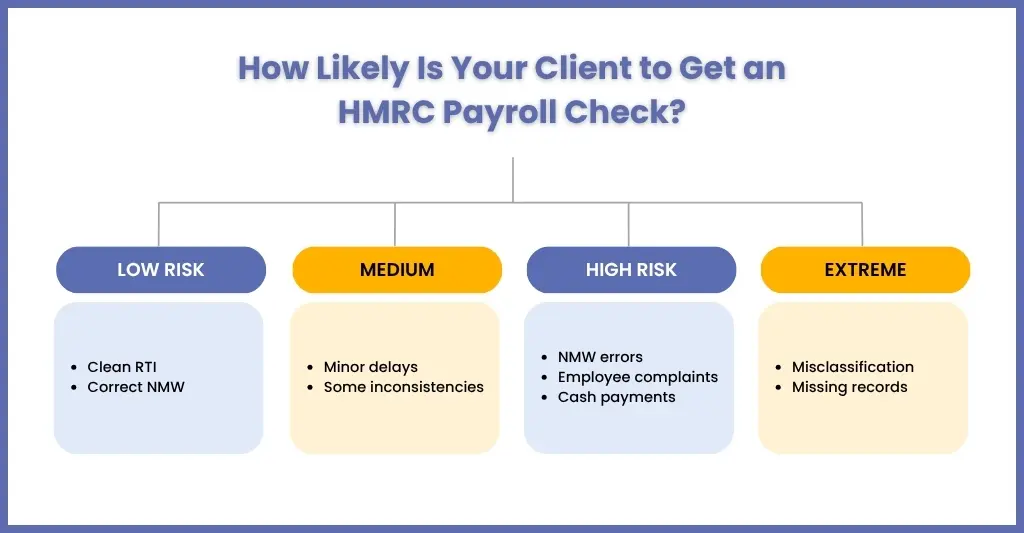
Inconsistent RTI submissions, NMW risk flags, employee complaints, high staff turnover, and sector risk (hospitality, retail, construction) are the five biggest triggers HMRC screens for.
Most of the HMRC wage raid payroll checks happen when the regulator identifies certain warning signs.
These warning signs are:
Inconsistent PAYE Submissions
When frequent errors or irregularities are noticed in the RTI submissions, it will immediately raise a red flag, making your client a target of frequent checks by HMRC officers.
National Minimum Wage Risks
In recent years, HMRC found 389 employers from across the UK failing to pay workers as per the national minimum wage, affecting tens of thousands of workers. These employers had to pay £12.6 million in penalties. This was the naming round published on 19 March 2026, which also saw £7.3 million in repaid wages returned to around 60,000 affected workers (GOV.UK, 19 March 2026)
Employee Complaints
Based on the complaint of a disgruntled employee regarding payroll issues, HMRC can launch a surprise visit to your client’s office. Therefore, it is important to resolve the issues to the satisfaction of the employee quickly before it comes to HMRC’s attention.
High Staff Turnover
HMRC will find it fishy when your client is frequently hiring employees and employees are frequently leaving for short durations. HMRC will conclude that employees are unhappy with their pay, triggering an automatic visit.
Most of these issues can be tackled in the beginning, but many practices have found it time-consuming and resource-intensive. Many practice have found outsourcing this work to professional outsourcing providers like Corient beneficial who get the job with perfection.
Sector-Based Risk
Some of your clients will be under greater chances of frequent inspections by the HMRC, if they are from industries like:
- Hospitality
- Retail
- Construction
What Happens During an HMRC Payroll Inspection (Step-by-Step)?
HMRC arrives with little or no notice, requests payroll and employment records, talks to staff, cross-checks RTI data against what’s on the ground, then issues a findings report.
When an HMRC officer makes a surprise visit, your clients will panic. That’s important to make them understand the entire process of the inspection and what to expect.
Step 1: Surprise Visit
HMRC usually makes a surprise visit or gives short notice to your client. The first thing the HMRC officers will do is introduce themselves and communicate the purpose of their visit to your client.
Step 2: Start Reviewing the Records
They will ask for documents in order to review them. These documents are:
- Payroll records
- Employee contracts
- Payslips
- Timesheets
Step 3: Discussion with Employees
For much deeper analysis, officers will also conduct face-to-face talks with employees to confirm hours and rates of pay.
Step 4: Cross-checking
HMRC will start cross-checking the RTI reports with the records provided, especially when it comes to:
- Wage calculations
- Tax deductions
- Compliance with NMW rules
Step 5: Outcomes
The outcome of the investigations will be provided in a report, which will show all the discrepancies or violations identified.
What HMRC Checks in Your Payroll Records
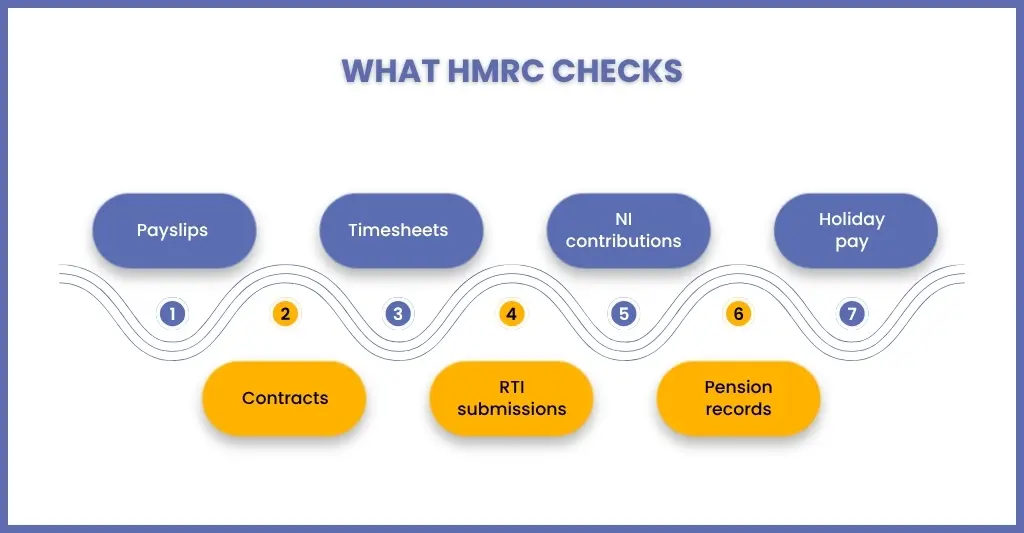
HMRC examines everything from payslips and contracts to NMW calculations, pension records, and statutory payments — not just RTI figures.
During their visit to your client’s office, HMRC officers will be interested in checking their payroll records, which include:
- Payslips
- Payroll journals and software reports
- Contracts of employment
- Time sheets or rota systems
- National Minimum Wage calculations
- Holiday pay records
- Pension enrolment details
- RTI submissions
- National Insurance contributions
- Pension deductions
- Statutory payments (SSP, SMP, etc.)
Penalties for HMRC Wage Raid Findings: What Your Clients Face
Arrears repayment plus a penalty of up to 200% of the underpayment (capped at £20,000 per worker), public naming above £500 underpaid, and penalties of up to 30% for careless PAYE errors.
Getting a grasp on what happens when an HMRC wage raid payroll check goes wrong is crucial for getting your clients to take compliance seriously – because the penalties are not only hefty but can snowball very quickly:
The Maximum: 200% of what’s owed
The penalty for arrears is capped at 200% but will be knocked down to 100% if you manage to pay up within 14 days of getting the underpayment notice – that’s a big incentive to act fast.
£20,000: That’s the Maximum Per Worker
HMRC will also slap a maximum penalty of £20,000 per worker if you get caught underpaying. It’s a big fine but one that’s capped.
£500+ & You’re On the Public List
Be warned – if the underpayment is over £500, you can expect to be publicly named and shamed on the gov.uk website as one of those naughty non-compliant employers
6 Years: That’s How Long HMRC Will Keep You On The Hook For
HMRC and the FWA will be sniffing around your payroll history for six whole years, looking for arrears or penalties to nail you with.
On top of the NMW penalties, you also have to worry about PAYE-related penalties:
- Late or inaccurate RTI submissions: You’ll get a fixed penalty for submitting your returns late or getting them wrong – it could be £100 or £400 per month, depending on how many staff you’ve got on payroll
- Inaccurate PAYE returns: If you mess up on your PAYE returns and HMRC deems it a careless error, you can expect a penalty of up to 30% of the unpaid tax. Ouch
The reputational damage of being named on HMRC’s public register can be severe for SME clients operating in consumer-facing sectors such as hospitality and retail. Prevention is always significantly less costly than remediation.
Employer Rights During HMRC Wage Raid Payroll Checks
Clients can ask for ID and a reason for the visit, have their accountant present, log every document requested, and ask for reasonable time to respond.
Your clients are entitled to certain rights during the inspection by the HMRC, and you must make them aware of these rights. Making them aware of their rights will keep them prepared and reduce their panic levels. These rights are:
- Asking for identification from the HMRC officers and requesting an open explanation for the purpose of their visit.
- Keep your trusted accountant at the location.
- Keep a record of each question, document presented, and answer provided.
- Ask for a reasonable time to provide documents.
It is important for your clients to be cooperative, knowing their rights, and the process. It will help in speeding up the inspections.
Common Payroll Mistakes That Trigger HMRC Checks
Most triggers are administrative, not deliberate — misclassified staff, missing holiday pay, wrong tax codes, and late RTI filings top the list.
HMRC often identifies issues that your clients may not realise, that’s why you must make your clients aware of these payroll mistakes that will immediately trigger HMRC checks. These mistakes are:
- Paying below the National Minimum Wage
- Not including holiday pay
- Incorrect use of tax codes
- Paying staff in cash without reporting it
- Employees marked as self-employed but working as staff
- Missing pension enrolment
- Not reporting payroll on time
How to Prepare for HMRC Wage Raid Payroll Checks
Keep six years of NMW records, run regular payroll audits, use up-to-date software, and stay current on NMW/NLW rate changes every April.
Prevention is better than cure; this proverb fits better when it comes to handling HMRC wage raid payroll checks. It’s better to keep your clients prepared for these checks so that it goes on smoothly without consuming much time or hassle. Here’s what your clients will need to do:
Keep Records in Order and Accurately
HMRC clearly says that all records related to PAYE must be stored for 3 years, and under the National Minimum Wage, employers are required to keep records for up to 6 years. So, make sure you and your clients keep payslips, timesheets, and contracts safe and label them correctly.
Conduct an Audit at Regular Intervals
Encourage your clients to conduct payroll audits or have them done on their behalf every few months to identify discrepancies before HMRC does. Such audits require honesty and integrity; therefore, many practices are getting the audits done through top audit companies offering audit services of professional and reliable accounting outsourcing providers like Corient. For a look at how HMRC-style testing works in a formal audit context, ACCA’s technical guide on auditing wages and payroll controls sets out the same control checks HMRC officers look for.
Use of the Latest Payroll Software
Get the latest payroll software like Xero or QuickBooks with automatic updates regarding compliance requirements and rates. Corient’s payroll team runs this kind of software-plus-review process as standard for the UK accounting practices it supports through outsourced payroll delivery, pairing automated RTI submissions with a second set of eyes on every pay run before it’s filed.
Keeping up with NMW and NLW
The national minimum wage and national living wage rates change in April. If your client misses these updates, then they would face penalties or pay back money. Since 1 April 2024, the National Living Wage has been for those aged 21 and over. Currently, the National Minimum Wage rates to apply from 1 April 2026 are:
| NMW rate | Annual increase (£) | Annual increase (per cent) | |
| National Living Wage (for those aged 21 and over) | £12.71 | £0.50 | 4.1 |
| 18–20-Year-Old Rate | £10.85 | £0.85 | 8.5 |
| 16–17-Year-Old Rate | £8.00 | £0.45 | 6.0 |
| Apprentice Rate | £8.00 | £0.45 | 6.0 |
| Accommodation Offset | £11.10 | £0.44 | 4.1 |
Conduct Trainings
Make sure to train your payroll teams and those of your clients about wage laws, deductions, and how to stay compliant.
This is where a formal outsourced review can help — Corient’s audit and payroll teams work alongside accounting practices’ own client relationships (not instead of them) through the outsourced audit support service, running the same six-year record checks and NMW recalculations an HMRC inspector would, before an inspector ever asks for them.
FAQs on HMRC Wage Raid Payroll Checks
Can HMRC visit without notice?
Yes. HMRC officers can — and increasingly do — conduct compliance visits to a client’s workplace without advance warning, particularly when they’ve detected discrepancies in payroll records, identified NMW risk factors through RTI data, or received a complaint from an employee about pay or deductions. Short-notice visits are becoming more common as HMRC’s digital risk-screening improves.
How do I avoid HMRC wage raid payroll checks?
You can’t eliminate the risk entirely, but you can significantly reduce it. Maintain accurate, up-to-date payroll records for every client, submit RTI data on time every pay period, apply National Minimum Wage rates correctly at each April uprating, and run periodic internal payroll audits. Practices that outsource this review work tend to catch discrepancies months before HMRC would.
How long does an HMRC payroll check take?
Duration depends on payroll complexity and what HMRC finds. A straightforward check on a small client with clean records can be resolved in a few hours on-site. Larger organisations, multi-site employers, or cases where discrepancies are found can extend to several days of document review, employee interviews, and follow-up correspondence over subsequent weeks.
Does HMRC do random checks?
Not typically. The majority of HMRC wage raid payroll checks are risk-based rather than random — triggered by data analysis of RTI submissions, discrepancies in returns, third-party or employee complaints, or sector-wide enforcement campaigns targeting industries like hospitality, retail and construction. A small proportion do arise from routine sampling.
What penalties can HMRC impose after a wage raid?
Where underpayment of NMW is found, employers face repayment of all arrears plus a financial penalty of up to 200% of the arrears owed — capped at £20,000 per worker. If paid within 14 days, the penalty reduces to 100%. Employers with unpaid arrears above £500 are publicly named on the government’s naming and shaming register. Separate PAYE penalties apply for late or inaccurate RTI submissions, and criminal prosecution is possible in cases of deliberate fraud.
Is my accounting practice liable if a client fails an HMRC wage raid check?
Liability for the underpayment and penalties sits with the employer, not the accounting practice — but reputational risk runs both ways. If a client is publicly named on GOV.UK’s register, it reflects on the adviser who managed their payroll. This is why many practices now use a second, independent review layer — either an internal audit cycle or an
outsourced audit support service — to catch NMW and RTI errors before HMRC does, rather than explaining them afterwards.
Conclusion
You cannot escape from HMRC wage raid payroll checks; it’s going to become more frequent, more detailed, and more data-driven.
For UK accounting firms, this means:
- Payroll processes must be accurate
- Compliance must be consistent
- Records must be audit-ready
With the right systems and support from experts like Corient, you can:
- Reduce compliance risks
- Streamline payroll processes
- Stay prepared for inspections
- Build stronger client confidence
Because in 2026, payroll isn’t just about paying employees, it’s about proving compliance every time, without exception. Get access to our services through the Corient contact form, and see the transformation.