

A balance sheet is a financial statement that shows what a company owns (assets), what it owes (liabilities), and what remains for shareholders (equity) as of a specific date. It follows the equation Assets = Liabilities + Equity. UK companies file one with Companies House each year, and accountants prepare it from the trial balance.
A balance sheet is an accounting report that is important for your clients. The balance sheet lays out in detail the financial position of your client’s business, thus promoting transparency. Using the balance sheet, your clients can see their financial health and take corrective steps if required.
A balance sheet can be shared with stakeholders such as investors, shareholders and lenders so they are updated with the financial status of the business and accordingly make their decision. The balance sheet is required to be submitted to Companies House if your client’s service companies are registered with it.
Key Takeaways
- A balance sheet is a snapshot of financial position on one date: Assets = Liabilities + Equity.
- Since 1 January 2026, FRS 102 puts most leases on the balance sheet as a right-of-use asset and lease liability.
- Small company thresholds rose on 6 April 2025 to £15m turnover and £7.5m balance sheet total.
- From 1 April 2028, all UK companies must file accounts via commercial software in iXBRL format, confirmed 9 June 2026.
- A reconciled monthly balance sheet catches errors early; outsourcing adds capacity at peak times.
What Are the Three Financial Statements?
The three main financial statements are the balance sheet, the profit and loss account and the cash flow statement. The balance sheet shows financial position on one date; the other two cover a period.
| Statement | What it shows | Time basis |
| Balance sheet | Assets, liabilities, shareholder equity | A single date |
| Profit and loss account | Income and expenses; profit or loss | A period |
| Cash flow statement | Cash inflows and outflows | A period |
There are three financial statements that you will have to prepare for your client; among them is the balance sheet, which is used to measure their financial performance. The balance sheet displays your client’s business assets, liabilities, and shareholder equity. The other two financial statements are the profit and loss statement and cash flow statement.
The balance sheet enables you to get a quick overview of your client’s business on any given date, especially on year-end or month-end. It is a valuable instrument to know about the value of the assets owned by your client. Through the balance sheet, you can get vital information, thus giving a clear picture and promoting stability. Using the balance sheet, banks and suppliers can offer loans, overdrafts, or credit facilities.
Profit and Loss Statement
Also known as an income statement discloses your client’s income and expenses during the specified period. Through this statement, you can make out whether your client is in profit or loss.
Both balance sheets and profit and loss statements are required to understand the financial health of your client’s business, and a review of these reports must be done at regular intervals.
Cash Flow Statement
The cash flow statement is another important financial statement that shows a company’s cash inflows and outflows over a specific period. You can use this report to see how your business is doing overall and whether it has enough cash to cover its expenses.
What is Included in the Balance Sheet?
A balance sheet includes three elements: assets (what the business owns), liabilities (what it owes), and shareholder equity (the difference between the two).
The balance sheet contains three important aspects: assets, liabilities, and shareholders’ equity. Assets are everything that is owned by your client’s business and can be used by them to pay off debts. Liabilities are money that your client owes to others, and shareholders’ equity is the difference between your client’s assets and liabilities. It shows how much of the company belongs to its shareholders.
What are Assets?
An asset is a resource a business owns that has economic value. Assets are split into current, fixed, and intangible assets.
Assets can be divided into three sections, i.e., current assets, fixed assets, and intangible assets.
Current Assets
Assets that are owned by your clients and can be easily converted into cash are considered current assets. Under it come the funds available in the bank, accounts receivable, and inventory stock. These assets are vital for maintaining liquidity and meeting your clients’ short-term goals.
Elaborating more on accounts receivable, it is the amount that is owed by the customers to your clients. Inventory stocks are items that your clients possess with the goal of selling them; under them also come products.
Fixed Assets
Fixed assets are also known as long-term assets, and as its name suggests, it is for assets that your clients are planning to use it for the longer term. Land, buildings, machinery, and vehicles are to be considered as fixed assets.
When your clients buy a fixed asset, it registers this purchase in the balance sheet at its original cost. Your clients will then depreciate its value over time. It is ideal for your clients to keep a register for fixed assets; this helps them in keeping a track of the value and condition of assets. It also plays a crucial role in financial management by making sure depreciation calculations are taken into account.
Intangible Assets
Intangible assets are those that are not in physical form, such as copyrights, patents, or trademarks. These assets are valuable and must be registered in the balance sheet. The price paid for acquiring these assets is known as the original cost. This figure is crucial for accounting purposes, as it serves as the basis for calculating depreciation or amortisation expenses over the asset’s useful life, thereby impacting your client’s financial statements and tax liabilities.
What Are Liabilities?
A liability is a financial obligation a business must settle in the future. Liabilities are current (due within 12 months) or long-term (due later).
Liabilities signify the financial duties your clients must fulfil in the future, which include loans. Liabilities can be divided into current and long-term liabilities.
Current Liabilities
Current liabilities are debts that must be settled within a year. Many of your client’s deal multiple current liabilities that include accounts payable, deferred revenue, taxes payable, and salaries payable. It is to be noted that active monitoring needs to be done of current liabilities, so that your clients can be warned if their debts are crossing a certain limit.
Long-Term Liabilities
Long-term liabilities are to be paid over more than a year; this includes money owed on a mortgage or loan and lease payments. From 1 January 2026, FRS 102 reporters show most leases here as a lease liability.
What is Equity
Shareholder equity is the value left for shareholders after total liabilities are deducted from total assets.
Shareholder equity, also known as owner equity, highlights the difference between the client’s assets and liabilities. It showcases how much of your client’s company belongs to the shareholders. When your client makes a profit, the profit amount is added to the shareholders’ equity. However, when your client loses money then loss is deducted from the shareholders’ equity.
What Has Changed for Balance Sheets in 2026?
Four changes matter in 2026: higher company size thresholds, FRS 102 lease accounting, the closure of the joint HMRC and Companies House filing service, and software-only filing from 1 April 2028.
| Date | Change | Impact for a large practice | Source |
| 6 Apr 2025 | Small: £15m turnover, £7.5m balance sheet total, 50 employees. Medium: £54m, £27m, 250. | Re-test client size categories; audit exemption can change. | SI 2024/1303 |
| 1 Jan 2026 | FRS 102 amendments: most lessee leases go on the balance sheet. | Build lease schedules; assets and liabilities rise. | ACCA |
| 31 Mar 2026 | Joint HMRC/Companies House filing service (CATO) closed. | Accounts and tax returns filed separately via commercial software. | Xero guide |
| 1 Apr 2028 | Software-only iXBRL filing; small companies file a profit and loss account; abridged accounts end. Confirmed 9 June 2026. | Confirm your software can tag and file iXBRL. | Companies House |
How to Prepare a Monthly Balance Sheet
To prepare a monthly balance sheet, reconcile every balance sheet account, post accruals and depreciation, then run the balance sheet report in your accounting software and compare it with the prior month.
These days, all businesses and accounting outsourcing service providers use accounting software because they come programmed with a balance sheet section.
Below are the options in Xero for producing a balance sheet:

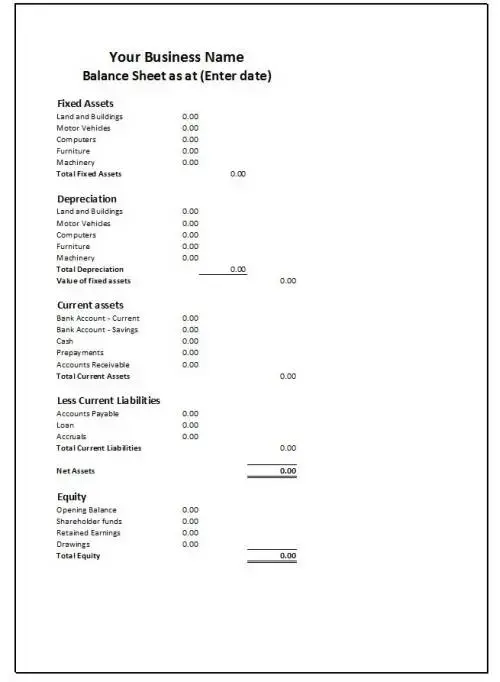
Below is a typical balance sheet example:
Financial Ratios and the Balance Sheet
The two most common balance sheet ratios are debt-to-equity (total liabilities ÷ total equity) and the current ratio (current assets ÷ current liabilities).
A balance sheet can be used to calculate several financial ratios, and calculating it is essential for two reasons.
The first reason is to see how well the client is performing by comparing it to previous years’ performance. The second reason is to compare your client’s performance with its competitors. That way, you will get an idea of how much profit your clients are making.
There are multiple financial ratios that can be calculated from the information on a balance sheet. But we will take a look at the two most common ones.
Debt to Equity Ratio
Under this ratio, the calculation is done by dividing the total liabilities by the total equity. This gives you a ratio showing how much your clients are financed by debt.
A higher debt-to-equity ratio means your clients relies more on debt to finance its operations. This could signify financial trouble if the debt is not being paid back.
Current Ratio
The current ratio is calculated by dividing the total current assets by the total current liabilities.
This shows how easily your clients can pay their short-term debts. A higher number means your clients are better positioned to do this.
What is a Balance Sheet Used for?
A balance sheet shows a business’s financial position to lenders, investors, shareholders and regulators.
The report gives a quick overview of your client’s business. It shows how much your client owns (assets) and owes (liabilities). This report can be used by your clients to gain bank loans and to maximise investment prospects by sharing it with investors, creditors, and shareholders.
Who Prepares the Balance Sheet?
A balance sheet is prepared by accountants in your practice or by the client. An accountant is recommended where it is filed with Companies House.
It can be prepared by accountants employed in your accounting practice or your clients themselves. If the balance sheets have to be submitted to Companies House, then it is recommended that an accountant prepares the balance sheet because they are well aware of the accounting principles.
Sometimes, accounting practices like yours may find themselves overloaded with work from multiple clients at the same time. This may hamper productivity and increase the chances of error. To avoid such a scenario, you can get it done by outsourcing to an accounting service provider such as Corient Business Solutions, which employs professional and experienced accountants.
Capacity is a real constraint at scale: the Department for Business and Trade counted 8,335 large businesses (250+ employees) among about 5.7 million UK private sector businesses at the start of 2025 (DBT, 2025). Corient, based in Coventry, supports UK accountancy firms with experienced accountants and AI tools, including Corby X for reconciliation. Our Director of Finance and Accounting, Shweta Kemnaik, has 8+ years serving UK-based CA firms. See also our year-end accounts, management accounts and audit support services.
Balance Sheet FAQs
What is the difference between a balance sheet and a profit and loss account?
A balance sheet is a snapshot of what a business owns, owes and has left for shareholders on one particular date. A profit and loss account covers a stretch of time, usually a year, and shows income and expenses. One tells you where the business stands; the other tells you how it performed. You need both to judge a client’s financial health.
What is the balance sheet formula?
The formula is Assets = Liabilities + Equity. Whatever a company owns has been paid for either with borrowed money (liabilities) or with shareholders’ money (equity). If the two sides don’t match, something is wrong in the ledger, usually a missing or wrongly posted journal. Fix it before anyone signs off the accounts.
How often should a balance sheet be prepared?
For Companies House and HMRC, a balance sheet is prepared once a year. Most large practices go further and produce one every month as part of the management accounts, because it shows up errors, missing accruals and cash pressure early instead of at year end. If lenders, investors or group reporting are involved, we’d say quarterly is the minimum.
Do small companies still have to file a balance sheet with Companies House?
Yes. Every UK limited company has to file a balance sheet with Companies House each year. For now, small companies and micro-entities can file abridged or filleted accounts, so no public profit and loss account. That changes on 1 April 2028, when the government has confirmed they’ll need to file a profit and loss account too, using commercial software.
Can an outsourcing provider prepare balance sheets for UK accountancy firms?
Yes. Corient prepares balance sheets for UK accountancy firms, working in your own accounting software, such as Xero. Experienced accountants do the preparation, with AI tools like Corby X (reconciliation) and Sherlock (error detection) helping with the checks. Everything is delivered to your review standards and agreed deadlines, so your team can get on with advising clients.
Conclusion
Balance sheets are of utmost importance because they show the financial position of a business. Hence, its preparation must be done with utmost care to maintain accuracy; after all, based on that, your clients will make decisions and investors will make their investment decisions.
If you find it difficult to prepare for complex client businesses or get overloaded with sheet work from multiple clients, then don’t stress because Corient is at your service. Our professional and experienced accountants will prepare error-free balance sheets on your behalf and within the deadline. For more information about our services, please visit our website and contact us via the contact form.
