

The next Making Tax Digital deadline is 7 November 2026, the second quarterly update for MTD for Income Tax, covering 6 July to 5 October 2026. Further deadlines fall on 7 February and 7 May 2027. MTD applies to sole traders and landlords with qualifying income above £50,000, falling to £30,000 in April 2027 and £20,000 in April 2028.
Are you managing the submissions of multiple clients’ VAT and Income Tax? Then, do remember some Making Tax Digital Deadlines: the quarterly updates due on 7 August, 7 November, 7 February and 7 May. MTD for Income Tax started on 6 April 2026, so the first update has already passed, and the next falls on 7 November 2026.
But remembering the dates is not a problem; the struggle is to manage it across multiple clients, systems, and workflows. We have seen one accounting practice handling MTD for VAT for multiple clients, but with the introduction of MTD for Income Tax, things started getting overwhelming.
The practice started facing:
- Delays in record submission by clients
- Pile up of quarterly deadlines
- Difficulty in manual tracking
- Constant firefighting
It’s not the lack of capability. There was a lack of structured systems to handle Making Tax Digital Deadlines at scale. Are you facing a similar issue? You are not alone. HMRC estimated 864,000 taxpayers in the first MTD for Income Tax cohort, yet an Azets Freedom of Information request, published on 10 July 2026, found only 282,637 had registered, leaving 67% unregistered. (Azets, 10 July 2026)
With all VAT-registered businesses now under MTD, millions more will soon fall under MTD for Income Tax.
The reality is that missing Making Tax Digital Deadlines will not be just a compliance issue, but an operational risk.
Key Takeaways
- The next quarterly deadline is 7 November 2026 (Q2). After that come 7 February 2027 (Q3) and 7 May 2027 (Q4).
- The income threshold starts at £50,000 from 6 April 2026. It drops to £30,000 in April 2027, then to £20,000 in April 2028, so more of your clients get pulled in each time.
- There’s some breathing room for now. Nobody gets penalty points for missed quarterly updates in 2026 to 2027. That changes in 2027 to 2028, and once a client reaches four points, a £200 penalty follows.
- Take-up is well behind where HMRC expected it. It estimated 864,000 taxpayers in the first group, but only 282,637 had registered by July 2026, based on an Azets FOI request from 10 July 2026.
- For practices, each in-scope client means four quarterly updates a year plus a Final Declaration. That adds up quickly across a client list, so it’s worth standardising your software, automating data capture and working out your capacity now, before the penalties begin.
What Is Making Tax Digital?
Making Tax Digital (MTD) is an HMRC programme that requires VAT-registered businesses, and now sole traders and landlords above an income threshold, to keep digital records, use MTD-compatible software and send tax information to HMRC digitally.
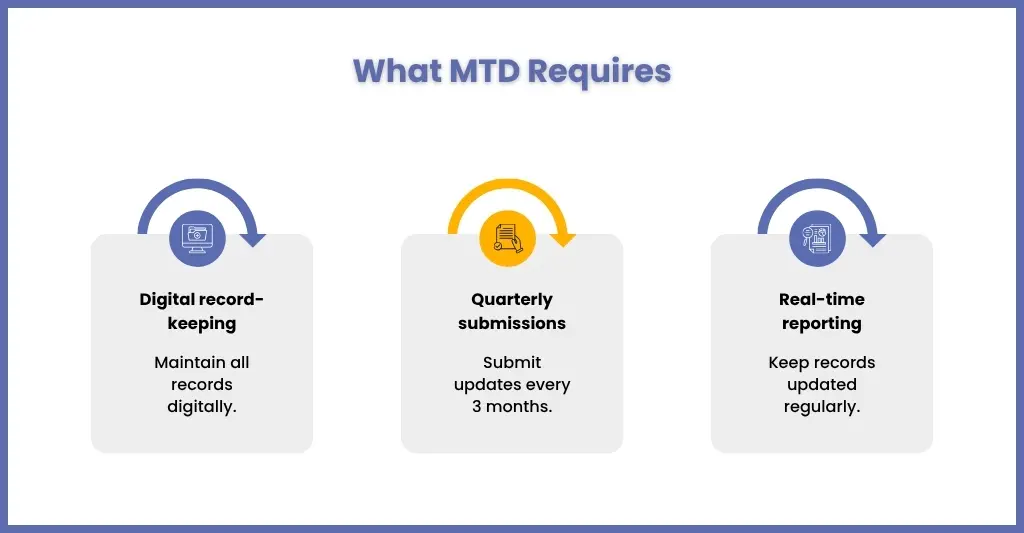
Making Tax Digital is an HMRC initiative to modernise/digitise the UK tax system. Under this initiative, your clients are required to maintain digital record-keeping and real-time submissions, thus eliminating manual tax reporting and replacing self-assessment as the annual tax return for taxpayers in scope.
Manual tax reporting means high chances of errors, and this is one of the reasons why MTD was introduced. With the introduction of MTD for income tax, say goodbye to once-a-year reporting. Under MTD for Income Tax, four quarterly updates and a Final Declaration replace the single annual return.
What Are the Making Tax Digital Deadlines From 2019 to 2028?
MTD for VAT began in April 2019 and covered all VAT-registered businesses from April 2022. MTD for Income Tax started on 6 April 2026 for qualifying income above £50,000, extends to £30,000 on 6 April 2027 and to £20,000 on 6 April 2028.
| Start date | Scheme | Who is affected | Income test | Est. taxpayers (HMRC) |
| April 2019 | MTD for VAT | VAT-registered businesses above the £85,000 threshold | Taxable turnover | n/a |
| April 2022 | MTD for VAT | All VAT-registered businesses | VAT registration | n/a |
| 6 April 2026 | MTD for Income Tax | Sole traders and landlords | Gross qualifying income above £50,000 in 2024 to 2025 | 864,000 |
| 6 April 2027 | MTD for Income Tax | Sole traders and landlords | Above £30,000 in 2025 to 2026 | 1,077,000 |
| 6 April 2028 | MTD for Income Tax | Sole traders and landlords | Above £20,000 in 2026 to 2027 | 975,000 |
Source: HMRC official statistics (13 August 2025), as reported by Ross Martin; eligibility rules on GOV.UK. The Spring Statement of 26 March 2025 brought the £20,000 phase forward to April 2028 (ACCA).
HMRC statistics also show that 75% of taxpayers above £50,000 were represented by an authorised agent, so most of this workload lands on practices rather than individuals. (HMRC, 13 August 2025, via Ross Martin)
HMRC has been gradually expanding MTD first on VAT, now on Income Tax, and no one can avoid it.
When Are the MTD Quarterly Update Deadlines?
Quarterly updates are due on 7 August, 7 November, 7 February and 7 May, about five weeks after each quarter ends. For 2026 to 2027, Q1 (7 August 2026) has passed, and Q2 is due on 7 November 2026.
Here’s the challenging part where many practice falter. Under MTD, instead of one annual return, you will need to submit quarterly updates on behalf of your clients.
| Quarter | Period covered | Deadline | Status at 15 Oct 2026 |
| Q1 | 6 April – 5 July 2026 | 7 August 2026 | Passed |
| Q2 | 6 July – 5 October 2026 | 7 November 2026 | Next deadline |
| Q3 | 6 October 2026 – 5 January 2027 | 7 February 2027 | Upcoming |
| Q4 | 6 January – 5 April 2027 | 7 May 2027 | Upcoming |
Handling these deadlines for a single client is easy, but handling them for multiple clients is difficult because data must be updated continuously, and there is no room for last-minute work. As a simple illustration, a practice with 150 in-scope clients must manage 600 quarterly updates a year (150 × 4), before any Final Declarations. That’s why many practices are moving from hiring an accountant to partnering with professional accounting outsourcing service providers such as Corient’s Making Tax Digital service to handle the quarterly workload efficiently.
When Do You Need to Register for Making Tax Digital?
There is no separate registration date. Each client must be signed up and using MTD-compatible software before their first quarterly update: before 7 August 2026 for the April 2026 cohort and before 7 August 2027 for the April 2027 cohort. HMRC has also announced it will start enrolling taxpayers it believes were in scope from September 2026 (UK Tax Calculators, 17 August 2026).
Important considerations:
- You must use MTD-compatible software
- Existing tax records must be up to date
- HMRC registration can take a few days to process
Common mistake: Some accounting practices wait until the last minute, leading to setup issues and missed deadlines. The Azets FOI response shows how common this is: only 282,637 of an estimated 864,000 taxpayers had registered by July 2026 (Azets, 10 July 2026).
To avoid this: Start onboarding your clients months before April 2027 for the next cohort (income above £30,000).
What Are the Penalties for Missing Making Tax Digital Deadlines?
From the 2027 to 2028 tax year, a missed quarterly update or tax return deadline earns one penalty point, and four points trigger a £200 penalty. HMRC issues no penalty points for missed quarterly updates in 2026 to 2027, but late payment penalties still apply.
Like VAT, there are penalties for late submission and payments under MTD for Income Tax. The rules below are taken from HMRC’s guidance, last updated 30 March 2026 (GOV.UK).
What Are the Late Submission Penalties?
The new late submission penalties will be based on points. For each quarterly update (for tax years after 2026 to 2027) or tax return deadline missed, your client gets one penalty point. Only one point is issued per deadline, even with several businesses.
| Tax year | Missed quarterly update | Missed tax return deadline |
| 2026 to 2027 | No penalty points | 1 penalty point |
| 2027 to 2028 onwards | 1 penalty point | 1 penalty point |
The penalty point threshold is 4 points. If it’s crossed, then your client will have to pay a:
- £200 penalty
- £200 penalty each time you miss another submission deadline
Points are removed automatically 24 months after the missed deadline while a client is below the threshold. Once 4 points are reached, a client needs 12 months of on-time submissions to clear them.
What Are the Late Payment Penalties?
Late payment penalties apply to balancing payments and amounts due after an amendment or assessment, not to payments on account. The new late payment penalties are more proportionate to how long it takes for your client to pay what they owe.
Late payment penalties apply to payments not paid in full by the relevant due date. This includes:
- A balancing payment for an outstanding amount on your tax bill
- Amounts due following an amendment or assessment on your tax return
In the first year, your clients will have 30 days from the payment due date to either:
- Make full payment
- Contact HMRC to set up a payment plan
After 30 days, the penalties will be applied. After your first year, this reduces to 15 days. Late payment interest is charged separately from day one.
The following table shows how late payment penalties will apply, depending on the tax year the payment is for.
| Penalties for 2026 to 2027 tax year | Penalties for 2027 to 2028 tax year | |
| Payment up to 15 days late | No penalty | No penalty |
| Payment 16 to 30 days late | 3% of the tax owed at day 15, or no penalty if it’s your first year | 4% of the tax owed at day 15, or no penalty if it’s your first year |
| Payment 31 days or more late | 3% of the tax owed at day 15, and 3% of the tax owed at day 30 Plus, an annual rate of 10% per year on the outstanding amount, charged daily from day 31 until the tax is paid, or for up to 2 years | 4% of the tax owed at day 15, and 3% of the tax owed at day 30 Plus, an annual rate of 10% per year on the outstanding amount, charged daily from day 31 until the tax is paid, or for up to 2 years |
How Do MTD Deadlines Affect Sole Traders and Landlords?
Both groups must keep digital records and send four quarterly updates a year. The difference is workload: sole traders need income tracking, landlords need regular expense tracking, and clients with both income sources are tested on combined gross income.
| Taxpayer | Digital records | Quarterly updates | Practice workload |
| Sole traders | Business income and expenses held digitally | Four a year | Income tracking and record chasing |
| Landlords | Property income and expenses reported digitally | Four a year | Regular expense tracking |
| Both | Combined gross income tested against the threshold | Four a year | Mixed workflows per client |
The new penalty regime does not apply to returns for partnerships, trusts, estates or non-resident companies, which stay under existing Self Assessment penalties (GOV.UK). This means you will need to work with different workflows and support levels. Such complexity is the reason why many firms partner with outsourcing providers like Corient to handle diverse client needs efficiently, including personal tax outsourcing for Self Assessment and MTD filings.
How Can Large Practices Prepare for MTD Deadlines?
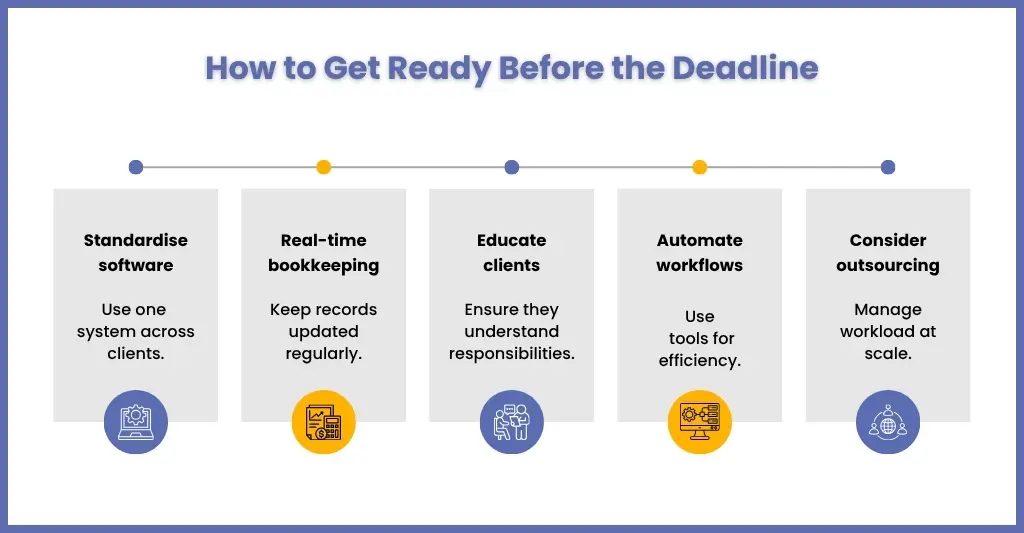
Large practices prepare by standardising one MTD-compatible software stack, moving clients to real-time bookkeeping, automating data capture and building a central deadline tracker. These steps cut quarterly rework and make the 7 November 2026 deadline repeatable at scale.
Just like to get ready for MTD for VAT you had to follow steps to setup, keeping your clients prepared for MTD deadlines will require more than just MTD-compliant software.
Step 1: Standardise Your Software
There are multiple MTD-compliant VAT software solutions available in the market, such as Xero, Sage, and QuickBooks, to name a few, which are now MTD for Income Tax compliant. Choose the one that perfectly fits your practice and works across your clients.
Step 2: Move to Real-Time Bookkeeping
Inform your clients that keeping their records updated on a regular basis is no longer an option; it’s the norm. Our bookkeeping outsourcing teams keep client ledgers current so quarterly updates are a review task, not a rebuild.
Step 3: Educate Clients
Help them understand the:
- Deadlines
- Their responsibilities
- Submission processes
Step 4: Automate Workflows
Save time by automating recurring processes using tools like Dext, Hubdoc, etc., for:
- Data capture
- Reconciliation
- Reporting
Corient’s AI Crew supports this: Billy handles invoice processing, Corby X handles reconciliation, and Galaxy manages tasks across a client portfolio.
Step 5: Consider Outsourcing
Handling multiple clients manually is not sustainable at scale. Partnering with an accounting outsourcing provider gives you trained capacity for peak quarters without permanent hires.
About Corient: Corient Business Solutions is a Coventry-based outsourcing partner for UK accountancy firms, combining people and AI across bookkeeping, VAT, personal tax and MTD support. This guide is written by Shweta Kemnaik, Corient’s Director of Finance and Accounting, who has 8+ years’ experience supporting UK CA firms. Learn more about Corient.
Frequently Asked Questions
What is the deadline for registering for Making Tax Digital?
There is no separate registration deadline, but clients must be signed up before their first quarterly update. For taxpayers mandated from April 2026, that meant before 7 August 2026. For the April 2027 cohort, onboard before April 2027, because HMRC has announced it will sign up taxpayers it believes should already be in scope.
What happens if I miss a Making Tax Digital quarterly deadline?
For the 2026 to 2027 tax year, HMRC does not issue penalty points for a missed quarterly update, but every update must still be sent before the tax return is submitted. From the 2027 to 2028 tax year, each missed quarterly update earns one penalty point, and reaching four points triggers a £200 penalty.
Are there penalties for missing MTD deadlines?
The penalty point threshold is 4 points. If it’s crossed, then your client will have to pay a:
a. £200 penalty
b. £200 penalty each time you miss another submission deadline
What are the MTD rules for April 2026?
From 6 April 2026, sole traders and landlords whose combined gross income from self-employment and property exceeded £50,000 in the 2024 to 2025 tax year must keep digital records, use MTD-compatible software, send quarterly updates and submit a Final Declaration. The threshold falls to £30,000 in April 2027 and £20,000 in April 2028.
Will MTD replace self-assessment?
MTD for Income Tax replaces the annual Self Assessment tax return with four quarterly updates and a Final Declaration for taxpayers in scope. Self Assessment itself does not disappear overnight: taxpayers below the thresholds continue to file a standard return until their phase begins, so practices will run both processes side by side until April 2028.
Conclusion
Confirm every in-scope client is registered, check quarterly data is up to date, and plan capacity for 7 November 2026, 7 February 2027 and 7 May 2027. Then start onboarding the April 2027 cohort.
Making Tax Digital Deadlines for VAT and Income Tax are reshaping how accounting practices operate in the UK. These deadlines are not just a compliance update; it’s a fundamental shift in how tax reporting works.
Practices that prepare early, adopt the right systems, and streamline workflows will thrive. With Corientbs, accounting practices can:
- Manage bookkeeping in real time
- Handle quarterly submissions efficiently
- Reduce workload pressure
- Scale without hiring
Are you finding it difficult to handle multiple MTD deadlines for your clients? It’s time to work smarter, not harder, by filling out our contact form or exploring our tax outsourcing support and turning MTD from a challenge into an opportunity.
