
Outsourced payroll services mean handing payroll over to an external provider who runs it for you — working out pay, submitting RTI filings to HMRC, and managing pension auto-enrolment along the way. AI now takes care of the repetitive groundwork: pulling data, keeping up with compliance changes, and flagging anything that looks off. For UK accounting practices, it’s a way to add payroll capacity without having to hire.
What was once a futuristic tool has now become an integral part of every accounting practice in the UK. We are talking about AI and its impact on accounting services, including outsourced payroll services. However, AI is continuously evolving at a rapid pace, which raises one question: What is the future of outsourced payroll services in the UK? AI is already transforming outsourced payroll in the UK by automating tasks, reducing errors, improving compliance, and delivering faster, cost-effective payroll processing.
This guide covers what outsourced payroll services are, how AI is changing them, why UK accounting firms use them, what they cost, the 2026/27 rates and deadlines that apply, the risks worth taking seriously, and how to choose a provider. Each section answers its own question, so you can jump straight to the part you need.
What are outsourced payroll services?
Outsourced payroll services are arrangements where an external provider takes over the operational running of payroll for a business or for an accountancy practice’s clients. The provider does the processing; the client retains approval, sign-off and the client relationship.
A full outsourced payroll service typically covers:
- Gross-to-net calculation, including tax, National Insurance, student loans and attachment of earnings orders
- Full Payment Submission (FPS) and Employer Payment Summary (EPS) filings to HMRC under Real Time Information
- Pensions auto-enrolment assessment, contribution calculation and file submission to the pension provider
- Statutory payments — SSP, SMP, SPP, SAP, ShPP and neonatal care pay
- Payslip production and distribution, plus P60s, P45s and P11Ds
- Year-end processing and reconciliation
One definition worth being precise about, because it is the source of most confusion: an FPS is the submission that tells HMRC what each employee was paid and what was deducted, and it must reach HMRC on or before the date the employee is paid. An EPS is the separate submission used to report recoverable statutory payments or a period of no payments, and it is due by the 19th of the following tax month.
How is AI changing outsourced payroll services?
AI is changing outsourced payroll in five specific places: data entry, compliance updating, employee query handling, fraud detection, and the advisory work providers can offer once routine processing is automated. It is not changing the gross-to-net calculation itself, which payroll software has handled reliably for years.
Payroll itself is a highly complex and time-consuming task that requires good technical and legal knowledge to maintain full compliance, but that’s not enough. Research by PayFit found that 37% of UK employers describe manual payroll tasks as stressful for them and their teams. The scale of the response is now measurable: the SD Worx Research Institute, surveying 5,625 employers across 16 European countries in February 2025, found that 42% of UK employers already use AI-powered agents or chatbots in payroll — roughly 12 points ahead of the European average. Investment in generative AI rose from 14% in 2024 to 22% in 2025.
We have reached a point where AI is materially affecting payroll outsourcing, and to stay relevant, providers are changing how they work. Here is where the change is actually happening:
| Payroll task | What AI does | What still needs a person |
| Data entry | Extracts hours, starters and leavers from timesheets and forms | Resolving conflicts between source systems |
| Compliance updates | Applies new rates and thresholds automatically at tax year end | Interpreting how a change affects a specific client |
| Employee queries | Answers routine payslip and deduction questions 24/7 via chatbot | Anything involving a complaint, an error or a sensitive case |
| Fraud detection | Flags duplicate bank details, ghost employees, unusual pay spikes | Investigating and deciding what the anomaly means |
| Reporting | Generates variance reports and cost forecasts | Explaining the numbers to a client and recommending action |
Automated Data Entry and Processing
AI-powered tools have enabled automation of the data entry process, reducing the requirement for manual input, thus reducing human errors. These AI tools can simultaneously extract information from multiple sources, such as timesheets, employee records, and tax forms, speeding up the payroll processing cycle. Through AI, payroll outsourcing service providers have prevented payroll discrepancies, enhanced forecasting, and improved budget planning.
Automation of Compliance
UK tax laws and payroll regulations change frequently, and payroll outsourcing services find it difficult to stay updated. But that’s the past. AI tools have conquered this problem by automatically updating payroll calculations as per the latest legal requirements, resulting in lower risks of non-compliance and fines. This also means fewer reworks and a less stressful environment.
Getting Employee Queries Resolved Through Chatbots
AI-powered chatbots reshape the employee experience by answering payroll queries 24/7, issuing payslips, or helping employees understand payroll deductions. This reduces the burden on HR and payroll teams while improving responsiveness.
Your clients’ employees can now expect their payroll queries to be attended to 24/7 through AI-powered chatbots. These chatbots have helped payroll outsourcing service providers disseminate payroll information and reply to queries without any human intervention.
Fraud Detection and Security
AI algorithms will detect irregularities and discrepancies in payroll data, helping to identify potential instances of fraud or data breaches. This will strengthen data security and safeguard sensitive employee information.
Strategic Role of Payroll Partners
Payroll is time-consuming and gets overwhelming when its volume increases, thus leaving less time for payroll service providers to make strategic decisions for accounting firms. With AI comes automation, which will take care of routine payroll work, thus giving providers the time to evolve into strategic advisors. By becoming a strategic advisor, a payroll outsourcing service provider will be offering value-added services such as insights on complicated payroll data, which aid in making informed decisions.
Why Accounting Firms are Choosing Payroll Outsource Solutions
Accounting firms outsource payroll for six reasons: it recovers time, it transfers the compliance burden, it improves accuracy, it scales without hiring, it costs less than an in-house payroll hire, and it gives access to software the firm could not justify buying alone.
It’s a fact that the accounting environment in the UK is becoming quite complex and fast-paced. Your clients will be demanding quality work in less time, which you will be under pressure to meet. The only way to reduce pressure is by outsourcing some of your recurring accounting tasks, like payroll, which was traditionally done in-house. It is a route chosen by countless accounting firms, so let’s understand why.
Saves Valuable Time
Payroll work is highly repetitive, time-consuming, and deadline-driven, and during peak times like paydays, it has the potential to overwhelm the most experienced teams. By outsourcing it, you are freeing up your teams to concentrate on high-value services that will impress your clients, such as advisory, tax planning, and client relationship management.
Compliance is Getting Complex
From RTI submissions to pensions auto-enrolment and ever-changing HMRC rules, handling compliance has become a full-time job. When you outsource payroll, you are getting access to teams that have knowledge about the latest laws, payroll deadlines, and formats, thus reducing the risk of non-compliance for you and your clients.
No Compromise on Accuracy
None of your clients will tolerate errors in their payroll that will reduce their respect among their employees and destroy the trust between client, employee, and accounting firm. To avoid such a situation, practices have started using outsourced payroll services, which have robust systems and checks, often backed by ISO certifications, to ensure precision in every run.
For instance, there is a case study where a professional service provider resolved incorrect payroll deduction allocations and ensured accurate salary payments and HMRC compliance. Such professionalism and use of tech restored employee trust and prevented future payroll issues
It’s Scalable and Flexible
No matter if you are handling the payroll of a client with 5000 employees, an outsourced payroll service provider can scale up with ease. Even onboarding new clients on an immediate basis will not be a problem.
Cost-Efficient Without Compromising Quality
One of the biggest plus points of outsourcing is the payroll outsourcing cost when compared with hiring, training, and retaining payroll staff in-house. By partnering with the right outsourcing partner, you will get access to payroll services offered by experienced talent backed by the latest tech, thus not sacrificing quality.
Access to Better Tech Without the Investment
Professional payroll outsourcing service providers proactively provide and train their accounting staff on the best payroll software. These top payroll software offer real-time data, employee portals, and AI-driven insights. Such technology requires huge investments, which an accounting firm cannot afford independently.
How much do outsourced payroll services cost in the UK?
UK outsourced payroll is normally priced per payslip per pay run, often with a small monthly scheme fee on top. The main cost drivers are pay frequency, employee count, the volume of monthly variations, pension scheme complexity, and whether year-end forms are included in the quoted rate.
| Cost driver | Effect on price | Why |
| Pay frequency | Weekly costs more per employee than monthly | 52 runs a year instead of 12 |
| Employee count | Unit price falls as volume rises | Fixed scheme setup cost spreads further |
| Variable pay | Increases price | Overtime, commission and timesheets need handling each run |
| Pension complexity | Increases price | Multiple schemes or salary sacrifice add processing steps |
| Year-end forms | May be included or charged separately | P60s, P11Ds and the final FPS — always check which |
| Payslip delivery | Portal usually cheaper than print and post | Physical distribution carries a per-item cost |
When comparing quotes, always compare on a full-year basis including year-end, and ask what happens when a client’s headcount changes mid-year. A low per-payslip rate with year-end charged separately can work out more expensive than an all-inclusive quote.
For worked examples and current ranges, see our full guide on how much it costs to outsource payroll in the UK and our published payroll pricing.
Challenges and Considerations in AI-Driven Payroll Outsourcing
AI is changing how accounting in the UK is done, and payroll is the first to feel its impact. With the rise of AI-driven payroll outsourcing, accounting practices are discovering new ways to streamline operations, improve accuracy, and reduce manual workload. However, with innovation comes complexity.
We have recently noticed challenges faced by accounting practices while outsourcing their payroll to an AI-driven service provider. Let’s explore these issues that UK accounting practices should address before outsourcing payroll to AI-driven providers.
Data Security and Privacy Risks
Payroll involves dealing with highly sensitive employee data, such as employee names, salaries, bank accounts, national insurance numbers, tax codes, and pension contributions. Outsourcing payroll already exposes your client’s employee details (with permission) to a service provider, but now, with AI in the mix, the exposure points have increased.
To minimise this challenge, you will have to consider the following:
- GDPR Compliance: Ensure your outsourcing partner fully complies with the latest UK data protection laws.
- Data Encryption and Access Control: Check or select a service provider that offers strong cybersecurity protocols to negate the risk of data breaches.
Integration and Compatibility Issues
AI solutions cannot work in isolation; they require integration with your existing systems. You are already using cloud-based platforms like Xero, QuickBooks, Sage, or BrightPay to perform accounting functions, and poor integration will lead to data loss, duplication, or system breakdowns.
To overcome integration and compatibility issues with the payroll service provider, you must consider the following:
- AI Integration Capabilities: Check whether the AI system used by a service provider is compatible with your current accounting and payroll software.
- Scalability: Is the AI-driven payroll system used by your service provider capable of handling high volumes of data and clients from sole traders to multi-site companies?
- Error Handling: Is there a clear process for managing exceptions and discrepancies?
Successful payroll service providers use AI to augment, not replace, their human expertise, especially when dealing with complex payroll scenarios.
Human vs. Machine Decision-Making
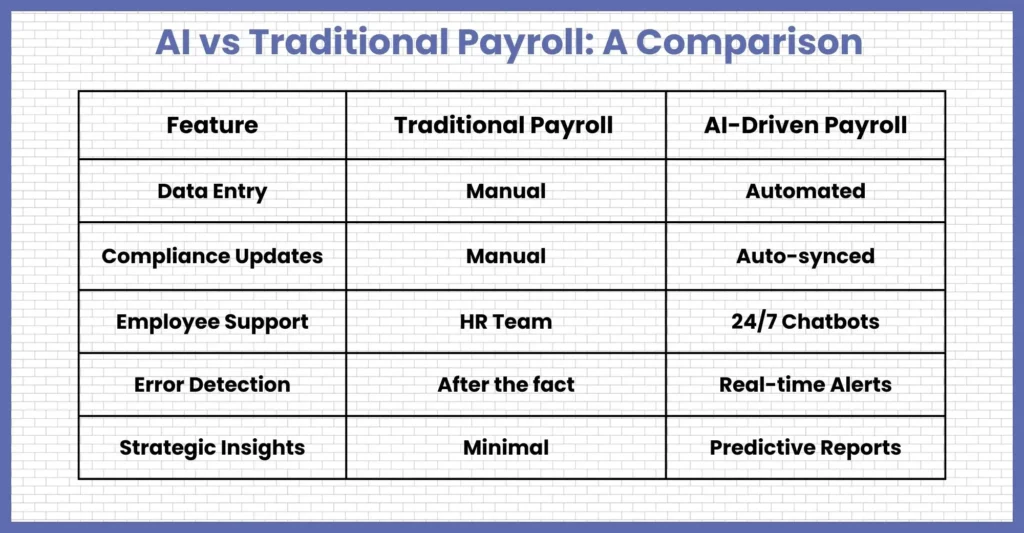
Yes, AI can automate most payroll tasks, such as salary calculations, tax deductions, and reporting. However, payroll is not rigid; certain aspects, such as one-off bonuses, maternity pay, or part-year calculations, require human judgment.
To overcome this predicament, you will have to consider the following things:
- Oversight Mechanisms: Check whether your payroll outsourcing team has qualified payroll accounting experts who regularly review AI-generated payroll outputs.
- Exceptional Cases: Does your payroll outsourcing service provider have an AI system in place that will detect unusual payroll activity and route it for manual review
- Client Communication: If a payroll issue arises, who will communicate— an AI bot or a trained payroll expert?
Training and Team Readiness
Adopting AI into your processes is not just incorporating a system; it’s a change in mindset. Your in-house team must have the trust and training to interpret and use AI-driven outputs.
So, what needs to be considered:
- Staff Training: Training of your staff in understanding and operating the AI interface provided by your outsourced payroll service provider. Your payroll outsourcing partner will provide some training to your staff.
- Client Education: Before outsourcing payroll to a service provider, you will have to inform and explain to your clients how their payroll will be handled and the benefits of an AI-driven payroll process for them.
Without proper onboarding and education, AI tools can lead to confusion, mistrust, or underutilisation, undermining the efficiency they promise.
What is the future of outsourced payroll services in the UK?
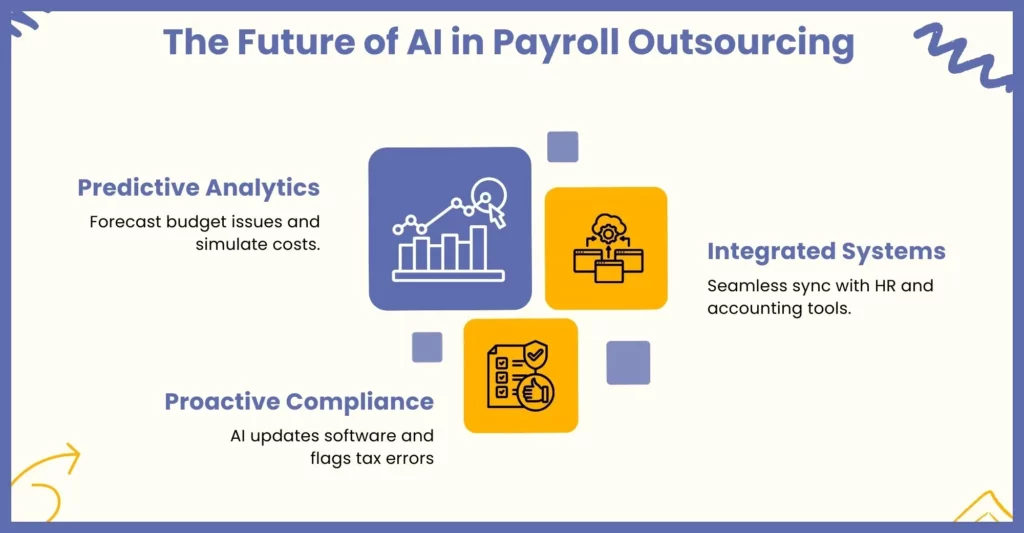
Three shifts are shaping the next few years: payroll moving from reactive processing to predictive analytics, deeper integration between payroll, HR and accounting systems, and AI taking on more of the compliance monitoring burden as legislation continues to change.
The UK payroll landscape is changing rapidly, and accounting practices are under tremendous pressure to evolve from being just a number crunching firm. Your clients will demand faster, smarter, and more integrated payroll solutions. All this means that the future is bright for outsourced payroll services providers in the UK, especially those ready to embrace artificial intelligence.
Let’s explore some transformative shifts shaping the future of outsourced payroll in the UK:
Predictive Analytics and Proactive Payroll Management
There were days when payroll meant processing payslips on time and maintaining compliance. However, now your clients demand proactive services and predictive analytics, which are provided efficiently through outsourced payroll services offered by payroll providers. Predictive analytics use historical data to forecast potential issues, such as budget overruns, tax liabilities, or employee views.
By integrating predictive analytics:
- Payroll providers can alert your clients about cost spikes before they occur.
- You can simulate payroll costs by suggesting different hiring or policy scenarios for your clients.
- With payroll outsourcing’s help, you can offer advisory-led payroll, thus increasing your client’s value and revenue.
In essence, payroll outsourcing is transitioning from a reactive function to a strategic forecasting tool, and your clients expect nothing less. The employer NIC changes of April 2025 made this concrete: at 15% above a £5,000 threshold, the cost of every hire changed materially, and clients wanted modelling, not just payslips.
Integration with HR and Financial Systems
In today’s fast-paced climate, your clients will demand that your payroll work seamlessly with HR platforms, time tracking tools, and accounting software. Achieving such integration will be tough for your practice singlehandedly, but with the help of payroll outsourcing services, it is possible.
Only those payroll service providers that offer seamless integration will survive. By integrating payroll with:
- HR software (e.g., for tracking leaves, benefits, and onboarding)
- Accounting platforms (like Xero, QuickBooks, or Sage)
- Time-tracking and expense systems
You can reduce manual inputs, eliminate duplicate data entries, and offer real-time reporting. Such deep integration enables faster reconciliations, more accurate tax filings, and stronger client retention through smoother operations.
AI & Compliance with Evolving Payroll Legislation
UK payroll legislation is constantly changing, including national insurance thresholds, sick pay, auto-enrolment updates, and the list goes on. Handling so many changes can also be overwhelming for an experienced outsourced payroll services provider without the assistance of AI tools.
Artificial Intelligence is set to play a vital role in staying compliant by:
- Automatically updating software with legislative changes
- Flagging anomalies in payslip calculations or tax deductions
- Generating alerts when deadlines or documentation are missed
More importantly, AI can learn from past errors. For accounting practices, this means fewer penalties, faster audits, and better compliance assurance for clients without the need for constant manual monitoring.
Frequently Asked Questions (FAQ)
How does AI improve payroll outsource efficiency?
AI reduces manual effort in three places: extracting data from timesheets and starter forms, applying legislative rate changes automatically, and flagging anomalies such as a salary that jumped 300% since last month. It does not replace the gross-to-net calculation, which payroll software already handles. The gain is in preparation and checking.
Is AI adoption common in payroll outsourcing services in the UK?
That’s right. Payroll outsourcing services have widely adopted AI for predictive analysis, automated payroll processing (including data entry), and fraud prevention. Using AI, payroll service providers have eliminated repetitive tasks and improved efficiency.
Will AI replace payroll professionals?
No. AI automates repetitive tasks but cannot exercise judgement on maternity pay calculations, part-year leavers, salary sacrifice interactions, or a director’s NIC position. It also cannot take legal responsibility for a filing. CIPP research reports that 34% of payroll workers worry about AI’s impact, but the shift so far has been toward advisory work rather than job losses.
What is the impact of AI on employees?
AI helps automate repetitive and routine tasks, which is beneficial for employees as it frees them up to focus on more complex and creative work. However, it can also create concerns about job displacement and changes in the demand for certain types of jobs.
How much do outsourced payroll services cost in the UK?
UK outsourced payroll is usually priced per payslip per pay run, often with a small monthly scheme fee on top. Cost drivers include pay frequency, number of employees, volume of monthly variations, pension scheme complexity and whether year-end forms are included. Weekly payrolls cost more per employee than monthly ones because there are 52 runs rather than 12.
Conclusion
Payroll outsourcing services have become a strong pillar on which many accounting practices have started to rely and provide value-added services. With AI in the mix, outsourced payroll services are becoming more efficient and quicker. In this blog, we have made an effort to describe how AI is making payroll outsourcing services even better and the challenges associated with it. Through this blog, you can select a future-ready payroll outsourcing partner.
Speaking about future readiness, many payroll outsourcing service providers are focusing on incorporating AI in their process, but Corient is one step ahead. Established in 2011, Corient is a tech-savvy accounting outsourcing service provider that has always preferred to use the latest tools, including AI, to increase the efficiency of its accounting services, including payroll. For more information or to post your queries, do it on our website contact form, and our executive will connect with you shortly.
We are looking forward to a long-term and fruitful association.