
Accounting services cover bookkeeping, payroll, VAT, management accounts, year-end accounts and tax compliance. UK practices improve them by defining a clear scope of work, customising SLAs, holding monthly governance meetings, using ISO 27001-certified partners, adopting MTD-compatible software and AI tools, and outsourcing routine compliance to release capacity for advisory work.
Outsourcing has been a game-changer for accountants and firms based in the UK. It has brought transformational changes in the way accounting firms conduct their operations. Multiple accounting firms have adopted outsourcing completely, which has increased their efficiency, brought down their operating costs, and scaled up their operations. However, it has been noted that a few accounting firms are unable to get the most out of outsourcing due to multiple factors.
In this blog, we will present some of the best ways to ensure that your outsourcing journey is an extraordinary success, especially for accountants in the UK. But before that, let’s first understand why quality accounting services matter.
Key Takeaways
- Accounting services span bookkeeping, payroll, VAT, management accounts, year-end accounts, personal and corporation tax.
- 73% of UK accounting firms are turning away work for lack of staff (Advancetrack, 2026 Accounting Talent Index, May 2026) — capacity, not demand, is the constraint.
- MTD for Income Tax has been live since 6 April 2026 for qualifying income above £50,000, moving affected clients from one annual return to four quarterly updates plus a final declaration.
- The threshold drops to £30,000 in April 2027 and £20,000 in April 2028 — submission volume keeps rising.
- Outsourcing transfers work to a third-party provider; offshoring means running your own team abroad. Pick on control versus flexibility.
What are accounting services?
Accounting services are the professional functions a practice performs to keep a client financially compliant and informed. In the UK these typically include bookkeeping, bank reconciliation, VAT returns, payroll processing, management accounts, year-end statutory accounts, corporation tax and personal tax returns, and company secretarial filings.
They divide into two groups. Compliance services are mandatory and deadline-driven — VAT, payroll, statutory accounts, tax returns. Advisory services are discretionary and margin-rich — forecasting, budgeting, benchmarking and strategic planning. Most practices want to shift the mix toward advisory, and capacity is what stops them.
Corient delivers the full compliance stack through its accounting outsourcing services, so practice partners can move their own senior time up the value chain.
Why Quality Accounting Services Matter for Your Client’s Business Success?

Quality accounting services matter because they determine whether a client stays compliant, understands their numbers in time to act on them, and trusts the practice enough to buy advisory work. Poor-quality accounting produces late filings, penalties and decisions made on stale data. High-quality accounting produces clean records, accurate reporting and clients who stay.
In today’s fast-paced financial landscape, accounting practices must stay ahead by offering top-tier services that ensure accuracy, compliance, and strategic financial insights. Quality accounting services are not just about crunching numbers—they will drive business success for your clients. In 2026, the stakes are higher than ever, with the Bank of England reporting 75% of UK financial services firms now use AI, raising client expectations for speed and accuracy.
The pressure is now structural rather than seasonal. Advancetrack’s 2026 Accounting Talent Index (published May 2026, 500 respondents) found that 73% of firms are turning away potential clients because they do not have the staff to do the work, and the same proportion describe the impact of the talent shortage as “severe”. Client expectations for speed have not moved to match.
Here’s why they matter:
Ensuring Compliance and Reducing Risks
Regulatory requirements in the UK, such as HMRC tax laws and financial reporting standards, are constantly evolving. By offering high-quality accounting services, you will help clients stay compliant, avoid penalties, and minimise financial risks. That burden stepped up on 6 April 2026, when Making Tax Digital for Income Tax became mandatory for sole traders and landlords with qualifying income above £50,000 — and it grows again in April 2027 when the threshold falls to £30,000.
Enhancing Financial Accuracy
Accounting errors can lead to misreporting, tax issues, and poor financial decisions. Your reliable accounting services will ensure meticulous record-keeping, proper reconciliations, and precise financial statements.
Boosting Efficiency and Productivity
When your team of experienced accountants takes care of your client’s account, you allow them to focus on their core operations. Automation, cloud-based software, and experts can further streamline processes, thus reducing workload and saving time.
Supporting Strategic Decision-Making
Quality accounting services provide detailed financial analysis, cash flow forecasting, and budget planning, thus helping your clients make data-driven decisions for growth.
Improving Cash Flow and Profitability
Managing cash flow effectively is crucial for a business’s success. Professional accountants will monitor cash inflows and outflows, ensuring clients have enough liquidity to expand smoothly.
Enhancing Client Trust and Business Reputation
A well-managed financial system will positively affect your client’s business, instilling confidence in stakeholders, investors, and clients. It will also strengthen your accounting practice’s credibility in the marketplace.
Facilitating Business Growth and Scalability
As businesses grow, their financial needs become more complex. Your expert accountants can support expansion by providing scalable solutions, tax-saving strategies, and financial structuring.
Achieving such high quality in-house requires considerable investment and time, both of which are in short supply. The UK market is not short of demand — Department for Business and Trade figures (published 2 October 2025) put the private sector business population at 5.7 million at the start of 2025, up 3.5% on the year. Demand is rising while capacity is not, which is precisely why outsourcing has moved from attractive to essential.
What are the best practices to improve your accounting services?
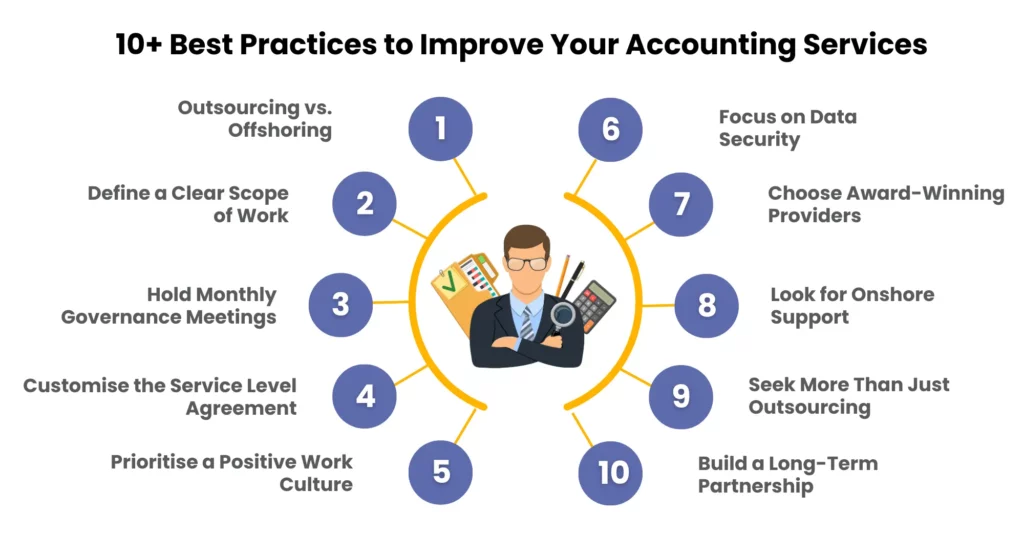
The practices that make the biggest difference are: choose deliberately between outsourcing and offshoring, define a written scope of work, customise the SLA, hold monthly governance meetings, insist on ISO 27001 and UK GDPR compliance, use modern workflow tools instead of Excel, build a quarterly MTD submission process, and commit to a long-term partnership rather than a series of transactions. Each is covered below.
1. Outsourcing vs. Offshoring
Outsourcing means transferring accounting work to a third-party provider who employs and manages the team. Offshoring means setting up your own team in another country. Outsourcing buys flexibility; offshoring buys control.
Decide whether you want to outsource or offshoring accounting based on your accounting requirements. Under outsourcing, you are required to transfer the accounting responsibility to a third-party accounting outsourcing service provider. On the other hand, offshoring involves setting up your team in another country to handle the work.
Both have strengths. For instance, outsourcing gives you access to valuable expertise. On the other hand, offshoring gives you control over the process. In our opinion, both approaches are right for long-term success, so choose which suits you better.
| Factor | Outsourcing | Offshoring |
| Definition | Work transferred to a third-party provider who employs and manages the team | Your own team, set up and staffed in another country |
| Control | Provider-managed; you set SLAs and review output | Direct — you set workflows, tools and priorities |
| Time to start | Weeks | Months |
| Cost model | Per job, per hour or per dedicated FTE | Fixed salary plus infrastructure and management overhead |
| Scalability | High — flex up for January and quarterly MTD peaks | Moderate — tied to headcount you have hired |
| Best for | Practices needing flexible capacity for compliance peaks | Practices with steady year-round volume wanting a branded team |
2. Define a Clear Scope of Work
Before you step into the world of accounting outsourcing services, both you and the service provider must be aware of what is expected of you. This includes tasks, deadlines, responsibilities, and communication processes.
A clear understanding of what is required will reduce the scope for misunderstandings. Both sides will be well aware of the expectations and how performance will be measured.
3. Understand Cultural and People Management Differences
When you choose to outsource, there is a higher possibility that your outsourcing partner will operate from a different country. The unique culture and work ethic of that country may not sync with that of the UK, creating its own set of problems. For a successful partnership, it is important to understand those differences.
While researching a country where the outsourcing partner is based, learn about that country’s work ethics and culture. With this understanding, you will be able to understand their sensitives and forge stronger relationships. It also helps prevent unnecessary cultural misunderstandings, thus helping you focus on customer satisfaction and service development.
4. Hold Monthly Governance Meetings
Regular governance meetings are important for tracking the performance of your outsourcing partner. These meetings will help you monitor the outsourced activities, address challenges, and keep everyone aligned with your goals. The monthly governance meetings will cover KPIs, performance, and any potential issues. Such meetings continuously provide vital feedback to improve performance.
5. Customise the Service Level Agreement (SLA)
A service level agreement (SLA) is a written contract setting out turnaround times, accuracy standards, escalation routes and review responsibilities. Every accounting firm is unique; your service level agreement must reflect that. A customised SLA will inform your outsourcing partner of specific requirements and performance expectations. Once the SLA is decided between you and the outsourcing partner, your partner will get clarity on deliverables, improving accountability. There will be fewer disputes and misunderstandings once there is clarity on what is expected from both sides.
6. Use Modern Workflow Tools Instead of Excel
While Excel is well-known and used widely, new and improved workflow tools offer better solutions for managing tasks and collaboration. Tools like project management software are widely used for real-time tracking and efficiency.
Using a modern workflow tool such as project management software, you can track in real-time, increase productivity, reduce errors, and provide better reporting for informed decision-making.
7. Prioritise a Positive Work Culture
A motivated workforce will put extra effort into their tasks and strive to deliver better results. One way to motivate your workforce is by partnering with outsourcing firms to reduce their work pressure. You can transfer recurring and time-consuming work to an outsourcing firm and create an ideal work environment that will also positively impact your client’s employee health.
Creating a positive work environment automatically boosts your employee’s morale and increases your retention rate. Thanks to outsourcing, your employees have more time to devote to customer queries and problems, leading to better service quality.
8. Focus on Data Security (ISO 27001, GDPR, Cyber Essentials)
ISO 27001 is the international standard for information security management. Insist on it. Data security is a necessity these days, especially when handling your client’s sensitive financial and personal information. Hence, it is essential on your part to outsource to a partner that follows global security standards like ISO 27001, GDPR, and Cyber Essentials.
Corient operates ISO 27001-certified processes and is 100% UK GDPR compliant, with a team of ACCA- and ICAI-qualified accountants. When your outsourcing partner has robust data security measures in place, you are assured that your client’s data are protected and compliance is maintained. Through data security measures, using the best accounting software, you can earn your client’s trust.
9. Choose Award-Winning Providers
When you outsource, partner with an experienced and well-recognised provider. Recognition is a proxy for consistency — it signals a firm has delivered at a standard long enough to be judged by its peers. Corient has been named among the Top 10 Outsourcing Service Providers in Finance & Accounting in India and nominated for the British Accountancy Awards, the Midlands Finance Awards and the Accountancy Excellence Award. Partnering with a well-recognised outsourcing provider gives you access to their expertise and experience, such as bookkeeping and payroll outsourcing, giving you confidence. Such expertise will positively impact your service quality, thus improving your credibility among your clients.
10. Look for Onshore Support
While searching for an outsourcing partner, make sure you choose the one that has an onshore presence to enable easier communication. You will get immediate help with onshore support without facing time zone challenges. Plus, the onshore representative will better understand the on-ground situation and local regulations, thus enabling them to serve you better.
11. Seek More Than Just Outsourcing
Accounting outsourcing is not limited to accounting; those days are over. Highly professional accounting outsourcing firms have already expanded beyond their traditional domain and have gained expertise in offering IT support, automation, marketing, and back-office services. With such all-round support from just one service provider, you can easily scale up your capabilities and free up your time to focus on your core activities.
12. Build a Long-Term Partnership
Trust is an important factor in outsourcing, and it is a fact that you can gain the maximum benefits from outsourcing only when you invest in a long-term partnership with a professional outsourcing service provider.
When ample investments are made in building a relationship with an outsourcing partner, you will enjoy service quality benefits. A long-term relationship with a professional outsourcing firm will reduce your transition costs, which will help both the outsourcing firm and your practice grow together.
13. Implement a Clear Feedback Mechanism
While selecting an outsourcing provider, research their feedback system. A good feedback system will help you pass constructive feedback, thus setting a positive relationship.
With constant constructive feedback, issues will be resolved as soon as possible, thus improving service quality. Also, it builds a healthy culture of open communication, where viewpoints and ideas are exchanged.
14. Invest in Training and Transition for a Smooth Start
A smooth and well-planned transition is key to a successful outsourcing relationship. For that, outsourcing partners must emphasise training and knowledge transfer so that they can understand your processes and standards. A smooth transition will reduce the chances of teething errors and increase productivity.
15. Ensure Scalability and Flexibility
One of the important expectations from an outsourcing provider is to scale up their services as per your accounting requirements. Hence, finding one that meets your accounting requirements and adapts to your evolving needs is important.
With the best outsourcing provider on your side, you will be in a better position to handle seasonal workloads without needing additional staff. With such capability, you will be in a position to support the growth of your clients and expand yourself.
16. Prepare Your Practice for Making Tax Digital (April 2026 Deadline)
From 6 April 2026, MTD for Income Tax Self-Assessment (ITSA) becomes mandatory for sole traders and landlords with qualifying income over £50,000 — affecting an estimated 780,000 individuals according to HMRC. From April 2027 this expands to those earning £30,000+, and from April 2028 to those earning £20,000+.
For accounting practices, this means a shift from a single annual return per client to four quarterly updates plus a year-end final declaration — a 5× increase in submission volume. Firms that haven’t built capacity for this will struggle.
Quick checklist:
- Identify which clients fall above the £50,000 threshold for 2024/25
- Migrate them to HMRC-recognised MTD-compatible software (Xero, QuickBooks, Sage, FreeAgent)
- Establish a quarterly submission workflow — outsourcing is the fastest way to scale this
- Educate clients on the new cadence well before April 2026
17. Adopt AI Tools as Accounting Co-Pilots
46% of UK accountants now use AI every day, and 91% are either using it or plan to (Wolters Kluwer, 2025). The Bank of England reports 75% of UK financial services firms already use AI, with another 10% rolling it out within 3 years.
But adoption is uneven: the Advancetrack 2026 Index found only 16% of firms are “actively investing” in AI, while 17% still consider it overhyped. The opportunity is for forward-looking practices to leapfrog competitors by integrating AI for invoice processing, reconciliation, anomaly detection, and draft reporting — while keeping experienced humans for judgement, advisory, and complex tax planning.
Frequently Asked Questions(FAQ)
How can outsourcing increase the quality of work performed?
Outsourcing gives your practice access to qualified accountants you would struggle to recruit locally. A partner with ACCA- and ICAI-qualified staff applies UK reporting standards consistently, runs a second-pair-of-eyes review on every file, and follows documented checklists. That reduces rework and query volumes. Quality improves because specialists handle routine compliance while your senior team concentrates on review and advisory.
Does outsourcing reduce productivity?
On the contrary, it helps scale up and encourages cost savings, which can be reinvested in improving the quality of your accounting services. This will have a positive impact on your accounting practices.
Does outsourcing increase profitability?
No — the opposite is typical. Outsourcing removes low-value processing work from qualified staff, so chargeable hours shift toward review, advisory and client contact. Practices also gain overnight turnaround when the delivery team works a different time zone, meaning files are ready for review each morning. Productivity falls only when scope is undefined or handover training is skipped.
How does outsourcing increase capacity?
By outsourcing, you can offload all your non-core activities to a third party who will do the tasks on your behalf, thus improving your productivity and efficiency. This strategy has benefited countless accounting practices by speeding up their processes, increasing their competitiveness, and reducing operational costs.
How do I prepare my accounting practice for MTD for Income Tax in April 2026?
Identify clients with qualifying income above £50,000 in 2024/25, migrate them to HMRC-recognised MTD-compatible software, build a quarterly submission workflow (5× more submissions than before), educate clients on the new cadence, and consider outsourcing the additional capacity rather than over-hiring.
Will AI replace UK accountants by 2026?
No. AI is automating routine tasks (bookkeeping, reconciliation, data entry) but is not replacing accountants. Industry research suggests AI will create roughly 20,000 new UK accounting jobs by shifting accountants toward advisory, judgment, and strategic work.
How much does it cost to outsource accounting services in the UK?
Pricing usually follows one of three models: a fixed fee per job, an hourly rate, or a dedicated full-time equivalent resource billed monthly. Per-job pricing suits variable compliance work; a dedicated FTE suits practices with steady year-round volume. Corient publishes bookkeeping and payroll pricing calculators so you can estimate cost before speaking to anyone.
How do I choose an accounting outsourcing partner?
Check five things: security certification (ISO 27001 and UK GDPR compliance), the qualifications of the people doing the work, whether there is UK-hours or onshore support, the transition and training plan, and references from practices of your size. Ask to see a sample working paper file. A partner unwilling to show one is a partner to avoid.
What should your practice do next?
Start with the two changes already in force: confirm your MTD quarterly workflow is running cleanly for every client above £50,000, and reprice any fixed-fee work agreed before April 2026’s employment cost increases. Then work through the practices above — scope, SLA, governance, security — in that order.
We have listed some of the best practices that will help you exploit the full potential of outsourcing. When implemented, these practices will guarantee you long-term success and a fruitful association with your outsourcing partner. With MTD live, employment costs up, and 73% of firms already turning work away, the practices that build capacity now will be the ones still growing in 2027. If you are looking for an outsourcing partner, then a little research should lead you towards Corient.
Since 2011 we have provided accounting outsourcing services to accounting practices — from four people in Mumbai and Coventry to over 580 professionals serving 180+ clients across three countries. From bookkeeping, payroll, and year-end to corporation tax, audit, and VAT, we cover everything that your practice requires. If you have any specific doubts or queries, do write them down on our website contact form. Our executive will get in touch with you shortly.
Looking forward to a fruitful partnership.