
April is a challenging time for accounting practices. Updating systems, recalculating taxes, and ensuring compliance for hundreds of employees. One mistake will trigger HMRC fines, disrupt the cash flow for your clients, and cause hassle for employees.
We noticed many accounting practices struggle to adjust to new PAYE thresholds and tax codes. Manual updates take time and will overwhelm your staff, leading to delays in payslips and reporting.
All this hassle can be avoided by adopting a structured payroll process and using payroll outsourcing support. Practices that have adopted this route and managed to bring down their payroll preparation time considerably, while improving their accuracy and client satisfaction.
This shows that saving time is possible even in the busiest payroll season, only if you approach it strategically.
In this guide, we’ll cover:
- The important updates for payroll in 2026
- Common pain points for UK accounting practices
- Time-saving strategies and automation
- How outsourcing with Corient can streamline payroll operations
Why the New Tax Year Changes Payroll
Every April, HMRC conducts changes in rates, and April 2026 is no different. These changes are in:
- Income Tax allowances and thresholds
- National Insurance rates and thresholds
- Statutory payment rates (SSP, SMP, SPP, SAP)
- Pension contributions and auto-enrolment rules
Even a small error in calculations or non-compliance will trigger HMRC penalties (ranging from 1 to 4% depending on the number of defaults in a tax year) or complaints from your clients. For firms managing multiple clients, manually updating each payroll is inefficient and risky.
Common Payroll Challenges at the Start of a New Tax Year
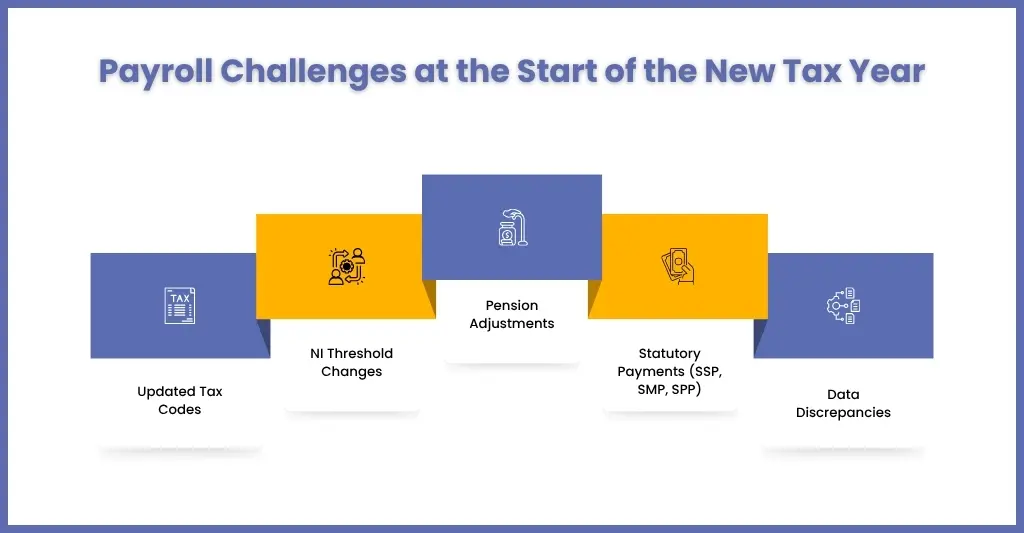
The new tax year in 2026 may look routine, but it often comes with multiple updates that, if missed, could lead to errors, delays, and compliance risks. Let’s break down these challenges in a practical, real-world way so you can manage them better.
Updated Tax Codes
On every new tax year, HMRC updates employee tax codes, and even a slight change can affect take-home pay.
This becomes a challenge when:
- Multiple clients are involved, which means hundreds of employees to update
- Mid-year changes can create confusion
- Incorrect codes lead to over- or under-taxation
What can go wrong:
- Employees receive incorrect payslips
- Client queries increase
- HMRC corrections become necessary
The best approach would be to:
- Cross-check all tax codes against HMRC notices before the first payroll run
- Use the best payroll software that auto-updates tax codes
Changes in National Insurance Threshold
National Insurance (NI) thresholds and rates are updated regularly and implemented in the new tax year that begins, and these changes must be applied accurately.
It can get confusing due to:
- Different thresholds for different employee categories
- Changes affect both employer and employee contributions
- Even minor miscalculations can accumulate over time
The impact of missing it will be:
- Incorrect payroll costs for clients
- Compliance risks with HMRC
- Time spent recalculating and correcting errors
The best approach will be to:
- Update payroll systems before the first pay cycle
- Verify calculations for different salary bands
Pension Adjustments
Auto-enrolment pension rules require careful attention, especially when thresholds or contribution percentages change.
It creates problems when:
- Employees are moved in/out of eligibility thresholds
- Contribution percentages needing updates
- Coordination is required between payroll and pension providers
It will lead to:
- Non-compliance with The Pensions Regulator
- Missed contributions or incorrect deductions
- Employee dissatisfaction
The ideal approach would be to:
- Review all employee eligibility at the start of the tax year
- Reconcile payroll data with pension provider reports
Statutory Payments
Statutory payments like:
- Statutory Sick Pay (SSP)
- Statutory Maternity Pay (SMP)
- Statutory Paternity Pay (SPP)
are updated each year and must be recalculated correctly.
Why this is challenging:
- Eligibility rules vary
- Calculation periods can be complex
- Errors are not always immediately visible
Impact of these challenges will be:
- Underpayment or overpayment
- Reprocessing payroll
- Increased client queries
The best approach will be to:
- Use payroll software with built-in statutory calculations
- Train staff on updated rules each year
Data Discrepancies
Errors in data are one of the most common and neglected challenges.
Typical issues under it include:
- Missing or late timesheets
- Incomplete employee data
- Outdated payroll records
- Incorrect working hours or rates
Why these matters:
- Without data accuracy, achieving payroll accuracy is impossible
Impact:
- Delayed payroll processing
- Rushed submissions
- Increased risk of errors
Best approach would be to:
- Standardise data collection from clients
- Set deadlines for updating timesheets and updates
- Use cloud systems for real-time data sharing
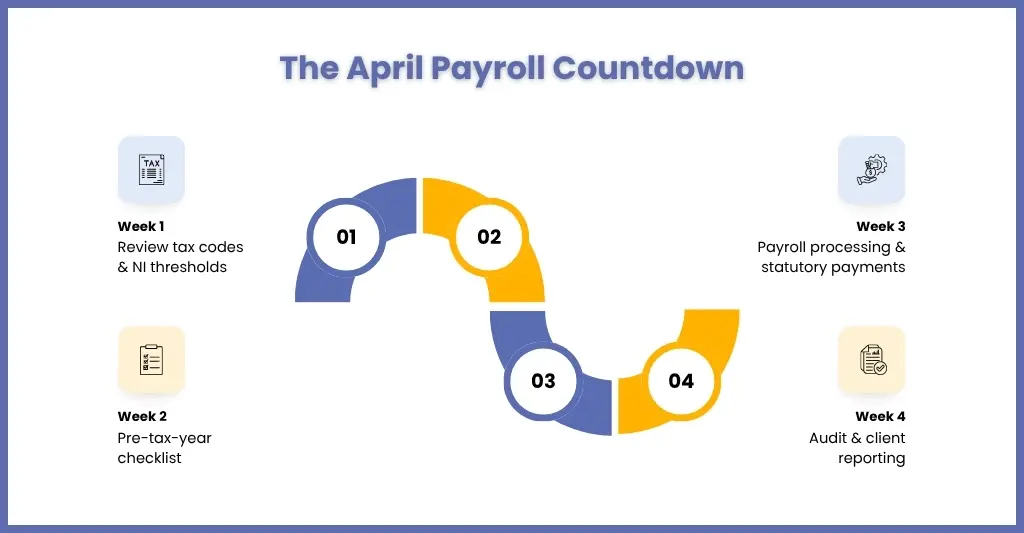
How Accounting Firms Can Save Time in 2026
Your clients are demanding fast and quality services without compromising on payroll compliance. To achieve that, we have developed some strategies that will streamline payroll and reduce manual effort:
Automate Payroll Updates
Incorporating payroll updates automatically can be achieved through modern payroll software. It will automatically update:
- Tax codes
- Adjust NI contributions
- Calculate statutory payments
- Flag anomalies for review
Benefit: Less manual calculation, fewer errors, faster processing.
Payroll software’s like Xero, QuickBooks, and Sage integrate HMRC updates directly into payroll systems, making them popular among practices.
Standardise Client Data
Focus on creating templates for repetitive data entry, like:
- Payroll information
- Employee details
- Benefits and allowances
Benefit: It ensures consistency across clients.
Implement a Pre-Tax-Year Checklist
Before you start, your payroll conducts a thorough review of:
- Employee tax codes
- NI contribution thresholds
- Pension contribution levels
- Statutory payment rates
Benefit: Discrepancies will be identified early, reducing last-minute corrections.
Outsource Payroll Support
Many accounting practices in the UK are also placing their faith in payroll outsourcing services for expert support.
Benefits of outsourcing are:
- Experienced payroll professionals will handle routine updates and calculations
- Real-time verification of tax codes and thresholds
- Timely submission of RTI and statutory forms
- Scalable support during peak periods like year-end or April transitions
- Outsourcing allows your in-house team to focus on high-value advisory services, resolving client queries, and business growth.
Use Cloud-Based Payroll Software
Use the latest cloud-based payroll systems that will allow you to:
- Access anywhere, anytime
- Multiple users for verification
- Automated alerts for new HMRC updates
- Easy integration with accounting systems
Train Staff Ahead of the Tax Year
Give your payroll and accounting staff good training on:
- New thresholds decided by HMRC
- Latest software updates
- On checking for anomalies
The benefit of good training will be a reduction in errors caused by misinterpretation or oversight.
Audit Payroll Regularly
Instead of waiting for year-end, conduct monthly audits:
- Reconcile payslips vs bank payments
- Check deductions
- Verify statutory payments
Benefit: Early detection of errors prevents HMRC penalties and client complaints.
How Corient Helps Accounting Firms Streamline Payroll
Many accounting practices struggle to implement all these steps while handling day-to-day accounting and payroll responsibilities. That’s where Corient comes into the picture. It provides end-to-end outsourced payroll services designed for UK accounting practices:
- Automated payroll processing with updated HMRC thresholds
- Compliance checks for tax codes, NI, pensions, and statutory payments
- Integration with cloud accounting platforms (Xero, QuickBooks, Sage)
- Real-time reporting and client-ready payslips
- Scalable support during tax year transitions and year-end
In a recent webinar, award-winning accountant Mark Telford shared how moving to Corient’s managed payroll helped him:
- Free up hours every month
- Reduce constant client queries
- Focus more on advisory work
With Corient, practices reduce manual work, prevent errors, and focus on advisory services, all while maintaining full compliance.
Best Practices to Save Time in Payroll
Apart from outsourcing, give due consideration to certain best practices to save time while running payroll for your clients. These practices are:
- Prepare early: Start reviewing tax changes before April 6
- Automate wherever possible: Use payroll software with HMRC integration
- Standardise client files: Templates reduce repetitive work
- Use checklists: Pre-tax-year and ongoing payroll checklists prevent oversight
- Outsource strategically: Combine in-house oversight with professional outsourcing
People Also Ask
Does the tax code change in 2026?
From April 2026, employment expenses and gift aid will be removed from the tax codes of some taxpayers where HMRC’s data shows that they are unlikely to be accurate or relevant.
What employment laws are changing in 2026?
Major UK employment law changes in April 2026, driven by the Employment Rights Act 2025, include day-one rights for paternity/parental leave, expanded Statutory Sick Pay (no waiting period/threshold), stronger sexual harassment protections, and the creation of the Fair Work Agency. National Minimum Wage will increase, with the main rate rising to £12.71/hour.
How much does outsourced payroll cost UK?
Payroll outsourcing in the UK usually costs approximately £4 to £25 per employee per month and offers significant cost savings versus managing payroll internally.
What is white-label payroll for accountants?
White-label payroll for accountants is a service where an external provider manages payroll tasks on your behalf, but everything is delivered under your firm’s brand name. Your clients see it as your service not a third party.
Conclusion
The new tax year has just started, and for many firms, payroll pressure starts right alongside it. It’s time to work smarter, not harder, by adopting a professional outsourcing partner like Corient:
Through Corient, you can:
- Reduce errors and compliance risks
- Save hours of manual work
- Maintain happy clients
- Free up staff for higher-value advisory services
Don’t let the new tax year slow you down. Use our contact form to share your requirements and keep payroll smooth, compliant, and stress-free, every month for every client.