

Are you managing the submissions of multiple clients’ VAT and Income Tax? Then, do remember some Making Tax Digital Deadlines, which are April 2026 (MTD for Income Tax starts) and the quarterly submission deadlines that follow throughout the year.
But remembering the dates is not a problem; the struggle is to manage it across multiple clients, systems, and workflows. We have seen one accounting practice handling MTD for VAT for multiple clients, but with the introduction of MTD for Income Tax, things started getting overwhelming.
The practice started facing:
- Delays in record submission by clients
- Pile up of quarterly deadlines
- Difficulty in manual tracking
- Constant firefighting
It’s not the lack of capability. There was a lack of structured systems to handle Making Tax Digital Deadlines at scale. Are you facing a similar issue? Because the majority of the practices in the UK are.
With all VAT-registered businesses now under MTD, millions more will soon fall under MTD for Income Tax. Meanwhile, multiple studies point out that they are underprepared to handle this MTD expansion, especially the quarterly reporting requirements.
The reality is that missing Making Tax Digital Deadlines will not be just a compliance issue, but an operational risk.
In this guide, we’ll break down:
- Every key MTD deadline
- What they mean for your clients
- How to manage quarterly submissions
- And how to stay ahead without overwhelming your team
What Is Making Tax Digital?
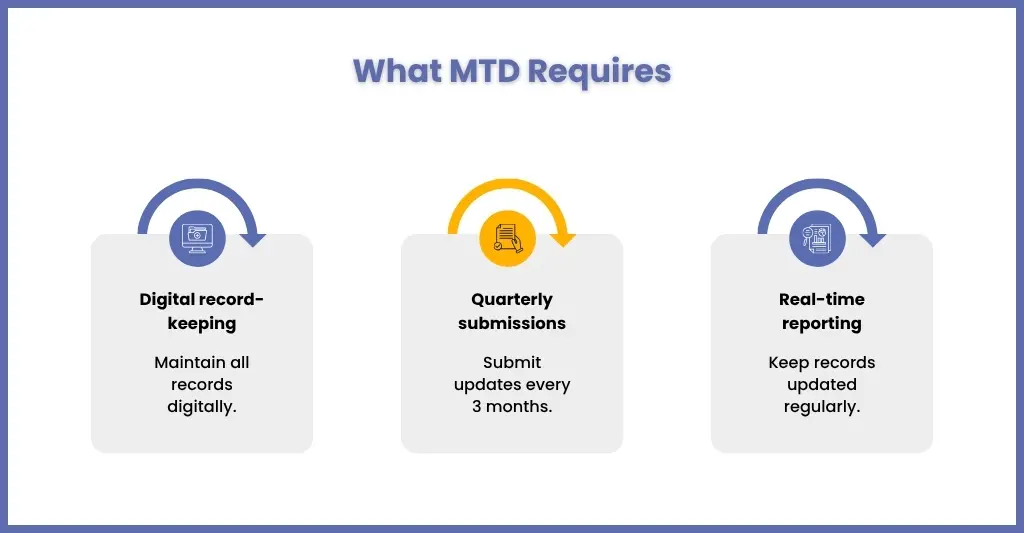
Making Tax Digital is an HMRC initiative to modernise/digitise the UK tax system. Under this initiative, your clients are required to maintain digital record-keeping and real-time submissions, thus eliminating manual tax reporting not self-assessment.
Manual tax reporting means high chances of errors, and this is one of the reasons why MTD was introduced. With the introduction of MTD for income tax, say goodbye to once-a-year reporting.
Making Tax Digital Deadlines — The Full Timeline
The Making Tax Digital initiative comes with multiple deadlines, and understanding them is important to stay compliant. Let’s start from where the MTD begin.
April 2019: Making Tax Digital for VAT
- In April, MTD for VAT was introduced for the first time for VAT-registered businesses with taxable turnover exceeding the £85,000 threshold.
- In April 2022, all VAT-registered businesses were brought under the MTD.
April 2026: Introduction of Make Tax Digital for Income Tax
- Looking at the benefits of MTD for VAT, HMRC has decided that from April 2026, Making Tax Digital will be further expanded on Income Tax for sole traders and landlords earning over £50,000 annual income from self-employment and property.
April 2027: Further Expansion of MTD for Income Tax
- April 2027 MTD for Income Tax will be further expanded for sole traders and landlords with a total annual qualifying income above £30,000 for the 2025 to 2026 tax year.
April 2028: Further Expansion of MTD for Income Tax
- April 2028 MTD for Income Tax will be further expanded for sole traders and landlords with a total annual qualifying income above £20,000 for the 2026 to 2027 tax year.
HMRC has been gradually expanding MTD first on VAT, now on Income Tax, and no one can avoid it.
MTD Quarterly Update Deadlines — When Do You Need to Submit?
Here’s the challenging part where many practice falter. Under MTD, instead of one annual return, you will need to submit quarterly updates on behalf of your clients.
| Deadline and Quarter | Period Covered | Deadline |
| 7 August 2026 – Q1 | 6 April – 5 July | Deadline to send your first quarterly update |
| 7 November 2026 – Q2 | 6 July – 5 October | Deadline to send your second quarterly update |
| 7 February 2027 – Q3 | 6 October – 5 January | Deadline to send your third quarterly update |
| 7 May 2027 – Q4 | 6 January – 5 April | Deadline to send your fourth quarterly update |
Handling these deadlines for a single client is easy, but handling them for multiple clients is difficult because data must be updated continuously, and there is no room for last-minute work. That’s why many practices are moving from hiring an accountant to partnering with professional accounting outsourcing service providers to handle the quarterly workload efficiently.
Deadline for Registering for Making Tax Digital
Another critical aspect of Making Tax Digital Deadlines is registration.
When should you register?
Before your first MTD submission period, ideally, well in advance of deadlines
Important considerations:
- You must use MTD-compatible software
- Existing tax records must be up to date
- HMRC registration can take a few days to process
Common mistake:
- Some accounting practices wait until the last minute, leading to setup issues and missed deadlines.
To avoid this:
- Start onboarding your clients months before April 2026.
Penalties and Extensions: What Happens If You Miss a Deadline
Like VAT, there are penalties for late submission and payments under MTD for Income Tax. These deadlines are applicable for sending quarterly updates, submitting tax returns, or making payments to your clients. Let’s go through them.
Late Submission Penalties
The new late submission penalties will be based on points. If you miss a quarterly update (for tax years from 2026 to 2027) or the tax return deadline, your client will get a penalty point.
The penalty point threshold is 4 points. If it’s crossed, then your client will have to pay a:
- £200 penalty
- £200 penalty each time you miss another submission deadline
Late Payment Penalties
The new late payment penalties are more proportionate to how long it takes for your client to pay what they owe.
Late payment penalties apply to payments not paid in full by the relevant due date. This includes:
- A balancing payment for an outstanding amount on your tax bill
- Amounts due following an amendment or assessment on your tax return
In the first year, your clients will have 30 days from the payment due date to either:
- Make full payment
- Contact HMRC to set up a payment plan
After 30 days, the penalties will be applied. After your first year, this reduces to 15 days.
The following table shows how late payment penalties will apply, depending on the tax year the payment is for.
| Penalties for 2026 to 2027 tax year | Penalties for 2027 to 2028 tax year | |
| Payment up to 15 days late | No penalty | No penalty |
| Payment 16 to 30 days late | 3% of the tax owed at day 15, or no penalty if it’s your first year | 4% of the tax owed at day 15, or no penalty if it’s your first year |
| Payment 31 days or more late | 3% of the tax owed at day 15, and 3% of the tax owed at day 30 Plus, an annual rate of 10% per year on the outstanding amount, charged daily from day 31 until the tax is paid, or for up to 2 years | 4% of the tax owed at day 15, and 3% of the tax owed at day 30 Plus, an annual rate of 10% per year on the outstanding amount, charged daily from day 31 until the tax is paid, or for up to 2 years |
How These Deadlines Affect Different Taxpayers
If your clients are both sole traders and landlords, then both will be impacted by the expansion of MTD for Income Tax in different ways.
Sole Traders
- Must maintain digital records
- Submit quarterly updates
- Manage income tracking
Landlords
- Report property income digitally
- Track expenses regularly
This means you will need to work with different workflows and support levels. Such complexity is the reason why many firms partner with outsourcing providers like Corient to handle diverse client needs efficiently.
Frequently Asked Questions
What is the deadline for registering for Making Tax Digital?
You are required to register your clients for Making Tax Digital well in advance (several weeks) before the first submission to avoid any setup issues.
What happens if I miss a Making Tax Digital quarterly deadline?
Missing the MTD quarterly deadline will lead to penalties based on points. If you miss a quarterly update (for tax years from 2026 to 2027) or the tax return deadline, your client will get a penalty point.
Are there penalties for missing MTD deadlines?
The penalty point threshold is 4 points. If it’s crossed, then your client will have to pay a:
a. £200 penalty
b. £200 penalty each time you miss another submission deadline
What are the MTD rules for April 2026?
MTD income tax applies from April 2026 to those who receive income from sole trades and/or property where turnover/gross income from these sources combined is above a threshold of £50,000.
Will MTD replace self-assessment?
Making Tax Digital (MTD) for Income Tax does not completely abolish Self Assessment, but replaces the traditional annual tax return with a new, mandatory quarterly digital process for many.
How to Get Ready Before the Deadline
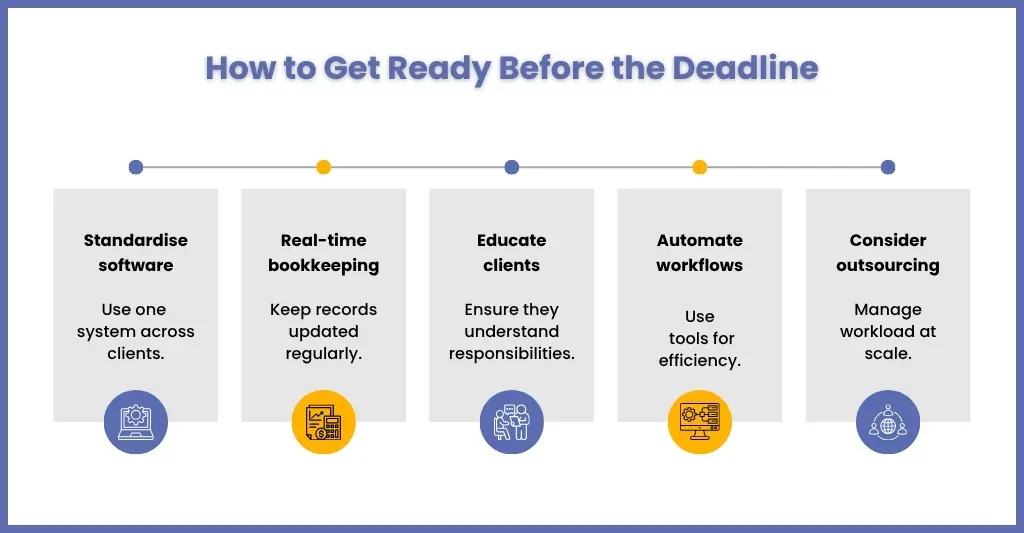
Just like to get ready for MTD for VAT you had to follow steps to setup, keeping your clients prepared for MTD deadlines will require more than just MTD-compliant software.
Step 1: Standardise Your Software
There are multiple MTD-compliant VAT software’s available in the market, such as Xero, Sage, and QuickBooks, to name a few, which are now MTD for Income Tax compliant. Choose the one that perfectly fits your practice and works across your clients.
Step 2: Move to Real-Time Bookkeeping
Inform your clients that keeping their records updated on a regular basis is no longer an option; it’s the norm. Due to digitisation, updated records are required for real-time bookkeeping.
Step 3: Educate Clients
Help them understand the:
- Deadlines
- Their responsibilities
- Submission processes
Step 4: Automate Workflows
Save time by automating recurring processes by using tools like Dext, Hubdoc, etc, for:
- Data capture
- Reconciliation
- Reporting
Step 5: Consider Outsourcing
Handling multiple clients manually is not possible. You will need an expert helping and by partnering with an accounting outsourcing service provider.
Conclusion
Making Tax Digital Deadlines for VAT and Income Tax are reshaping how accounting practices operate in the UK. These deadlines are not just a compliance update; it’s a fundamental shift in how tax reporting works.
Practices that prepare early, adopt the right systems, and streamline workflows will thrive. With Corient, accounting practices can:
- Manage bookkeeping in real time
- Handle quarterly submissions efficiently
- Reduce workload pressure
- Scale without hiring
Are you finding it difficult to handle multiple MTD deadlines for your clients? It’s time to work smarter, not harder, by filling our contact form and turn MTD from a challenge into an opportunity.
