
Making Tax Digital for Accountants means keeping digital records and sending HMRC quarterly updates through compatible software. MTD for Income Tax began on 6 April 2026 for sole traders and landlords with qualifying income above £50,000. The threshold falls to £30,000 in April 2027 and £20,000 in April 2028. Limited companies are not yet in scope.
MTD for VAT began in April 2019 for businesses above the VAT threshold. By April 2022, every VAT-registered business had to follow it. Income Tax is the next step, and it is a much bigger one.
Making Tax Digital has changed how tax compliance works in the UK. Paper-based compliance is on its way out, and reporting is moving toward something close to real time. The Income Tax phase went live in April 2026, and the first quarterly deadline, 7 August 2026, has already come and gone. For a large practice, the question isn’t really whether you’re ready anymore. It’s whether your process will still hold up when the next wave of clients lands in April 2027.
This guide is meant to help your practice stay ahead of the rules, stay compliant, and treat MTD as a chance to grow rather than a chore. We’ll look at how to adapt, take on more clients and do well in a digital-first tax world. If you want to go further, our Making Tax Digital guide for 2025 lays out the roadmap and what needs doing this year.
What Is Making Tax Digital?
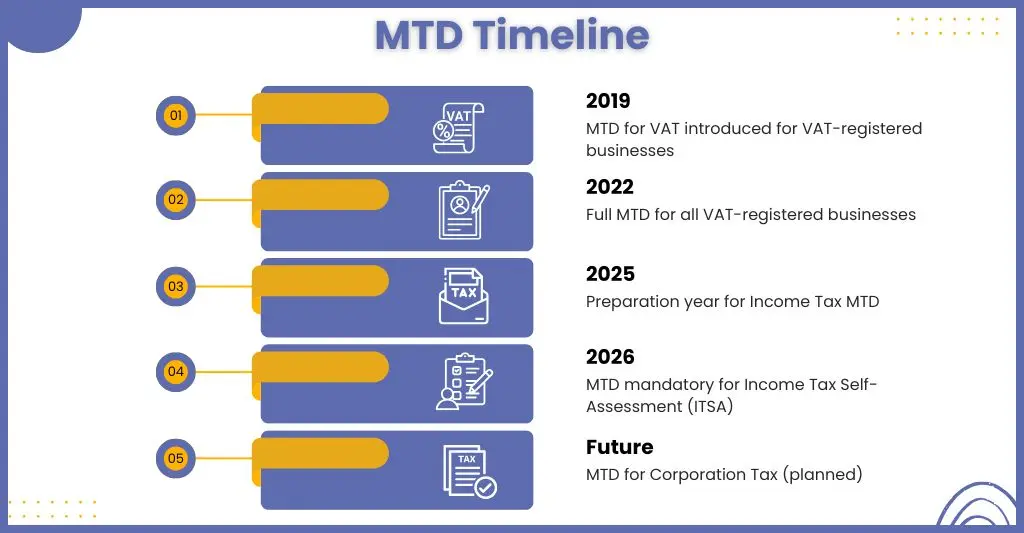
Making Tax Digital (MTD) is an HMRC programme that requires businesses and individuals to keep digital records and send tax information to HMRC through compatible software. It covers VAT today, Income Tax from April 2026, and has no confirmed date for Corporation Tax.
Through this initiative, paper-based compliance will be a thing of the past, and taxpayers will be required to maintain digital records and use MTD-compatible software to make tax submissions electronically.
The rollout is phased, and the table below shows where each tax stands.
| Tax | Who’s covered | Start date | Where it stands (October 2026) |
|---|---|---|---|
| VAT | Businesses registered for VAT | April 2019 for turnover above £85,000; April 2022 for every VAT-registered business | Already running |
| Income Tax | Sole traders and landlords with qualifying income over £50,000 | 6 April 2026 | Already running |
| Income Tax | Qualifying income over £30,000 | 6 April 2027 | Confirmed |
| Income Tax | Qualifying income over £20,000 | 6 April 2028 | Announced, with legislation still to come |
| Corporation Tax | Limited companies | No date set | Not part of MTD for now |
Qualifying income is gross income from self-employment and property before expenses. Sources: HMRC, Making Tax Digital; AccountingWeb, 27 July 2026.
What Does Making Tax Digital Mean for Accountants in 2026?
In 2026, MTD means running a quarterly cycle for every client in scope: digital records, four updates and a final declaration, all filed through HMRC-recognised software. Year-end stops being one big push and turns into a rolling workload, so planning your capacity matters more than it used to.
MTD has been reshaping UK tax since 2019, and 2026 is the year the Income Tax phase went live. Rather than treating it as just another regulatory box to tick, use it to modernise how your practice works, build stronger client relationships and move into more of an advisory role.
The scale is big. BDO UK, citing HMRC data, reported in early 2026 that more than 850,000 people would have to join MTD for Income Tax in April, and that the number would climb to almost three million by 2028 (BDO UK, 2026). By the time the first quarterly deadline came round, THP reported that over 864,000 sole traders and landlords were due to send in an update by 7 August 2026.
Here’s what MTD means for you in 2026.
Digital-First Compliance Becomes the Norm
Instead of manual systems, your in-scope clients are now required to use MTD-compliant software to maintain records and submit updates. Match the software to the client. Xero, QuickBooks, Sage and FreeAgent each suit different clients (see the comparison below).
Quarterly Reporting = Means Ongoing Engagement
Since 6 April 2026, in-scope clients’ income and expenses go to HMRC quarterly, not once a year. Your work shifts from year-end tasks to real-time advisory services like cash flow forecasting and tax planning.
More Automation, Less Admin
One reason for HMRC’s MTD push is to reduce paperwork and increase automation through MTD-compatible software. These tools are used for data capture, bank feeds, and reconciliations. With less manual work, your team can spend more time on strategic guidance. Train people on the software, then put the time saved into advisory work.
Increased Need for Client Education
Plenty of your clients in the £30,000 to £50,000 band probably don’t realise their MTD obligations kick in on 6 April 2027. It’s down to you to tell them, explain what it means and answer their questions before they have to sign up for anything. You could run webinars, send regular emails, or offer MTD-readiness audits, using an accounting outsourcing provider if you’d rather not handle that yourself.
Practice Management Must Evolve
Be prepared for more frequent submissions under income tax. For that, you have to select the best MTD-compliant software and integrate it with your system. If your system is unable to integrate the growing number of digital clients or the new software, then it must be upgraded. Start by investing in integrated practice management software for workflow automation, client tracking, and deadline management.
Which Accounting Software Is Best for Making Tax Digital?
There is no single best option. Xero, QuickBooks Online, Sage Accounting, FreeAgent and TaxCalc are the platforms most UK practices weigh up, and the right choice depends on the client type and how well the product connects to your practice systems. Check each one against HMRC’s recognised software list before you onboard clients.
MTD is now a core part of the UK accounting system, so choosing the right accounting software matters. It affects compliance, efficiency, and client satisfaction.
Pick the right MTD-compliant software (here’s a look at the best accounting software) and submissions get smoother, mistakes drop, and you can give clients advice based on real-time figures. That holds whether you’re handling VAT returns or MTD for Income Tax Self-Assessment (ITSA). Choose your software and have it set up and ready early, because it makes a real difference.
Here’s a look at the top accounting software for MTD in 2026.
| Software | Where it tends to fit |
| Xero | Cloud ledger with strong bank feeds. Common choice for practices running many clients on one platform. |
| QuickBooks Online | Small and growing businesses that want a wide app ecosystem alongside MTD filing. |
| Sage Accounting | Clients already on Sage who would rather not migrate. |
| FreeAgent | Sole traders, freelancers and landlords, the core of the Income Tax phase. |
| TaxCalc | Tax-return-led workflows where the filing side matters most. |
What Are the Benefits of MTD for Accountancy Practices?
The main benefits are less manual admin, steadier client contact through the year, and new paid advisory work. Practices that automate bank feeds and reconciliations can take on more clients without hiring at the same rate.
MTD was introduced by HMRC as a compliance requirement, but its benefits have turned it into a transformative force that is making accounting practice more efficient and proactive.
Enhanced Efficiency and Automation
MTD-compatible software now handles a lot of the manual accounting work for you, things like bank reconciliations, sorting expenses into categories, and preparing VAT returns. That means less time lost to admin, more done in the same hours, and fewer slips from typing things in by hand.
Stronger Client Relationships Through Real-Time Support
Under MTD for ITSA, clients report quarterly instead of once a year, so you’re in touch with them far more often. That’s your opening to help before problems pile up, to do some proper tax planning with them, and to offer advice that adds value, rather than being stuck in a frantic scramble every year-end.
Growing Without Growing the Team
MTD-compliant software lets you scale faster. New clients get set up quickly, you and they can both reach the data from anywhere, and you can work through it together as it happens. You can take on more clients without hiring more people, which keeps costs down.
Running the Practice More Smoothly
Platforms like Xero and QuickBooks pull deadlines, tasks, messages and tax filings into one place. Now that the quarterly deadlines are fixed, much of the last-minute panic drops out of the calendar.
More Accurate Numbers, More Confidence
Digital records and automatic submissions are fast becoming the norm under MTD, and they’ve wiped out a lot of the errors that came from keying figures in by hand. The software checks the numbers as you go and keeps an audit trail, so what reaches HMRC is complete, accurate and compliant. That matters more once the penalty regime tightens in 2027/28, because fewer errors mean fewer penalty points for your clients.
New Service Offerings and Revenue Streams
MTD is turning out to be more than just compliance; it has started creating new demands for onboarding training, digital migration, real-time tax planning, and cash flow insights. These tasks are an opportunity for your practice to earn revenues. You can start offering these services through premium, tiered service packages.
What Are the MTD for Income Tax Deadlines and Penalties in 2026/27?
Quarterly updates are due by 7 August, 7 November, 7 February and 7 May, and the final declaration by 31 January after the tax year ends. HMRC is not issuing penalty points for late quarterly updates in 2026/27. From 2027/28, four points bring a £200 penalty.
| Update | Period covered (standard dates) | Deadline | Tax year |
| Quarter 1 | 6 April to 5 July | 7 August 2026 | 2026/27 |
| Quarter 2 | 6 April to 5 October | 7 November 2026 | 2026/27 |
| Quarter 3 | 6 April to 5 January | 7 February 2027 | 2026/27 |
| Quarter 4 | 6 April to 5 April | 7 May 2027 | 2026/27 |
| Final declaration | Full tax year | 31 January 2028 | 2026/27 |
Under the points system, each missed deadline earns one point. Reaching four points triggers a £200 penalty, and each further missed deadline adds another £200. Points below the threshold expire after 24 months, and Income Tax points are counted separately from VAT points (Xero, 13 August 2026).
The grace year is not a free pass. The update still has to be filed, and the tax return cannot go in until the required quarterly updates have been sent. Treat 2026/27 as a rehearsal for the £30,000 group.
How Does Corientbs Help Accounting Firms Navigate MTD Compliance?
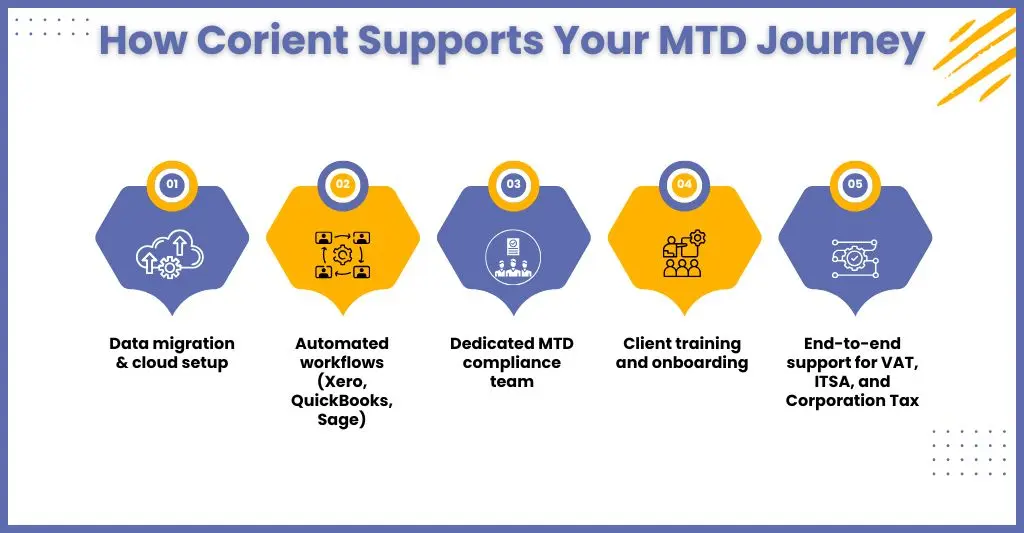
Corientbs is a UK-focused outsourcing partner that gives accounting firms dedicated MTD specialists and AI-assisted workflows for record-keeping, reconciliation and error checking, so in-house teams can stay on advisory work. Our Making Tax Digital service is led by a team with deep practice experience: Director of Operations Sachin Lohade has spent more than 19 years at firms including BDO International, PricewaterhouseCoopers and Serco Plc.
MTD is not just a regulatory shift; it has changed the way accounting firms manage and report client data to HMRC. However, many practices are also finding it difficult to adjust to mandatory digital compliance due to multiple operational, technological, and compliance-related hurdles. That’s where Corientbs steps in—not just as a service provider offering accounting outsourcing services but as a strategic partner.
We can help you become MTD compliant in the following ways:
Digital Record-Keeping & Automation
We will help you migrate your client’s data into fully digitised platforms. Our accounting team can integrate cloud accounting solutions like Xero, QuickBooks, and Sage with automated workflows to minimise human error and streamline tax submissions. Our AI tools handle the routine checks: Corby X takes care of reconciliation, and Sherlock flags errors before anything reaches HMRC. For clients on Self Assessment, our personal tax outsourcing team picks up the final declaration.
Dedicated Compliance Teams
We are already one step ahead when it comes to MTD compliance by training and creating dedicated MTD specialists. These specialists provide HMRC updates, manage client onboarding, and align every submission with the latest MTD mandates. Where clients are also VAT-registered, our VAT outsourcing team keeps both regimes running side by side.
Client Training & Support
Corientbs will help you train and increase digital literacy and awareness about MTD among your clients. This will reduce the compliance burden on your internal teams and ensure clients understand the value of digitisation.
How Can Large Practices Get MTD-Ready in 2026?
Begin by sorting your clients into groups based on their qualifying income. Then work out which software, which people on your team, and which filing dates go with each group. Tackle the £50,000 group first, and treat its quarterly updates as a trial run so you can iron out the kinks before the £30,000 group joins in April 2027.
Staying MTD compliant reduces risk and adds value to the services you offer clients. ACCA’s guidance for practitioners makes the same point: firms that prepare early avoid late submissions and unhappy clients.
Here are some steps to become MTD-ready:
- Segment clients by qualifying income: above £50,000 (live), £30,000 to £50,000 (April 2027), £20,000 to £30,000 (April 2028) and below £20,000 (out of scope for now)
- Migrate to MTD-compliant software such as Xero, QuickBooks, Sage, or FreeAgent, and confirm each product on HMRC’s recognised list
- Upskill staff on MTD regulations, software, and client communications
- Educate and onboard your clients, and put agent authorisation in place for each one
- Digitise your internal processes, with internal cut-off dates a week before each 7th-of-the-month deadline
- Set up monitoring and review systems that show which clients have missed an update, ahead of penalty points starting in 2027/28
- Collaborate with an experienced outsourcing partner to absorb peak quarters
FAQ about making tax digital for accountants
1. How do accountants support clients during the MTD transition?
Accountants choose and set up MTD-compatible software, keep digital records accurate, and make sure every link between systems follows HMRC’s digital links rule. They explain quarterly deadlines, submit on the client’s behalf where authorised, and train clients on the tools. In a large practice, a shared filing calendar and internal cut-off dates stop deadlines slipping across hundreds of clients.
2. Is Excel still allowed for Making Tax Digital?
Yes, but only as part of a setup, not on its own. You can still keep your records in Excel, as long as it feeds into HMRC through MTD-compatible bridging software. Any movement of figures between spreadsheets and that software also has to happen through digital links. If someone copies and pastes numbers by hand, that breaks the rules.
3. What does Making Tax Digital mean for accountants?
Basically, every in-scope client has to keep digital records, send quarterly updates through recognised software, and then finish with a final declaration. So instead of one big scramble at year-end, you get a steady cycle, with review points around 7 August, 7 November, 7 February and 7 May. The practices that’ll cope best are the ones that plan their capacity early and automate how they capture client data.
4. What is MTD compliance?
MTD compliance really boils down to this: keep your records digitally, and send HMRC your returns or updates through software that’s compatible with its systems. No retyping figures from one system into another. For VAT, it covers every VAT-registered business. Income Tax is different. It only applies to sole traders and landlords with qualifying income above the threshold, currently £50,000, which falls to £30,000 from April 2027.
5. Does Making Tax Digital apply to Corporation Tax?
Not at the moment. As of October 2026, there is no requirement for quarterly Corporation Tax reporting under MTD, and limited companies already file their returns digitally. HMRC has not set a start date, so large practices should concentrate on VAT and Income Tax now and keep an eye on official announcements for any change.
6. What are the steps to set up MTD for VAT with HMRC?
Check the client must follow MTD, choose compatible software, then create or verify their Government Gateway account. Sign the client up with HMRC, connect the software, and keep digital records from day one. Finally, submit VAT calculations from the software only, with no manual re-entry. Following this order avoids the most common sign-up errors.
Conclusion
MTD for Income Tax is already live, and the next batch of clients comes in on 6 April 2027, which is under six months away. It looks like a big change, but it’s also a chance to get your practice ready for what’s coming and give clients more for their money. Get clear on what the rules require, pick the right software, bring your team and clients up to speed, and don’t wait until the last minute. Do that and you’ll be compliant, and probably ahead of most other practices too.
There is also another ally that can help you become MTD-compliant much quicker, and that is through accounting outsourcing services. Corientbs is among those service providers that have been one step ahead when it comes to making its accounting services MTD-compliant and has helped multiple accounting firms in this endeavour. Whether it is VAT or Income Tax, we will cover MTD compliance. If you have any queries or questions, communicate with us using our website contact form, and our executive will contact you.