
An audit report is the independent auditor’s written opinion on whether a company’s financial statements give a true and fair view and follow the applicable framework, such as UK GAAP or IFRS. In the UK, it is prepared under ISAs (UK) and tells lenders, investors and regulators how far the accounts can be relied on.
What better way to maintain transparency in the complex UK business environment than to prepare a flawless audit report? Using an audit report, which offers an independent financial review, you can provide your clients with vital financial information, thus developing trust, facilitating decision-making, and strengthening corporate governance.
Using an audit report made by a third party will help your clients with independent financial analysis, thus offering their stakeholders reliability in the numbers. In this blog, we explore what an audit report entails, why it matters, and how professional audit services can make a tangible difference to your business.
What is an Audit Report? Definition and Purpose
An audit report is the signed opinion of an independent auditor on whether a set of financial statements is free from material misstatement and prepared under the right reporting framework. Its purpose is to give lenders, investors, and regulators confidence in the numbers.
An audit report is a formal independent review in which the auditor’s opinion is shared on your client’s financial position, internal controls, and regulatory compliance. In addition, it provides stakeholders with information to evaluate the organisation’s financial accuracy, transparency, and adherence to UK accounting standards decided by the Financial Reporting Council. In the UK, audit reports are prepared based on International Standards on Auditing (UK) (ISAs (UK)) and International Standard on Quality Management (UK) 1 (ISQM (UK) 1), which replaced ISQC (UK) 1 on 15 December 2022 (ACCA).
An audit report serves multiple critical purposes:
- Verification of Financial Statements: It verifies and gives opinions on the financial statements to ensure the accurate financial position of your clients is accurately reflected.
- Regulatory Compliance: Verifies that all the legal and accounting standards, such as IFRS or UK GAAP, are met.
- Assurance for Stakeholders: It gives confidence to stakeholders like investors and lenders of your clients that financial reports are verified, thus reliable.
- Decision-Making Support: Based on the audit data, your clients can make informed decisions.
Not every company needs one. For financial years beginning on or after 6 April 2025, a company can claim audit exemption if it meets two of three limits: turnover of £15 million (previously £10.2 million), a balance sheet total of £7.5 million (previously £5.1 million) and 50 employees (GOV.UK).
What Are the Types of Audit Reports?
There are four types of audit opinion: unqualified (clean), qualified, adverse and disclaimer of opinion. They run from full assurance to none, and the type issued tells readers how far they can rely on the accounts.
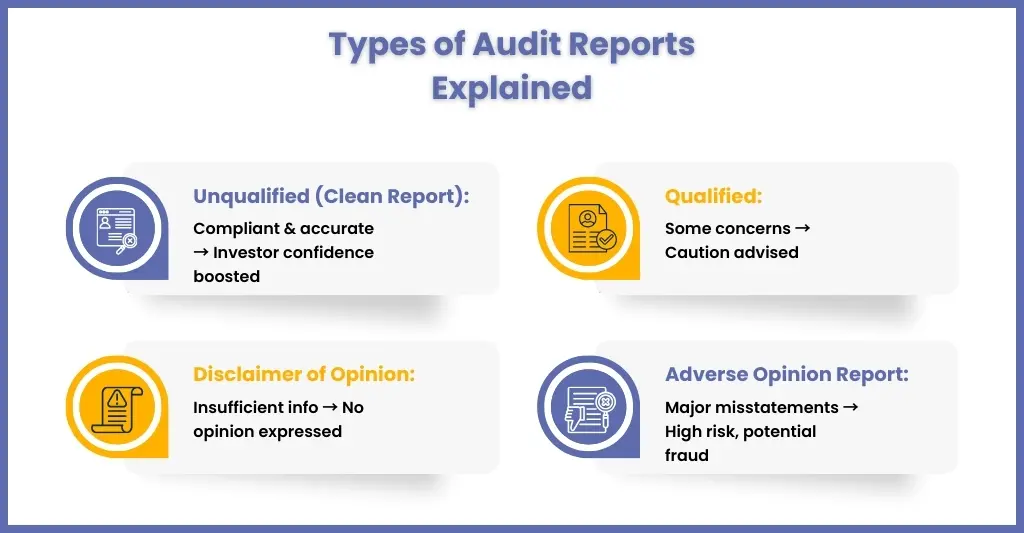
While doing audit planning, you must understand its types. Each of these audit report types provides a distinct level of assurance. The type of audit report includes :
Unqualified Audit Report
An unqualified report is also called a clean report, which all your clients would expect to receive. The issuance of this report indicates that the auditor is satisfied with the financial reporting and believes that it has followed all the UK accounting standards and regulations. As a result, such a statement suggests that your clients’ financial statements are free from material misstatements and comply fully with accounting standards, increasing confidence in their investors and stakeholders.
Qualified Audit Report
A qualified audit report is like a qualified opinion issued when the auditor is not confident about some process or transactions. Certainly, none of your client will want such a report because it casts a negative opinion in the area of financial position of your client.
Disclaimer of Opinion
Under the disclaimer of opinion, the auditor issues a report only when they choose to refrain from expressing any opinion on the financial statements. The auditor issues this type of report when the client obstructs a thorough audit or fails to provide satisfactory explanations for certain transactions.
Adverse Opinion Report
It is the final type of audit report and a big red flag. Getting such a document indicates that the financial reports contain gross misstatements and may indicate fraud. In addition, an adverse opinion report is also issued when financial reports are not by UK accounting standards. Consequently, an adverse opinion report will alert investors to stop doing business with the client and also push your clients to take corrective actions.
Why Do Accurate Audit Reports Matter for Your Clients?
Accurate audit reports matter because they give clients, lenders and regulators independent proof that the numbers can be trusted, and they help your practice catch problems before a regulator or HMRC does.
Audit reports play a vital role in the continuous improvement of your clients’ financial positions. Moreover, they give stakeholders independent assurance of the clients’ financial position. To understand in detail why audit reports matter to your clients, you have to take a look at the benefits they offer:
Regulatory Compliance
Through audit reports, you can ensure that your clients are adhering to statutory requirements, thus saving them from penalties and fines. Additionally, this prevents reputational damage to your practice.
Fraud Prevention
Audit reports also identified irregularities, mismanagement, or fraud in financial papers before they are discovered by the HMRC, helping you take corrective actions. As a result, it reduces potential legal and financial risks. The FRC published revised ISA (UK) 240 on fraud and ISA (UK) 570 on going concern on 30 April 2026 (FRC). They apply to audits of periods beginning on or after 15 December 2026 (Scottish Financial News).
Investor Confidence
Transparent reporting creates confidence in the existing investors of your clients and attracts new investment and supports, thus promoting sustainable growth. Thus, it promotes sustainable growth.
Strengthen Internal Processes
Audit findings often reveal inadequacies or control issues, giving your clients a roadmap to improve operations and reduce risk.
Why Should Large Practices Choose Professional Audit Services?
Large practices outsource audit work to add capacity at peak times and to bring an independent view to the file without adding permanent headcount. The Advancetrack 2026 Accounting Talent Index, published in June 2026, found that 73% of the 500 accountants surveyed across the UK, US, Canada and Australia were turning away potential clients because they lacked staff (Consultancy.uk).
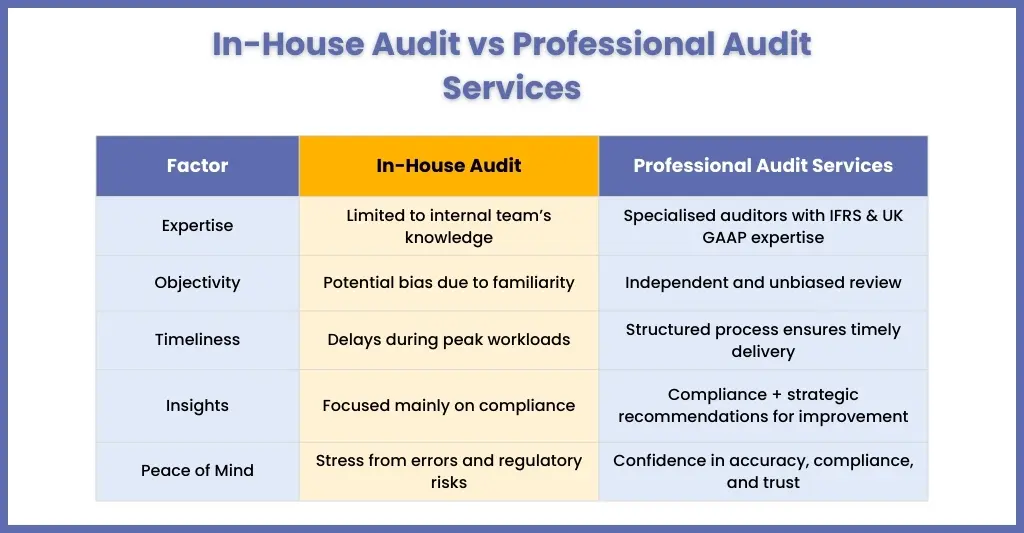
You might be having a capable audit team handling the internal audit work of your clients. However, using the professional audit outsourcing services is preferable because it brings in more transparency and independent analysis of your client’s financial standing.
Partnering with a professional audit firm delivers tangible benefits:
Expertise and Knowledge
Professional audit outsourcing firms employ certified and experienced auditors to navigate complex accounting standards like IFRS and UK GAAP. Their expertise helps in identifying potential issues easily before they become a significant risk, thus safeguarding you and your clients. Quality does vary: the FRC’s Annual Review of Audit Quality, published on 22 July 2026, found audit quality improving but not yet consistent across the market, with smaller firms furthest behind (FRC).
Objectivity and Independence
One of the benefits of audit outsourcing is that your clients get a pure independent perspective. Unlike your team, which may be too familiar with numbers, external auditors will do their work without any bias. For you, this independence also reinforces credibility and trustworthiness in client relationships.
Timely Reporting
Your auditing team might suffer from limited capacities, which makes it challenging to meet deadlines when the workload increases. On the other hand, professional audit firms can meet the deadlines without sacrificing quality. By leveraging proven methodologies, technology, and experienced teams, they can manage audits efficiently even during peak periods. With timely reporting, you can facilitate timely decision-making and strategic planning.
Strategic Insights Beyond Compliance
Instead of being stuck with numbers, professional audit outsourcing providers will help in identifying risks and opportunities for improvement. Therefore, they are turning into a strategic tool for your client’s growth.
How Does Corientbs Deliver Reliable and Timely Audit Reports?
Corientbs, headquartered in Coventry, supports UK accounting practices with outsourced audit support, from planning through to a reviewed audit file.
Apart from providing multiple accounting services, including year-end accounts, Corientbs also offers audit services and outsourced audit support to accounting practices in the UK. We understood that there was a demand for independent audit report-making services among practices. Therefore, we have designed audit services that follow the following approach:
Comprehensive Planning
Tailored audit strategies based on your client’s business size, industry, and regulatory requirements.
Experienced Auditors
Our audit teams are proficient in IFRS, UK GAAP, and sector-specific reporting standards.
Real-Time Updates
We maintain transparent communication with clients throughout the audit process.
Actionable Insights
We offer simple and straightforward recommendations that will help you enhance your clients’ internal controls and financial efficiency.
With Corientbs, accounting practices can ensure that every audit report is accurate, compliant, and delivered on time.
Ready to Get Your Audit Report? Book a Free Consultation
Frequently Asked Questions About Audit Reports
1. How long does it take to prepare an audit report?
It depends on the size and complexity of the engagement, the state of the client’s records and how quickly queries are answered. For mid-sized clients, Corientbs typically completes the audit work in four to six weeks. Groups with several entities, intercompany balances or component auditors usually take longer, so agree a realistic timetable at the planning stage.
2. Can an audit report uncover fraud or financial mismanagement?
An audit is designed to give reasonable assurance that the accounts are free from material misstatement, including material fraud, but it is not a fraud investigation. Auditors test controls, journals and unusual transactions, so irregularities can come to light. Revised ISA (UK) 240, applying to periods beginning on or after 15 December 2026, tightens fraud risk assessment further.
3. Do Corientbs’s audit services follow UK GAAP and IFRS?
Yes. Corientbs’s audit teams work with UK GAAP, IFRS and sector-specific reporting requirements, and audit work follows ISAs (UK). The opinion itself is always the auditor’s own judgement based on the evidence obtained. It is never agreed in advance with the client or the practice, which is what keeps the report credible with lenders, investors and regulators.
4. What is the role of auditing in financial transparency?
Auditing adds independent scrutiny to financial reporting. The auditor checks that the figures are complete, accurate and fairly presented, then gives an opinion that directors, lenders, investors and regulators can rely on. That independent check is what turns a set of accounts into information people will base lending and investment decisions on, which is why transparency depends on it.
5. Why is an audit report required?
An audit report is required when a company does not qualify for the small company exemption, or when its articles or shareholders ask for one. It gives users an independent opinion on whether the accounts give a true and fair view. For years beginning on or after 6 April 2025, exemption needs two of: £15m turnover, £7.5m assets, 50 employees.
What Should Practices Take Away About Audit Reports?
A well-prepared audit report is more than a regulatory requirement; it is a critical tool for ensuring transparency, financial accuracy, and stakeholder confidence. For accounting practices in the UK, partnering with experienced audit professionals can deliver unmatched expertise, independent assessments, and actionable insights that drive business success.
With Corientbs, you gain a trusted partner dedicated to providing reliable, timely, and high-quality audit reports, helping your practice and clients thrive in a compliant and transparent financial landscape. To know more about our services, contact us through our website and get a free trial and access to our experts.